


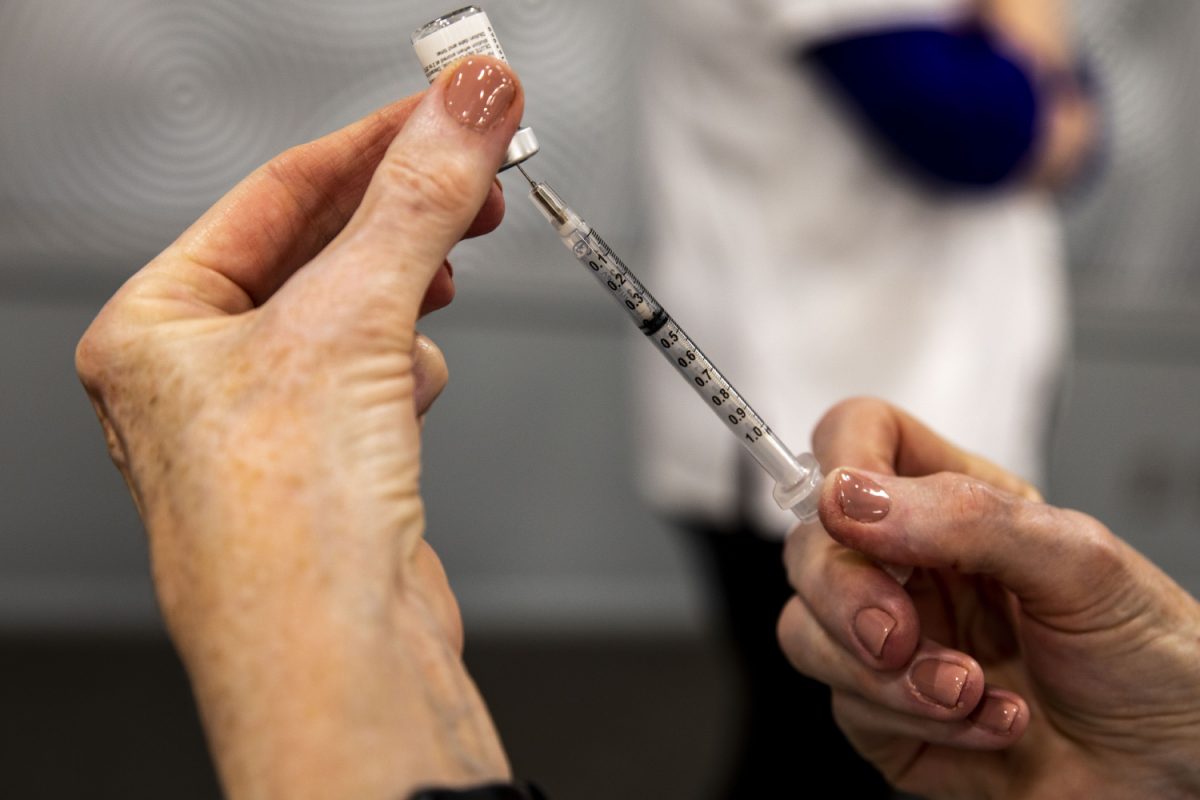
University of Iowa students and public health experts are wary of the Centers for Disease Control and Prevention, or CDC, lowering the number of recommended vaccines for children.
On Jan. 5, the Department of Health and Human Services, or HHS, and the CDC implemented new recommendations for the childhood vaccine schedule, reducing the number of vaccines that are recommended for children from 17 to 11.
The new recommendations state all children should be vaccinated against diphtheria, tetanus, acellular pertussis, or whooping cough, Haemophilus influenzae type b, Pneumococcal conjugate, polio, measles, mumps, rubella, human papillomavirus, or HPV, and varicella, or chickenpox.
Vaccines such as influenza, hepatitis A, and rotavirus are no longer broadly recommended, and other vaccines have seen changes in timing and dosage. The HPV vaccine is only recommended for a singular dose, instead of the two doses previously recommended.
RELATED: Decline in vaccine rates raise concern and awareness amid approaching flu season
University of Iowa third-year student Rose Kelly said she feels the changes to vaccine recommendations are dangerous for young children.
“The childhood vaccines are super important because kids’ immune systems aren’t very strong, and so it’s important that they are getting these vaccines,” Kelly said.
The importance of childhood vaccines is not only something Kelly emphasizes professionally, but something she can reflect on personally.
“As someone who got all of the vaccines, I’m super grateful that I have them,” Kelly said. “I’m very pro-vaccines, and I think it’s really important to get vaccinations.”
The CDC’s changes alarmed UI public health experts, who say the revisions veer sharply from the evidence-based process that has guided immunization policies for decades.According to the CDC, trust in public health declined from 72 percent to 40 percent between 2020 and 2024.
The CDC reported that vaccination rates among kindergarteners decreased for all vaccines between 2020 and 2025 from 94.9 to 92.1 percent.
Natoshia Askelson, a professor at the University of Iowa’s College of Public Health, said she feels as though the new vaccine recommendations have not been adequately tested.
“A new vaccine would go through extensive clinical trials with thousands of adults or kids, and they make sure that it was safe and that it worked right,” Askelson said.
Askelson said after rigorous testing and approval by the U.S. Food and Drug Administration recommendations would be reviewed by the CDC.
The next step in this process is the Advisory Committee on Immunization Practices. The federal advisory committee is composed of medical and public health experts that develop recommendations on the appropriate use of vaccines in the civilian population.
The committee helps guide the CDC on immunization schedules, which the CDC publishes annually for the American public. Askelson is concerned about lowering doses for vaccines as well.
“They have not looked at the evidence to understand whether or not going from two doses to one dose makes the vaccine less effective,” Askelson said. “There is some concern that if you only have one dose, you might not be as protected.”
The federal government’s position, according to a CDC press release, is that the updated recommendations are based on the practices of other developed countries and how these countries structure their immunization schedules.
Askelson said she feels that before these changes, the U.S. system for recommending vaccines was the gold standard internationally.
Since these new changes are recommendations, Askelson said medical providers are still allowed to administer the vaccinations that are not being recommended anymore.
Major professional organizations, including the American Academy of Pediatrics and the American Medical Association, have publicly affirmed that they will continue to follow the previous vaccine schedule.
Holden Dukes, a UI first-year student, also worries about the changes being made.
“I think this is a misinformed change since this will only put more kids at risk for illnesses that we have vaccines for,” Dukes said. “This is only going to cause an increase in preventable diseases that often have lifelong consequences.”
Dukes is concerned about the future impact of this revision.
“I understand their reasoning behind this choice, but I think it will cause more harm than good,” Dukes said.