
I’ll say this for Andy Serkis’ “Animal Farm:” it could have been worse.
With recent films like “One Battle After Another” and “The Long Walk” stirringly reworking novels by well-known authors for the current moment, it was easy to imagine a world in which George Orwell’s classic story — about a group of animals who overthrow their farmer and try their hand at a more just society — received a similar treatment. Unfortunately, this new reimagining only further proves those truly topical adaptations to be outliers.
Orwell’s work has a history of bizarre adaptations. “Animal Farm” was first brought to the screen in 1954 with an animated film that was later revealed to have been funded by the CIA in a blatant effort to combat perceptions of communism. Now, actor and director Serkis attempts to modernize the story as a family-friendly crowd-pleaser.
In diagnosing this new film’s issues, it’s hard to know where to begin. A version of Serkis’ “Animal Farm” had been in production since 2011, with the project undergoing various overhauls and eventually being tossed from Netflix to Angel Studios. In that sense, I suppose it’s a miracle that the film has a coherent vision at all.
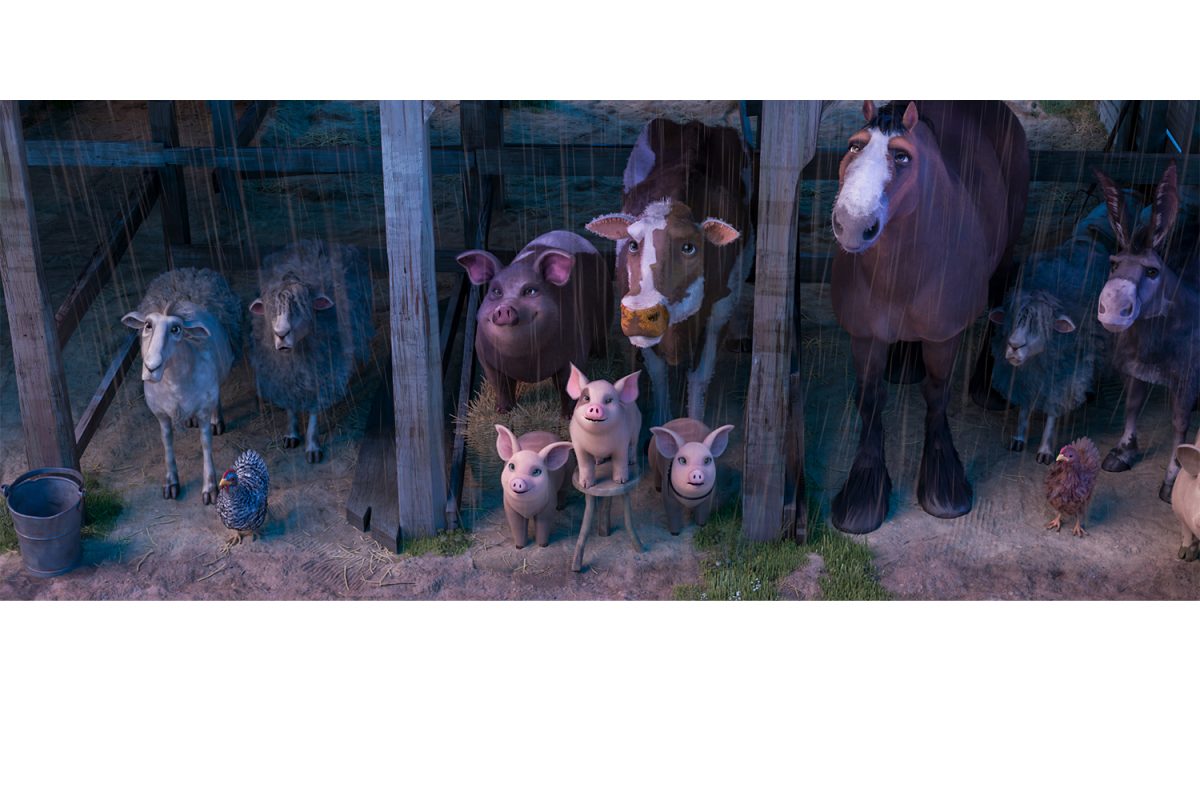
It only takes a few minutes of runtime to realize what that vision is. With television-budget animation, extreme lowbrow attempts at humor, and an effort to present something stimulating onscreen at all times, the filmmakers’ mission was clear. This is Orwell à la CoComelon.
Of course, deviations from the source material are inevitable. Our pig protagonist, Lucky, is a completely new character as our moral center, and an evil tech entrepreneur is introduced as a supplementary villain. This subplot seemed to be the film’s only attempt to update the story for our times, but the character fell completely flat — she was just any other villain from any other kid’s movie.
RELATED: Review | Pixar’s ‘Hoppers’ is a manic, uproarious ode to nature
Some of Orwell’s brilliance still manages to shine through. The first half presents his ideas faithfully enough, even through the kiddie jokes and simplification of themes. Even as the plot starts to deviate in the second half, these ideas remain mildly compelling.
Unfortunately, the ending strays in a way that’s borderline irresponsible. Though they’ve suffered losses along the way, the animals come to the conclusion that everything will be OK as long as they always help each other. This is an oversimplified message that strips away the political nuance of Orwell’s book, which was largely written as a diatribe against communism and, more broadly, against revolutionaries who became corrupted by their own message.
Because I can’t in good conscience recommend the film, I feel no shame in revealing its handful of decent jokes. The first came when Boxer the horse, lamenting how foolish he is, tries to remember the proper order of the alphabet by drawing in the dirt. He writes E, M, C, and 2, with the final product resembling a certain scientific equation.
The second came in the credits, which presented a green and red QR code correlating to whether or not the audience liked the movie. “How’s our farming?” it said. Naturally, I chose the red one.
I was presented with an official communiqué informing me that my opinion was wrong and that I misremembered enjoying myself. I was then directed to a “correction payment portal,” which offered me the chance to make a contribution and allow more families to see the film. The bit was enjoyable, but this final request felt like a step too far for a number of reasons.
I’m perhaps more willing than most to give modern adaptations the benefit of the doubt, but my goodwill only goes so far. Everyone eyeing this film would be better off reading the very short original novel, and if you must watch a gently thought-provoking modern animal picture, I recommend “Shaun the Sheep Movie.” Armed with those two texts, I can’t think of any good reason to watch this new “Animal Farm.”