


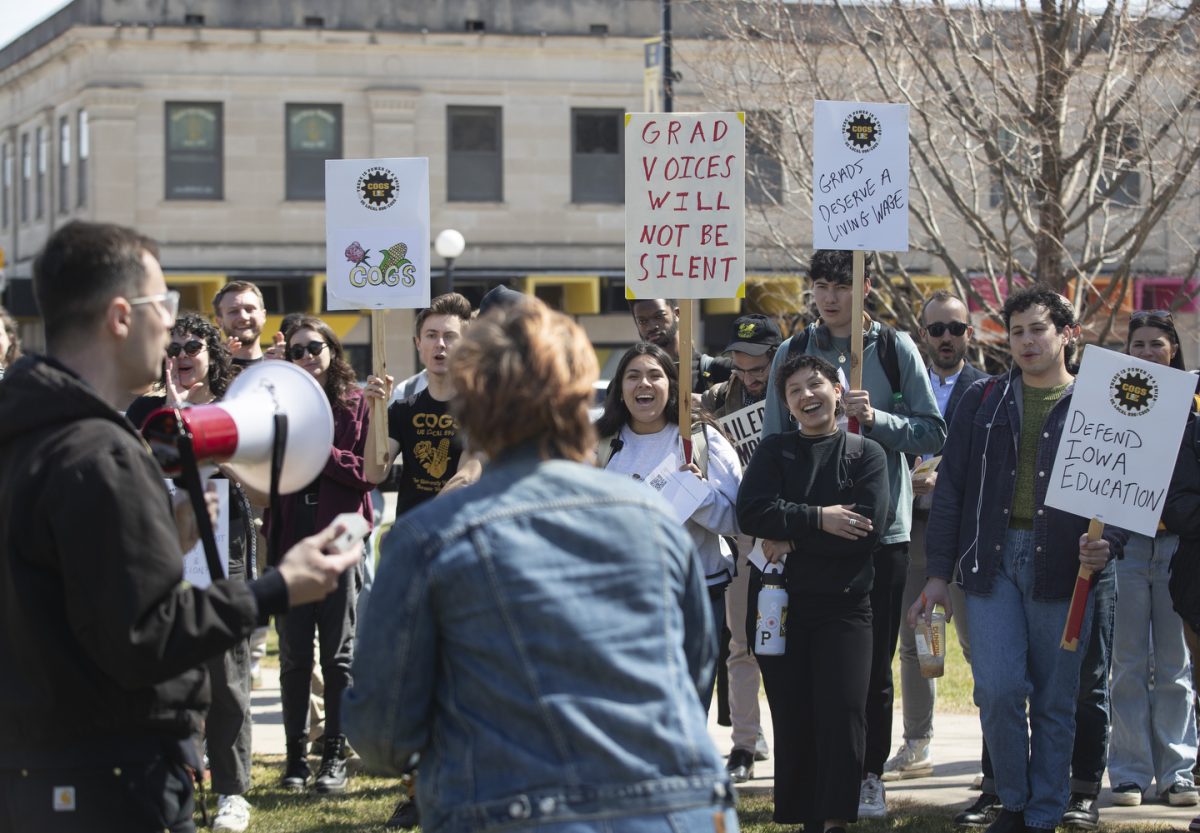
University of Iowa students and alumni in the Campaign to Organize Graduate Students, or COGS, are celebrating 30 years since the union’s founding, while continuing to maneuver a changing bargaining landscape and advocate for improved graduate student employee conditions on campus.
The organization, which represents approximately 2,600 graduate students at the UI, started in 1996 after formally affiliating with its parent union, United Electrical, Radio, and Machine Workers of America.
Since 1996, COGS has established various contracts with the university to bargain for graduate student worker rights.
UI second-year student Anne Moore serves as the press and publicity chair for COGS, working on outreach through COGS’s social media. Moore first became a member in fall 2024. She said without COGS, the benefits of graduate student teaching or research would not exist.
“Without COGS, we would not have health care, we would not have as high pay as we have,” she said. “The university does not want to give us those things. They do that because of the union and advocacy work that we do on campus, but it’s also supported by the community as well.”
Moore has been in unions before coming to UI. She was a former member of the American Federation of State, County, and Municipal Employees, which fueled her passion for joining COGS.
Moore and other members of COGS have had multiple challenges over the past decade.
In 2017, the Iowa legislature amended Iowa Code Chapter 20 of “Public Employment Relations (Collective Bargaining),” the new provisions required unions to undergo recertification elections every two years before the expiration of their collective bargaining agreement.
It also put limits on union bargaining negotiations — any union that has less than 30 percent of public safety members, such as cops or firefighters, can only bargain for base wages. This excludes discussing health insurance, supplemental pay, or evaluation procedures.
“In the past, there were all these topics that the university legally had to talk with us about, such as health care, pay, time off, sick leave,” Moore said. “Now they can say no. Our biggest challenge is really just the political environment in Iowa. I was living in Massachusetts before I came here, where we don’t have those laws.”
Moore also said this has forced COGS to hold votes where 50 percent of the 2,600 bargaining graduate teaching and research assistants voted in favor of the union’s existence.
These factors are now solely the university’s decision. Moore believes these changes are “anti-labor” and make it hard for unions to exist.
“We’ve done that with wide margins every two years since this law passed in 2017, but it takes a lot of work, and it can be hard to work on our other priorities as a union because of these recertification efforts. We also have to pay to hold this vote, and that comes out of our own union budget,” she said.
Another challenge Moore said COGS faces is the lack of dues-paying members. Despite representing 2,600 eligible graduate students who retain the benefits of COGS contracts, only 300 pay fees that keep the union sustainable.
Moore believes the system of benefiting regardless of whether a graduate assistant is in the union risks incentivizing people not to join, ultimately reducing the resources available for COGS to maintain its presence on campus.
“There are people who work here who are eligible for the Union, who maybe haven’t heard about the Union. The university often tries to bar us from coming to workplace orientations, so it can be quite difficult sometimes to make people aware of their rights as workers at the university,” Moore said.
Moore said COGS has had great success with its 2025-27 contract, securing a 6 percent minimum base-wage raise over two years for all graduate assistants, which is higher than the 5 percent minimum. This is the largest raise any public-sector union has received from the Iowa Board of Regents since the 2017 amendments to Chapter 20, she said.
RELATED: UI Black Student Union finds solace, community following Ped Mall shooting
In an email with the Daily Iowan, Public Relations Manager Steve Schmadeke said the university provides coverage for half of all mandatory graduate student fees, which total to $687.50 per year. Schmadeke also said Graduate assistantships with 10 or more working hours provide full tuition coverage on a semester basis. Assistantships where graduate students are given a stipend offer $11,256 annually for full-time and in-state students, while Graduate assistants, who are employed by the university to help departments or faculty, earn $21,329 for nine-month, half-time appointments, or $66,019 if they work full-time.
Former UI graduate student and COGS member Jonathan Kissam has served as the communications director of United Electrical, Radio, and Machine Workers of America since 2017 and has described his time with COGS as wonderful.
“They were our first graduate workers locally, and they’ve brought a lot of energy and sort of youthful vitality to the UE,” he said.
During his time at COGS, Kissam helped advocate for one of the first graduate student health care plans on campus, prior to when grad students were only allowed to go to the UI Student Health Center without formal health insurance. Kissan said he is honored to be part of such an accomplishment.
Although the 2017 law has removed health insurance as one of the scopes of negotiations, Kissan is still proud of the efforts COGS has made to increase graduate student wages by 6 percent.
“It’s sort of the administrative things that make it very difficult for the union to function. So we are very proud that COGS has, despite all these restrictions put on it by the laws, continued to persevere and fight for graduate workers in raising wages more than the minimum set by the law,” he said.
The United Electrical, Radio, and Machine Workers of America is a national independent labor union that represents approximately 60,000 workers in various industries. They were originally formed as a union in the electrical manufacturing industry that has since grown to include public sector, higher education, retail, and transportation workers as well.
“We pride ourselves on being a very democratic union run by the members, not by staff or officers, and historically, we’ve been a very progressive union,” Kissam said. “We took a case for equal pay for equal work to the World Labor Board in the 1940s, have always been very strong against racism and for civil rights, and were very early opponents of the Vietnam War.”
UI graduate student Clara Reynen serves as COGS’s Unity Chair and has been a dues-paying member since 2023, when she first started as a teacher’s assistant.
Reynen works to make sure that people within the union feel represented, such as international and first-generation students. She’s described her experience with COGS as “amazing.”
“Being involved in COGS has been a great way to stay connected to what’s happening politically, locally, statewide, nationally, and it’s just given me a much deeper perspective on the struggles that those workers and the laboring class go through,” she said.
Reynen said the university has made it difficult for international students in particular to continue their enrollment. However, she acknowledges much of these issues are related to state-level defunding, for which the university is trying to make up.
Reynen referenced the 80 percent general semester and a one-time payment of 83.3 percent orientation fee recommendations made by the regents for international students, fees that COGS has heavily opposed.
She also said the university’s dining dollar system has disrupted the ability for graduate students to obtain meals.
“Showing graduate students that they care about us as people, and not just free and cheap labor,” she said. “A lot of students interact with grad students more than their professors themselves, and so I think the university could be doing a lot more.”
As her graduation approaches, Reynen remains determined to help and encourage COGS beneficiaries to join the union for additional support and resources, especially international students who may be afraid to join.
Under Section 7 of the National Labor Relations Act, employees are allowed to unionize. The statute does not distinguish legal status, which allows international students the ability to join COGS and other unions.
“Everybody has the right to be in a union, whether you’re an international student or a domestic student. Whether you’re coming straight from undergrad, whether you’re a returning student in your 60s, you have the right to get involved in your union,” Reynen said.