


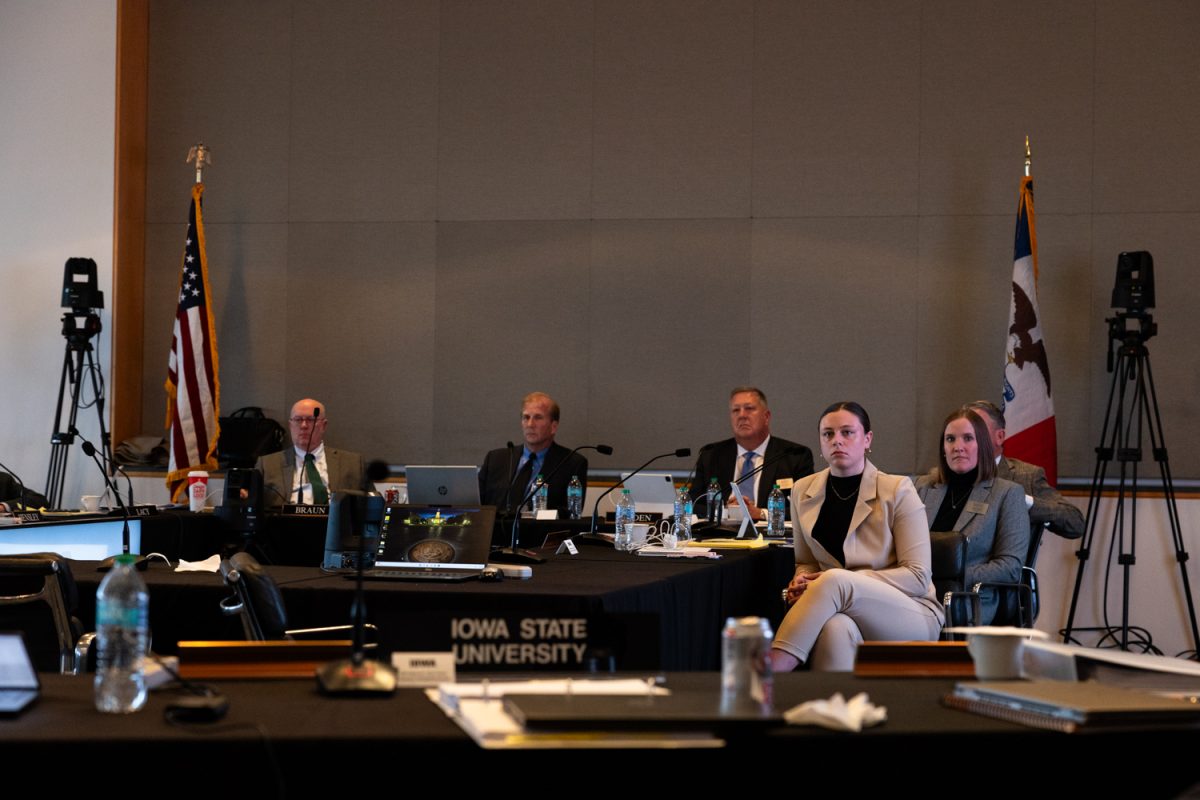
A potential international student fee increase brought to the Iowa Board of Regents by the University of Iowa is creating additional pressure for international students.
Between travel bans, demographic limits, and the proposed student fee hikes, several factors are contributing to growing uncertainty for international students at the University of Iowa as U.S. international student numbers drop.
The Iowa Board of Regents’ Feb. 26 agenda featured the first reading of a proposed 80 percent increase in international student fees across two categories, from $125 per semester to $225 per semester, and $162.50 in the summer, starting fall 2026.
Regent Christine Hensley affirmed she would vote “no” in the board’s April meeting.
At a discussion following public comments the day prior, UI graduate students spoke out against the proposed increases, calling them problematic for international students.
According to data provided by UI International Programs, the university’s proposed international student fee increase is the greatest increase since the fee was implemented in the 2000-01 academic year.
In 2000-01, the fee was $40 each semester and $20 in the summer before increasing to $60 per semester in 2007 and to $70 three years later. In June 2018, the board approved a 78 percent increase to $125 each semester.
According to board documents, the UI’s reason for the increase request is “to cover increased program costs of International Student and Scholar Services.”
In a previous statement to The Daily Iowan, Russell Ganim, UI Associate Provost and Dean of International Programs, wrote the UI has “applied for modest increases in international student fees.”
Ganim denied the DI’s request for additional comment regarding the increase request.
The regents are set to vote on the proposed fees in April. The national OpenDoors report by the Institute of International Education states new international student enrollment has dropped 17 percent between fall 2024 and fall 2025.
According to regent documents, the UI’s international student population saw a 0.9 percent decrease in the 2024-25 academic year.
Hensley said the process to design and implement tuition and fee increases was poorly communicated among the board, saying she heard about potential tuition increases from the media.
“But we still have a big issue,” she said. “And to have to read about something that is really significant to the Board of Regents, where we determine what the tuition is going to be, and I find out about that in the media, that’s not the way a board should work.”
Hensley went on to cite a 2026 Gallup Poll on higher education, naming affordability as a top issue among students.
“Affordability was at the top of the list, and I think we need to be sensitive to that,” she said.
One proposed increase is an 80 percent increase for the general per semester international student fee. Potentially increasing by 83.3 percent is a one-time payment for international student orientation, designed to provide a crash course in U.S. culture, values, and political systems to those coming from abroad, from $120 to $220, according to board documents.
Iowa State University and the University of Northern Iowa do not have an individual program fee for international students, but have orientation fees of $120 and $125, respectively. Regent documents show that only ISU is requesting an increase of 8.3 percent compared to the UI’s 83.3 percent request.
The UI’s International Student and Scholar Services administers the mandatory orientation program.
UI International Students Committee Chair Milad Arzani said the committee is working with scholar services to voice concerns about the fee increases, even meeting with them the morning of Feb. 26, when the regents read the proposition on their agenda.
Arzani said the committee plainly asked scholar services not to raise the fee, but they said the increase was necessary and would need to happen.
Arzani said scholar services proposed alternative methods to financially support international students, such as fundraisers and requests to academic departments.
Scholar services did not respond to the DI’s request for comment at the time of publication.
In 2020, data from the National Immigration Forum reflected that 74 percent of U.S. higher education admissions directors said restrictive immigration policies place limits on international student recruitment.
At the end of President Donald Trump’s first term in 2020, his administration had placed travel bans on 14 countries.
In just one year, Trump has placed travel bans on 75 countries, according to January 2026 data by the Council on Foreign Relations.
Arzani said travel bans bring rise to biased admissions for international students, resulting in economically based preferential treatment for non-international students.
“Whenever departments ask, ‘Here is a travel ban, should we consider this student for our application?’” he said. “They recommend that you should not consider nationality when doing this, but it will cause bias eventually. Like an American wouldn’t cost as much as international, so why bother with it?”
In Iowa, legislators are poised to acquiesce to the Trump administration’s higher education compact. Iowa House Study Bill 548, which has passed through the House, would request Iowa’s three regent universities to join the compact.
The compact would offer specialized federal funding to universities that ban the use of race and sex in admissions, freeze tuition rates for five years, and, among a list of other conditions, place limits on international student enrollment.
“Universities that rely on foreign students to fund their institutions risk, among other things, potentially reducing spots available to deserving American students, and if not properly vetted, saturating the campus with noxious values such as anti-Semitism and other anti-American values, creating serious national security risks,” the compact reads.
The compact also limits student population participants in the Student Visa Exchange Program to 15 percent and no more than 5 percent from one country.
According to the OpenDoors report, 96 percent of a survey pool of 828 U.S. higher education institutions said the visa process, in general, is contributing to declining international student enrollment.
“It’s just another added stress,” Arzani said. “For me, eventually you will get numb from the country, you will get numb from the amount of stress.”
Arzani said graduate students employed at the UI are allowed to work 20 hours a week at maximum, which the university defines as a part-time position. With the fee increases and uncertainty in immigration at the federal level, Arzani said it is difficult as an international student to maintain savings to fall back on.
“So then, if we’re getting paid 20 hours, and we cannot do anything extra, things get tight,” he said.
During the Board of Regents public comment on Feb. 25, two members of the UI’s Campaign to Organize Graduate Students, or COGS, spoke out against the proposed fee increases.
COGS President Olivia Jones said the fee increases would undermine a contract between COGS and the board providing a 3 percent wage increase in academic years 2024-25 and 2025-26, saying 10 percent of international graduate workers’ start-of-semester paychecks would go to paying the fees.
“This creates more need for every graduate worker to rely on government assistance through food banks, mental health services, WIC, SNAP, and housing assistance,” she said. “You’re underpaying your workers and charging them at the same time.”
The board has a second reading of the fee and tuition increase set for its April meeting, where it will officially vote on the directive. In the meantime, Arzani said the international student experience is shifting on all fronts without students’ input.
Following Jones, COGS Unity Chair Clara Reynen said the UI Center for Intellectual Freedom is an improper use of $1 million in appropriations funding from the state, saying the university’s and, by extension, the regents’ priorities are in the wrong place.
“We could’ve used it to pay teaching assistants, we could have used it to avoid international student fees going up,” Reynen said.