


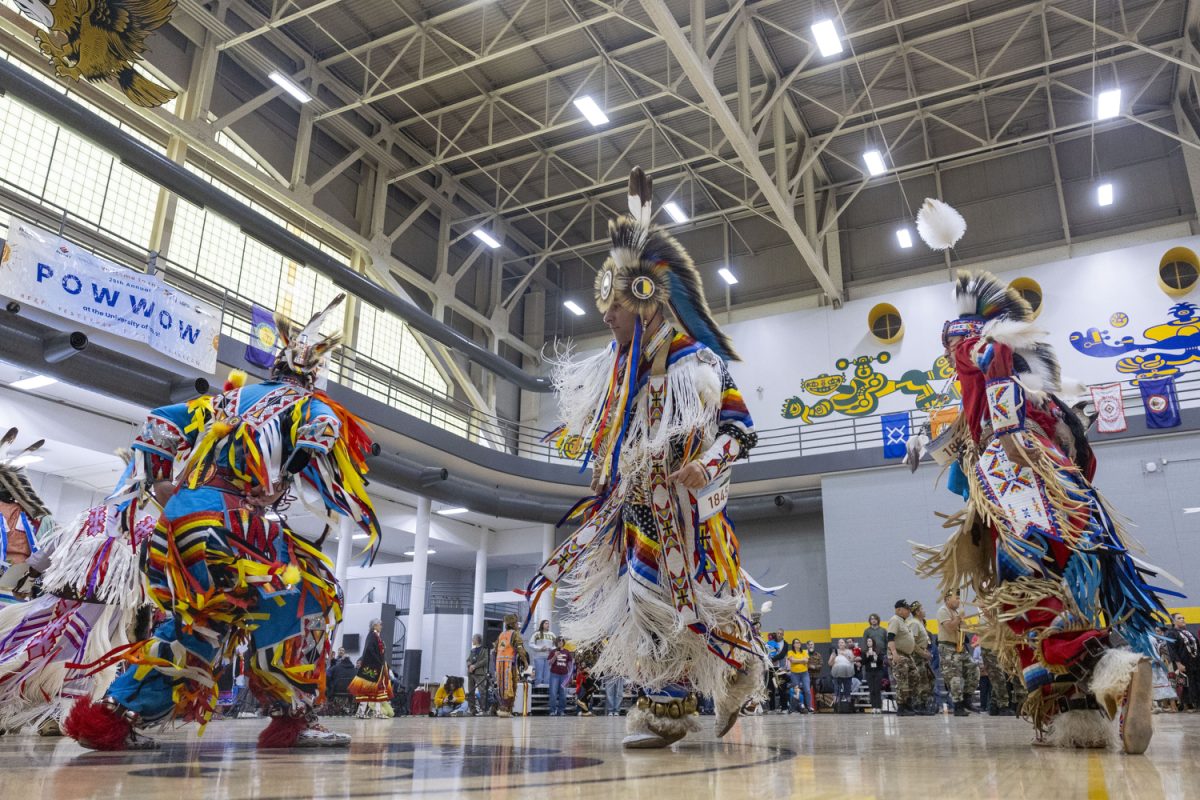
The University of Iowa’s Native American Student Association held its 29th annual powwow, bringing hundreds of people together to partake in Indigenous culture, food, and celebration.
The event ran from 8 a.m. to 8 p.m. on April 18 at the UI Field House.
This is the first powwow since 2024, after last year’s was canceled due to funding issues. The powwow previously received funding from several UI departments, but in 2024, the Iowa Board of Regents released new guidelines prohibiting university departments from donating to student groups.
“We took a break last year just because we were navigating some changing landscapes, but we’re so happy to be back this year with the theme ‘Here: Yesterday, Today, and Tomorrow,’” Joe Maxwell, the president of the association, said.
Joe Maxwell said the slogan represents the resilience of Indigenous people.
“No matter what happens politically, environmentally, there’s one thing that all people can be confident in, and it’s Indigenous people,” Joe Maxwell said. “The people who care for the land are always going to be here.”
Joe Maxwell said the association had to build this year’s powwow from the ground up. He said they created an apparatus to fundraise and recruit people for the event. They had to find volunteers, vendors, dancers, and guests, which he said required a lot of time and effort.
“There was just a whole lot of work at a whole lot of different angles,” Joe Maxwell said. “I’m so grateful for everyone.”
One change this year is that the powwow was held at the UI Field House on the west side of campus. In the past, the event was held at the Iowa City Fairgrounds, but Joe Maxwell said the UI was generous to donate the new space to the association for the day.
“We’re just happy to bring it closer to students, closer to where life is happening on campus,” he said.
Joe Maxwell said the annual powwow is an important event for the local Indigenous community. He said it is good to have a ceremony that the community can engage in on a yearly basis that keeps them true to their hearts and spirits.
“It kind of grounds us in the story that we inherit from the people who come before us,” Joe Maxwell said, “So even for this powwow, I’m planning it right now, but I know I follow a long line of students.”
The powwow began with a prayer, followed by the Grand Entry, a dance to music by the Eagle Feather Singers that featured Native Americans of all ages. They were dressed in traditional, colorful regalia, covered in feathers and beads.
Ryan Kinser, chair of the UI’s mathematics department, gave a speech on behalf of the university. He thanked the Native American Student Association and the community for their participation in the powwow.
“We’re thankful for all of you and especially the students,” Kinser said, addressing attendees. “You being here is so important.”
Madelyn Luna Deutsch, a UI graduate student, was one of four Native American students being recognized at the powwow graduate ceremony. Deutsch said it was very meaningful for her to be recognized in this way, especially because of how important the Native American community of Iowa City has been to her in the past.
She said her family recently went through an extremely hard time, and the community supported them through it.
“It’s nice to be here and to see faces of people who helped me and have been there for me and my family,” Deutsch said.
Deutsch said the powwow was going very well and that Maxwell did a great job planning it.
“He, I know, has had sleepless nights over this planning and preparing, and he’s done amazing,” she said.
Adam Potter, a human resources specialist at the UI and powwow advisor, led the graduate ceremony. He gave a speech recognizing four UI students who are graduating this spring.
He presented each graduate with a special beaded cap and explained the symbolism of the beads, with the black, white, and gold beads representing the UI, and the alternating knots reflecting joy and hardship experienced during their education.
Joe Maxwell’s parents and sister supported him by working as volunteers at the powwow. His father, David Maxwell, said the powwow means a lot to the Indigenous community, especially now in the U.S. during times of divisiveness.
“The focus on people of color and the disregard for their lived experiences really just amplifies the importance of these types of events where there is a celebration of the original inhabitants of the land,” David Maxwell said.
He emphasized that Native Americans are not immigrants, but instead the original people of North America.
“Our culture is still here, and there have been many attempts to wipe out the culture of indigenous people,” David Maxwell said. “We’re still here, and that is what this celebrates.”