


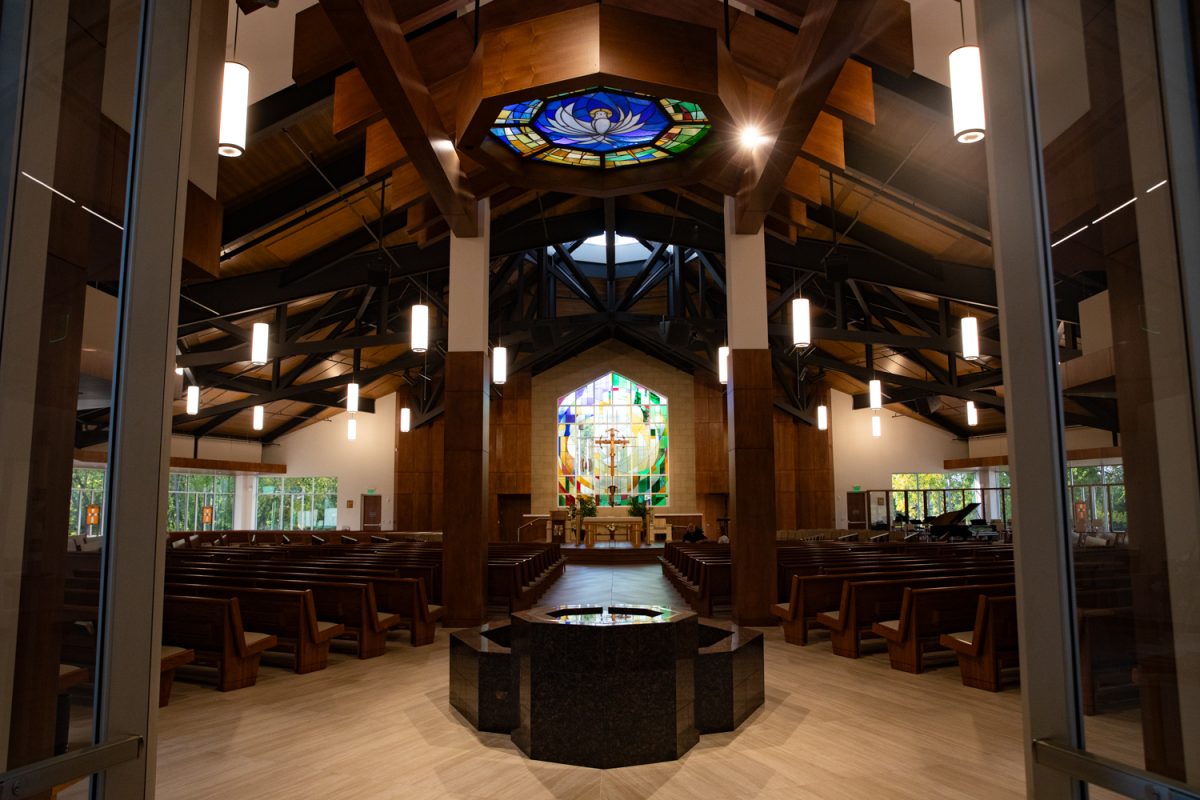
The Newman Catholic Student Center, a Roman Catholic ministry at the University of Iowa, reports an uptick in attendance at services and participation in events over the last year. This rise isn’t exclusive to UI and has been reported across Iowa and the U.S. as more people convert, revert, and attend Catholic services in the search of a welcoming community.
Rev. Jeffrey Belger, the priest director at the Newman Center, said Bible studies, retreats, discipleship, and conferences have seen around a 40 percent increase in student participation in the last year. He said it is difficult to accurately track student participation at Mass, but he is still observant of the growing crowds.
He said the growth in student involvement has happened every year for the past six years.
Second-year UI student and a member of the liturgy and prayer team at the Newman Center, Rylande Stewart, said he has also seen increases, particularly for services during the week.
“I’ve seen a very big increase in the attendance at our Thursday night masses or Friday masses,” Stewart said. “Normally, we get like 10 people who would show up. Now, I’m seeing like 70 people.”
UI anthropology professor and endowed chair member in Catholic studies Kristy Nabhan-Warren, said the rise in Catholic churchgoers is a nuanced topic and doesn’t have one specific cause, rather there are multiple reasons for the increase.
In 2024, data from the Public Religion Research Institute found that around one in three members of Gen Z identified as religiously unaffiliated.
Nabhan-Warren said a major cause of this was the global issues that Gen Z had grown up with, which turned into a sense of despair among young people. She also said the rise of the contemporary Evangelical movement, a Protestant movement characterized by personal conversion and the rules of the Bible, around this time may have acted as a deterrent to Gen Z to engage with religion.
Nabhan-Warren said Pope Leo XIV, who is the first American pope, has played a major role in the uptick in Catholic engagement in this country, but not because of his being born in the U.S., rather because of his outspokenness on social and geopolitical issues.
RELATED: Osama Sharairi marks second anniversary amid Ramadan
She said Leo has been speaking about how society feels and saying what they are afraid to say by condemning the war in Iran, embracing the poor, and criticizing the Trump administration’s immigration efforts.
Nabhan-Warren said Leo’s message of “Jesus loves all” is not only him quoting scripture, but also him calling out the contemporary Evangelical Christian messaging that is coming from the White House through President Donald Trump’s spiritual advisor, Paula White-Cain comparing Trump to Jesus.
On April 5, Easter Sunday, Leo urged those who are starting wars to lay down their weapons while Trump made threats to Iran over social media regarding the Strait of Hormuz. Leo also stated during his homily that Jesus “does not listen to the prayers of those who wage war, but rejects them.”
For Stewart, the pope’s direct and unafraid way of calling out injustice in the world is something Stewart is amazed by.
“He is straight to the point. He does not care,” Stewart said. “He’s literally told Trump to end the war in Iran, and he’s done all these amazing things.”
She also said the rise in Catholic engagement is partially due to the beauty and mystery of Catholicism that isn’t seen in the world today because of how impersonal everything feels due to the mass implementation of artificial intelligence.
“People feel very alienated from each other. Couple that with the current war we have, the tanking economy, and young men and women trying to find their way in the world,” Nabhan-Warren said. “It’s actually no surprise when we look at things historically and sociologically, why we see an uptick in conversion to Catholicism right now.”
Nabhan-Warren said as people continue to feel alienated, they will search for ways to connect with other people. She said the Catholic church gives people that sense of community, especially at a time when they express the need for third spaces, or places outside of home, work, and school to interact with others.
The university offers many third spaces outside of the Newman Center, including the cultural houses such as the Afro American Cultural Center, the Latino Native American Cultural Center, the Asian Pacific American Cultural Center, and the Pride Alliance Center, student organizations, and physical activities offered through the Campus Recreation and Wellness Center.
She said the Catholic church’s more recent messaging of “Come as you are” and “Love everyone” has appealed to the younger generations, many of whom have LGBTQ+ or transgender friends who have been alienated by other churches and faiths.
For Stewart, the Newman Center has been a third space for him, and when he first arrived at the center, he felt immediately welcomed by his peers.
He said the sense of community people feel not only at the Newman Center, but also Catholic churches in general, is the main reason for the increase in Catholic churchgoers.
“The first year I went, it took me about maybe a day to make my first group of friends, and then I just rolled with them for the rest of that time,” Stewart said.