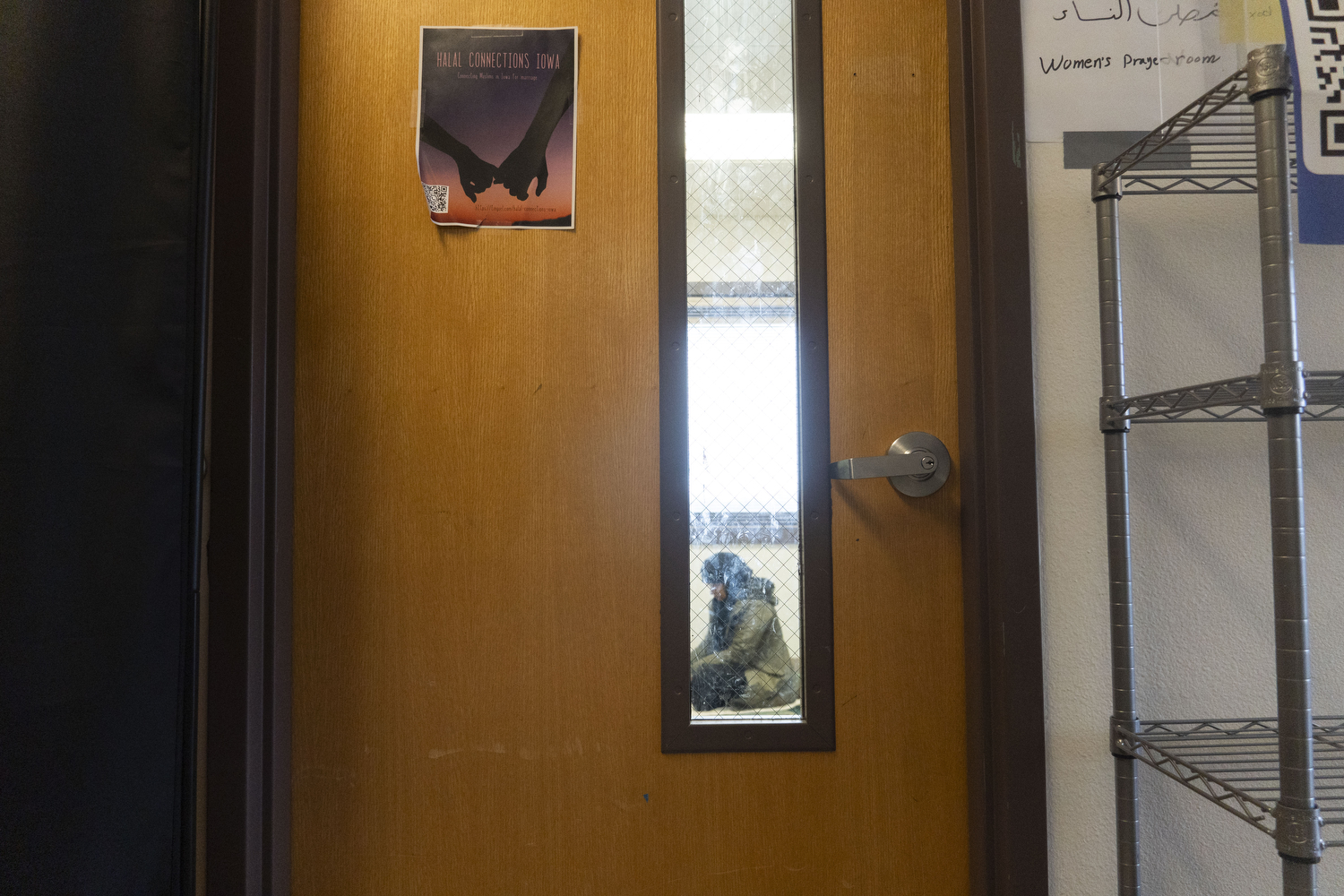

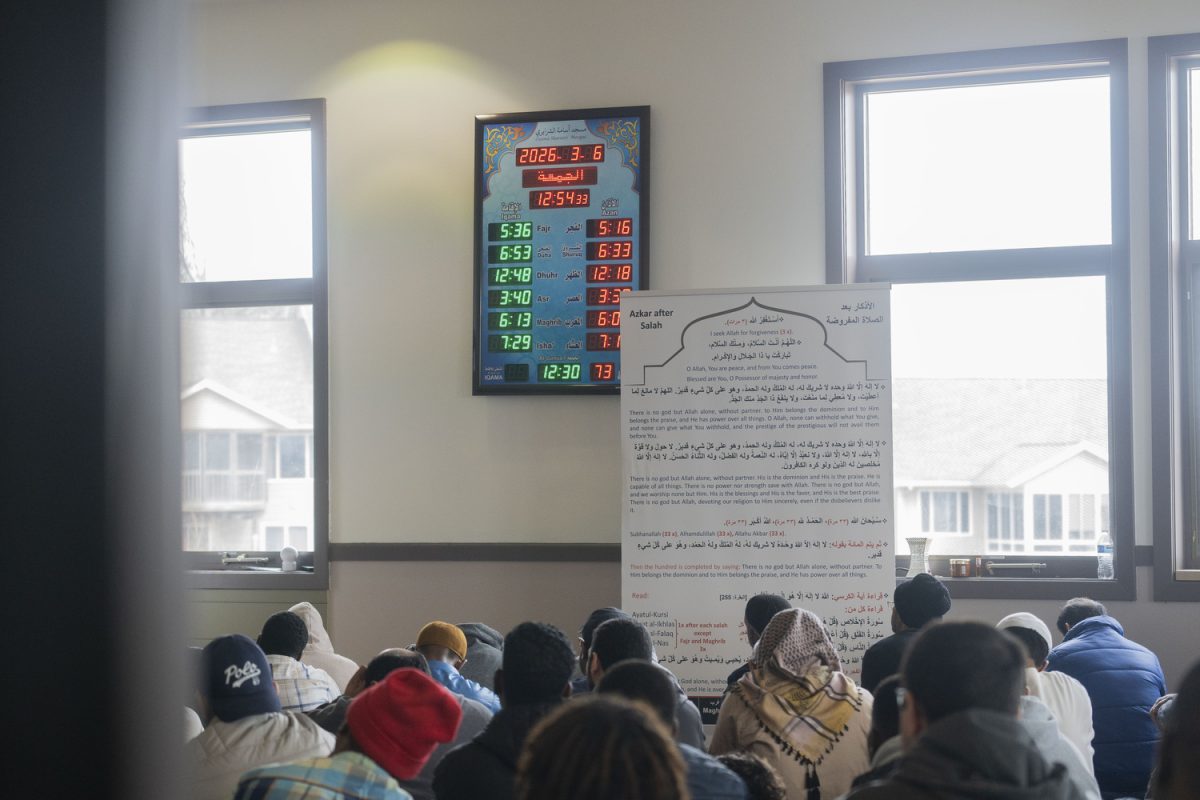
As Muslims in Coralville and Iowa City observe Ramadan, a month-long fast from sunrise to sunset, the Osama Sharairi Mosque is one of two places of worship that hold communal prayers in Johnson County. The Islamic holiday is held from Feb. 17 to March 19.
The mosque approaches its second-year anniversary after opening in March 2024 at 2251 1st Ave. in Coralville. The owner, Hadi Sharairi, named the mosque after his late father. He said the Muslim community in the area has grown and needed another mosque, especially as the older Iowa City Mosque has limited parking.
Pew Research Data shows Muslims make up less than one percent of Iowa’s population. According to a 2020 Association of Religion Data Archives report, 5.92 percent of people were estimated to identify as Muslim in Johnson County. This is a significant increase from the 2.35 percent of identified Muslims recorded in 2010.
Sharairi also hopes the Osama Sharairi mosque can help educate non-Muslims.
“This will also help the non-Muslim communities to learn about Islam and to show them that Islam is a peaceful religion,” he said.
Before opening the mosque, Sharairi wanted to build a daycare. He then realized there was enough space to incorporate a mosque in the upstairs portion of the building. The building now functions as both.
“That’s what’s unique about it because it’s not a community that came up with this idea to make it happen. It’s the owner who always wanted to have a mosque and saw it as a good opportunity to pursue a blend,” Samir Falah, a good friend of Sharairi said.
The mosque welcomes a variety of backgrounds, including Sudanese, Pakistani, Indian, and others, but Ramadan and al-Jumu’ah, or Friday prayer, brings in the most engagement from various groups, especially students.
Although most Muslims in the greater Iowa City area attend the Iowa City Mosque which has been operating for over 27 years on 1812 W. Benton St., Osama Sharairi has begun partnering with University of Iowa students to volunteer for prayers host Qur’an lectures and is working to launch women-led Quran lessons. Much of the college outreach is from UI students spreading the word, Falah said.
Due to their relatively recent establishment, Falah said recruiting more students has been a gradual process.
Many Muslim students at UI believe practicing Ramadan on campus is difficult, but new mosques like Osama Sharairi help them through Ramadan.
UI first-year electrical and computer engineering student Omnia Ali said Ramadan offers many opportunities to connect with the Muslim community and build support for one another.
“One of my favorite parts is breaking fast side‑by‑side, hearing the Qur’an recited in congregation, and sharing conversations that remind me I’m not experiencing this month alone. It’s a beautiful reminder of how strong and uplifting the Muslim community can be during Ramadan,”she said.
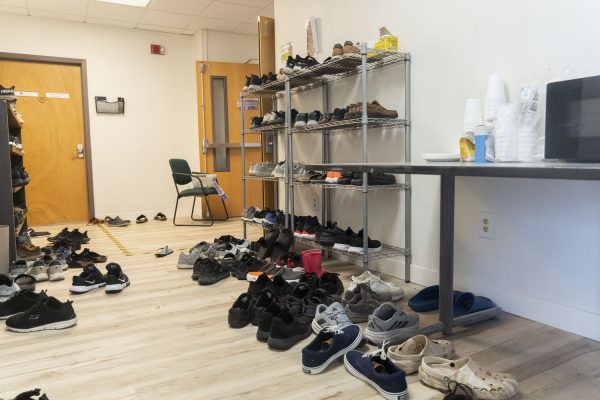
She believes the opening of Osama Sharairi is vital for the growing Muslim population in Iowa City and Coralville. Though she has not had a chance to visit, she said her community has a strong need for more gathering spaces and educational programs.
Ali also said practicing Ramadan and attending the Iowa City Mosque allows her to reflect on her relationship with Islam and grow closer to God.
“I see fasting as a practice of self‑discipline by abstaining from some of the most prominent human desires,” she said. “I’m reminded of the importance of patience, restraint, and self‑control. Fasting also helps me slow down, be more intentional, and reconnect with the spiritual values that guide me throughout the year.”
However, Ali struggles to find convenient spaces to pray on campus.
“Right now, the only designated prayer areas are in the Main Library and the Seamans Center, and it can be difficult to walk all the way to those buildings, especially during work hours or in the short breaks between classes,” she said.
As a result, Ali pivots to using empty classrooms to avoid distractions while praying but wishes there were more prayer areas to accommodate those who have to pray throughout the day.
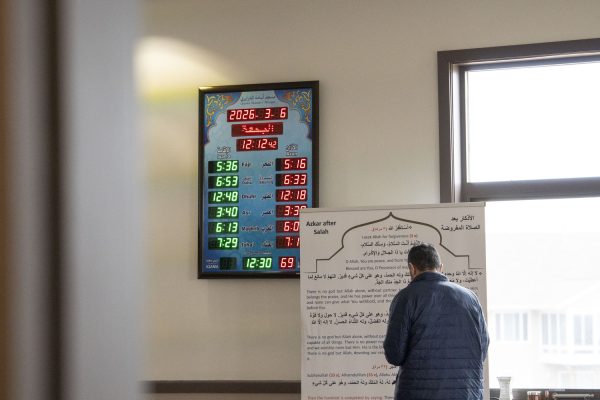
During Ramadan, Muslims must perform five prayers daily: Fajr, Dhuhr, Asr, Maghrib, and Isha. Each prayer is done at different times of the day: dawn, midday, afternoon, evening, and night.
UI first-year student Bashir Eltyeb has similar issues to Ali. He described practicing Ramadan on campus as “challenging but manageable,” with classes being a primary obstacle because they interfere with prayer times.
Because prayer locations are not common on campus, he often uses his dorm residence on the third floor of Catlett Residence Hall when other areas aren’t available.
Sometimes Eltyeb commutes to his mosque with fellow Muslim students for Ramadan-specific prayers such as Tarawih.
For him, Ramadan is an opportunity to reflect on himself, his goals, and his faith.
“So it’s just a time for me to look back and have a conversation with former Bashir. Did you make it? Did you not? If not, why?” he said.
Before attending the UI, Eltyeb faced difficulties taking time off for religious holidays in high school. He has not yet done that at UI, but is concerned if the process will go smoothly when the time comes.
The university provides policies meant to help students observe religious holidays in their Statement of Religious Diversity and the University Calendar. It allows people who celebrate holidays such as Ramadan to request time off if the holidays conflict with work and class schedules.
Holidays such as Eid al-Fitr, the celebration after fasting, sometimes fall on school days. Eid al-Fitr, however, will be held during the UI’s spring break this year.
Because his family is nearby, Eltyeb said he does not stress over logistics such as driving for Eid celebrations. Eltyeb believes this is a common worry for Muslim students on campus who are not from the area.
“And so Eid, which is supposed to be a time where you spend with your loved ones, is a little difficult, especially for Muslim students who are not from Iowa City, who can’t just go home and then come back the day after,” he said.
Eltyeb grew up in Iowa City and considers local mosques like the Iowa City Mosque and Osama Sharairi as supportive spaces for Ramadan. Muslim and culturally-related organizations on campus have helped him out.
“I definitely have a community, and I encourage other people to try to find a community as well. Even within that Muslim population, there are more specific groups, like the Sudanese Student Association, that have been very helpful in hosting events that connect me more to my culture,” he said.
A third-year UI student who wishes to remain anonymous, because her family does not know she’s Muslim, said she has found community in Iowa City despite being away from home for Ramadan.
She believes Ramadan is a time when she avoids material temptations to follow her connection to Allah.
This student is a convert to Islam who fell in love with the religion after visiting a mosque in 7th grade. Although her family isn’t Muslim, her Muslim and non-Muslim friends have supported her throughout her fast.
“I am friends with many Muslims here in Iowa City. I am also a part of a Muslim girls’ group in my hometown. I do have many friends who are not Muslim but know about my religion and fasting, and do their best to encourage me,” she said.
Like Ali and Eltyeb, she sometimes struggles to find places for prayer. She specifically references the challenges of finding bathrooms to perform wudu, a cleansing ritual before prayer.
However, she describes fasting on campus as easy.
“It’s honestly very easy to fast on campus. Like, spending time in lecture and lab helps the day go by,” she said.
This student has not formally attended Osama Sharairi either but said she has watched it transition from a church to a mosque since it was first purchased. While new mosques are important to her, she mentioned that the two masjids, or mosques, in the area are only accessible by bus or car, which limits nightly prayers for UI students.
“I wouldn’t call either of them close to the UI, and it is important to note there is no masjid in downtown Iowa City,” she said.
Another issue she highlighted was her experience with Ramadan while living in dorms from 2023 to 2024. She specifically mentioned the limited suhoor meals, or predawn meal that is eaten before Muslims begin to fast at sunrise.
“It had to come from the university convenience stores, was largely limited in options like oatmeal, cereal, and was only offered about a week after Ramadan had started,” she said. “But I had to email several times to even be told it was an option.”
She hopes that the UI continues to improve conditions for Muslim students on campus.
“I cannot imagine that the situation for fasting Muslim students who live in dorms has gotten better,” she said.