
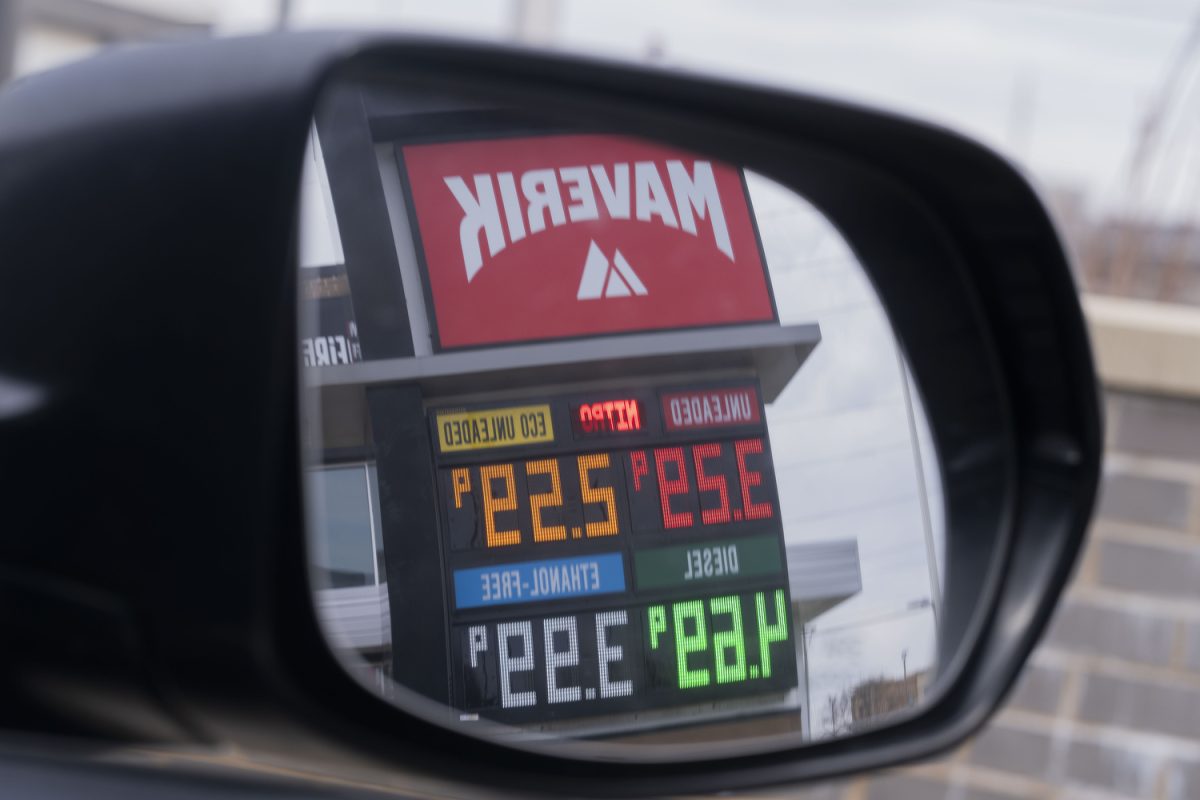
The price of gas in Iowa as well as the rest of the nation has increased over the last month primarily due to the Iran war. There has been no planned resolution to the war, leading to prices continually increasing.
According to the U.S. Naval Institute, the Strait of Hormuz, a waterway between the Persian Gulf and the Gulf of Oman, was closed off by Iran in early March following U.S. and Israeli strikes, effectively blocking a key global shipping route, driving up fuel prices.
According to data from the American Automobile Association, or AAA, the current average price of regular gas in Iowa as of March 29 was $3.29 per gallon which is a 65 cent increase from prices one month ago. This price is 24 cents higher than it was a year ago.
Data from the AAA found that in Johnson County, the average price of gas was higher than the state average, sitting at $3.38 per gallon based on data from March 29.
In Iowa City specifically, the AAA listed the average price at $3.39 per gallon based on data from March 29. One month ago, the average price was $2.65 per gallon, and one year ago, the average price was $3.03 per gallon.
North Liberty resident Corey Robinson has kept up with the increase and tracked how much it has affected his wallet.
“Usually my car is filled up by $25, now it’s an additional $5,” Robinson said.
Due to the increase in prices, Robinson said he has stopped buying gas from Shell gas stations like he used to and instead buys gas exclusively at Kwik Star.
According to the AAA, despite the increase, Iowa is still below the national average as of March 29, which lists the average price of gas per gallon nationally at $3.98.
Tim Hagle, a political science professor at the University of Iowa, said despite President Donald Trump running on an anti-war agenda and promising to make things affordable, Hagle isn’t shocked by the Iran war and the economic impact it had.
“You have to almost say that you can never really be surprised at what Trump does because he’s an unusual person,” Hagle said.
Hagle said he is unsure of how long the war will last, but the longer it lasts and the more lives lost will result in decreased support for the war and the Trump administration.
RELATED: UI students feel the effects of lower Iowa City gas prices
According to YouGov, disapproval rates from independent voters have increased, with survey data showing that from March 6 to March 9 about 53 percent of independent voters either somewhat or strongly disapproved of the way Trump has handled the war in Iran.
More recent data from March 13 to March 16 shows that 63 percent of independent voters either somewhat or strongly disapproved of the way Trump has handled the war in Iran.
Support from Republican voters is strong, with about 81 percent saying they either strongly or somewhat support the way Trump has handled the war in Iran.
With Democrat voters, the disapproval rate has stayed consistent, with about 92 percent saying they either somewhat or strongly disapprove of the way Trump has handled the war in Iran based on data from March 6 to March 16.
Hagle said this is customary in contemporary politics for the majority of members of either political party to strongly support or disapprove of a cause based on what party is in power, which is why the opinion of independent voters is more informative.
“So the no party voters, they’re the ones that decide the elections, especially at the statewide election, statewide level, but even congressional level and probably a lot of the state legislative offices, too,” Hagle said.
He specified that while independent voters typically align themselves in the middle, some are further left of the Democratic party and some are further right of the Republican party. He said that in Johnson County, there’s a considerable number of voters who are further left of the Democratic party and as such, register themselves as
an independent.
Hagle said the average independent voter, or an individual that aligns themself in the center of the two parties, oftentimes isn’t interested in the political infighting but instead cares more about the national economy.
“What they care about are the so-called kitchen table issues, or pocketbook issues, as some people are calling it now,” he said. “It’s like jobs, economy, health care, cost of things, the affordability.”
Iowa lawmakers consider increasing state’s gas tax
Iowa Republican leaders, including Gov. Kim Reynolds, are considering raising the state gas tax.
Senate File 2472, which advanced out of committee on March 16, is aimed at offsetting property tax cuts by allowing for changes like indexing the state gas tax to inflation, which could lead to gradual increases in gas prices over time.
As gas prices increase due to the Iran war, any state-level policy changes, like indexing Iowa’s gas tax to inflation, could compound price increases driven by international events, potentially leading to even higher costs for drivers, according to FUELIowa.
FUELIowa is a nonprofit serving as the primary voice for Iowa’s fuel industry. They advocate for industry interests, promote renewable fuels like E15 and biodiesel, and offer services such as regulatory compliance, insurance, and safety training to members.
The proposal includes a provision that would cap those increases at 2 percent per year, meaning the gas tax could rise gradually rather than spike with higher inflation rates.
GOP supporters such as Reynolds and Republican lawmakers said the cap would help limit sudden jumps in costs for drivers while still allowing the tax to keep pace with inflation over time.
However, critics from advocacy groups including FUELIowa argued that even with the cap, the policy would still result in automatic yearly increases, adding to the financial burden for Iowans already dealing with rising prices at the pump.
In a news release sent out on March 10, FUELIowa opposed the legislation and warned the proposal could make already high prices even worse.
They argued that automatically raising the gas tax each year would gradually increase costs for both consumers and businesses.
They pointed to rising fuel prices tied to the war in Iran and said adding an indexed tax, or a tax that automatically adjusts over time based on changes in inflation, on top of those increases, would drive-up fuel purchasing costs and raise the price of everyday goods.
They urged lawmakers to reject what they described as an untimely tax hike during a period of inflation and affordability concerns, with midwest consumer prices rising about 2.8 percent over the past year, according to the U.S. Bureau of Labor Statistics.
Additionally, housing affordability remains a significant concern in Iowa, particularly for lower-income residents.
According to the National Low Income Housing Coalition, 87 percent of extremely low-income renters in the state are cost-burdened, spending 30 percent of their income on housing.
“Fuel tax increases like this not only drive-up fuel purchasing costs on Iowans; they also drive up the costs Iowans pay for their daily essentials,” FUELIowa said in the release. “At a time when inflationary drivers and affordability are the key issues facing Iowans, now is not the time to impose tax increases on Iowa consumers and Iowa businesses.”