


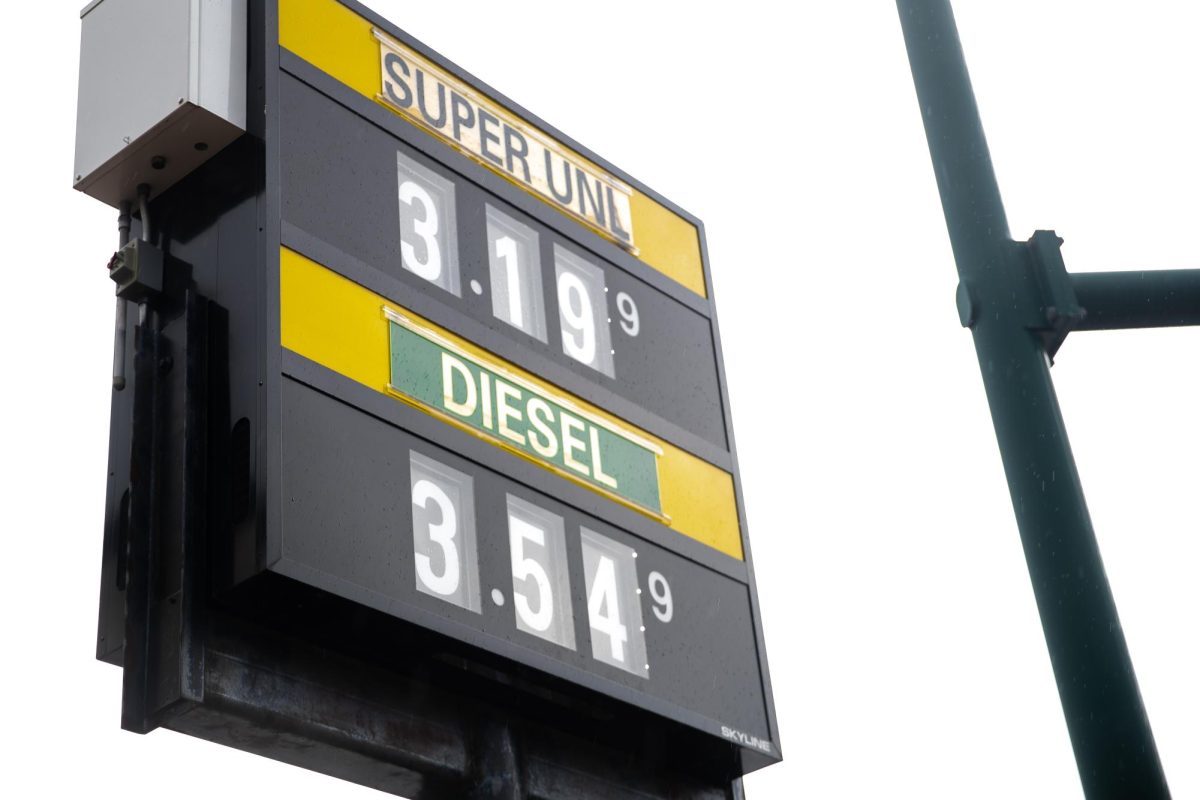
Since returning to campus for the 2025-26 academic year, University of Iowa students say filling up the tank is not as painful this semester as it has been in the past, even as gas prices in Iowa City continue to tick up and down after a brief period of cooling at the end of the summer.
For students juggling rent, utilities, tuition, and groceries, relief from expenses like gas is welcome.
The average price for regular unleaded gas in Iowa City was $2.95 per gallon as of Sept. 28, according to AAA Fuel Prices. Previously, gasoline in Iowa was $3.21 per gallon in September, according to the U.S Energy Information Administration, or EIA.
Out-of-state students notice a difference in gas prices when comparing their hometown to prices in Iowa City. For Emily Manalli, a second-year student at the UI, gas prices in Iowa are significantly cheaper than in her home state of Illinois.
“It is always fun to get gas here because of how much less I’m spending,” Menalli said.
Compared to its neighboring states, Iowa fares well in terms of the price of gas. According to AAA, as of Sept. 28, Iowa’s average price for regular unleaded gasoline is $2.85 per gallon. Wisconsin sits below Iowa, averaging $2.84 a gallon. But, Illinois gas prices are significantly higher than Iowa’s, averaging $3.38
a gallon.
Nationally, the average price of gas is $3.13 per gallon, meaning UI students are paying less than most drivers across the country.
“I’d say toward the end of last year gas prices really fluctuated a lot, but this year has been really cheap,” UI fourth-year, Lily Fournier said. “Instead of it being a $50 tank, it is a $30 tank, which, as a student, makes it way more affordable.”
The difference between spending $30 and $50 on a tank of gas may seem insignificant to some, but for college students like Manalli and Fournier, these savings can help them afford other essentials.
“It is so annoying to have to spend money on gas, so I love that the prices have been cheaper recently,” Manalli said. “There are just so many other things I would rather be paying for than gas.”
As inflation continues to climb, essentials like milk, eggs, and bread continue to affect students’ budgets. Since 2022, milk prices have increased by nine percent in the Midwest, and egg prices have gone up by over 12 percent in the Midwest as of 2025, according to the Bureau of Labor Statistics.
UI students working a part-time job average roughly $13.95 an hour, according to a survey conducted by the UI Human Resources Office. With growing concerns around the cost of living, the cooling of transport costs is providing relief for
]students’ wallets.
The City of Iowa City offers fare-free transit on city buses, but for students who go home on weekends, commute, or travel, cheaper gas allows them to do so freely while still affording living essentials. April Phillips, a fourth-year student at the UI, said she has taken more trips this fall due to lower prices.
“It’s really nice to have cheaper gas prices in the area right now,” Phillips said. “I went to Des Moines last weekend, and I went to Ames the weekend before, and it feels like I can justify doing more things when gas is cheaper.”
Patrick De Haan, head of petroleum analysis for GasBuddy, a website updating gas prices across the country, said weather plays a huge role in the price of gasoline.
“A lot of what we’re seeing now is seasonal. Now that we are out of the summer driving season, gasoline demands will slowly decline into the fall,” De Haan said.
De Haan said, companies have begun producing winter gasoline, which is cheaper to produce and less costly as a whole. De Haan said the price of oil is also a factor.
“This year the price of oil has been remarkably stable. There have been a lot of economic headlines that have caused oil prices to be locked in a pretty tight range,” De Haan said.
In January 2025, U.S Crude Oil First Purchase Price was $73.15 per barrel, according to the EIA. In August 2025, this number decreased slightly to $65.33 per barrel, a 12 percent decrease
in prices.
De Haan is surprised to see the lack of fluctuation, because the war in Ukraine and conflicts in the Middle East would typically cause prices to increase. Russia is a major supplier of the world’s oil and gas.
The war in Ukraine is causing infrastructure to be targeted, leading to a decrease in supply, simultaneously leading to an increase in demand and price, according to the International Energy Agency, or IEA. The Middle East also plays a crucial role in the distribution of oil. Tensions in the Middle East make transporting oil more difficult, according to the IEA.
The Organization of the Petroleum Exporting Countries, or OPEC, controls a third of the world’s oil supply, according to De Haan and the EIA.
In March 2025, the organization started raising the amount of oil being produced on a monthly basis. This increased the supply of oil, making it easier to compete with demand this summer and
into the fall.
Demand for gas goes down due to fewer trips being taken in the winter, along with a general decline of activity. In January 2025, the EIA recorded 499,551
gallons of finished petroleum products distributed.
These products include gasoline, diesel fuel, and jet fuel. In June 2025, the EIA recorded 516,315 gallons of finished
petroleum products.
This is a 3.29 percent change in fuel consumption in the summer compared to the winter.
“Gas prices tend to slowly decline for the next several months, bottoming out around the holidays. We tend to see gas prices remain relatively low through about February,” De Haan said.