

Some people believe artificial intelligence makes our lives easier, others argue that it can detract from our creativity and working efficiency. As a college freshman in this world where AI is becoming more and more relevant, figuring out how to use it has become a key skill for navigating my life.
However, many professors feel that instead of encouraging us to use these tools, it might be better to focus on our own creativity, leading some to ban any use of AI in the classroom. But is shutting out AI really the best way to prepare us for what’s ahead?
A study conducted by the Pew Research Center in 2025 revealed a significant increase in awareness of AI among adults since 2022. Back then, only about 26 percent of adults reported having heard a little about AI. However, by 2025, that figure rose to 47 percent, highlighting the ongoing growth and evolution of this form of technology.
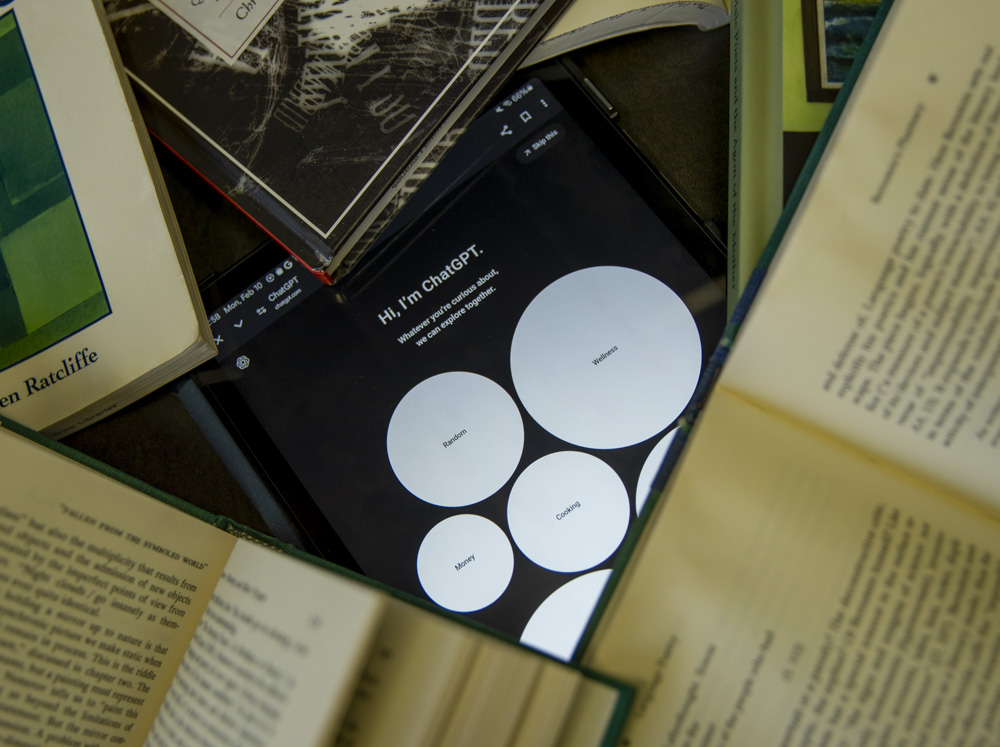
I see AI tools such as ChatGPT as a helpful tool for organizing my notes and better understanding subjects. It generates answers based on the info you give it. Instead of stifling creativity, it helps create or rearrange material as you need it. In the end, it’s up to you to provide the information.
AI tools like ChatGPT have really changed the game for students, especially for those of us who just started college. These resources have been incredibly helpful in organizing my notes and breaking down complex topics into simpler explanations that I can actually understand.
As an English and Creative Writing major, certain tools like Grammarly help me catch grammatical mistakes, so I can focus on my writing instead of stressing over every little detail.
Rather than a binary argument for or against banning AI in education, I believe the focus should be on finding a balance. The University of Iowa is making exciting moves to keep up with AI including the Certificate in AI.
Bahaa Mohammad, a fourth-year biomedical engineering student at the UI, has experienced firsthand the impact AI has had on education.
“AI has been a great help when it comes to explaining complex problems, summarizing readings, and lecture slides,” he said.
For Mohammad, the advantages extend beyond mere comprehension; AI has also played a pivotal role in organizing his study plans, providing him with a strategic edge in a demanding field like engineering.
If educators don’t allow and teach students how to effectively use AI in the classroom, they risk leaving a generation unprepared for a workforce where these technologies are becoming the norm.
A study by the College Board noted that AI technology use among high school students grew from 79 percent to 84 percent between January and March of 2025, despite many educators’ hesitation and reluctance toward it. This is a significant trend, yet many institutions seem to be avoiding the issue instead of addressing it directly.
Banning AI in schools and classrooms isn’t a practical solution. It’s just a temporary fix that ignores the important implications of this technology. Instead, educators should focus on integrating AI into the curriculum, teaching students how to use these tools creatively and ethically, and allowing it as a guide in their classrooms.
UI second year student Grant Monacella, studying electrical engineering on the computer track, shares a unique take on using AI in his studies. To him, AI isn’t just a crutch; it’s a tool that really boosts his understanding. He notes,
“It has really helped me understand difficult concepts and can help search for alternative explanations that are reputable and correct,” Monacella said. “The way I use AI is very different than how I see my peers use it. AI is more powerful the more information you give it, so I give it as much context as I can.”
We need to start seeing AI as a tool that can boost and help our knowledge and skills, not just something that could replace them. After all, the more we learn about AI, the less scary it becomes.
Editor’s note: Grant Monacella is a former employee of The Daily Iowan.