


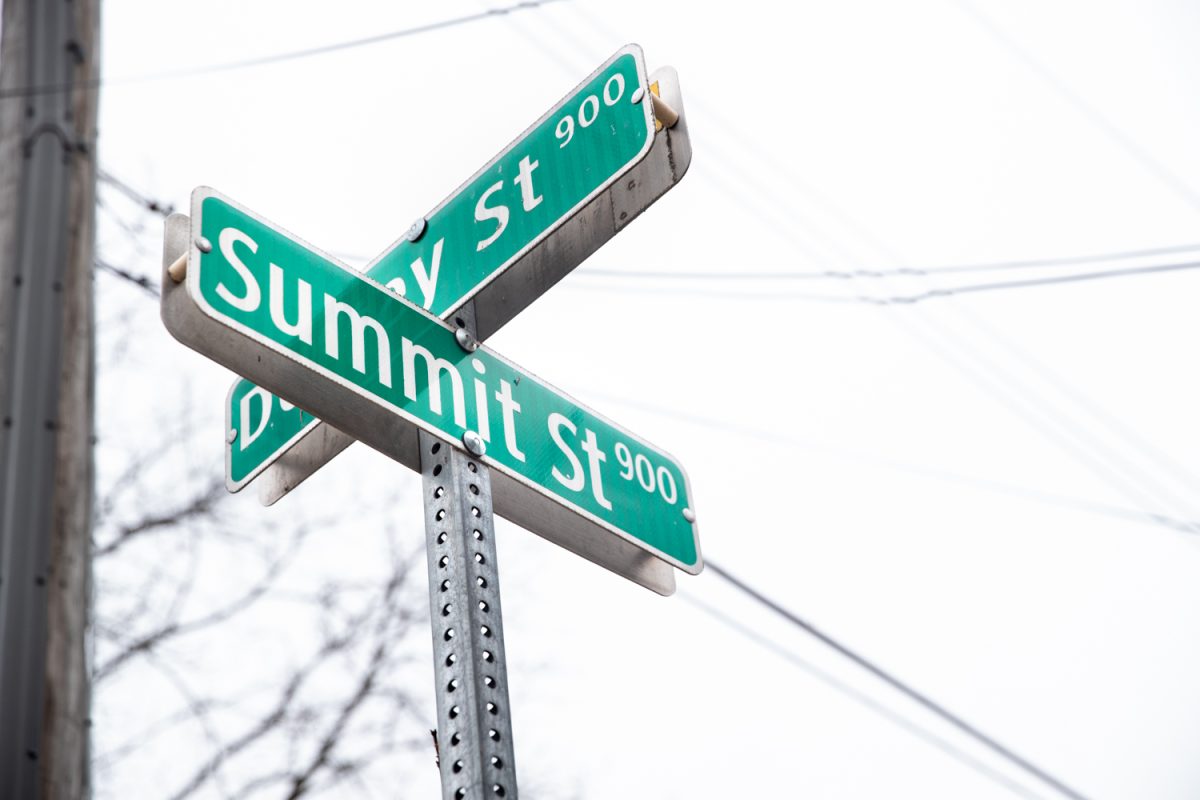
Iowa City Housing Authority is progressing with a long-planned affordable housing development on North Summit Street after securing a development manager and additional funding for its first project as an independent developer.
As the project has moved forward, it has received $3.7 million in a federal PRO Housing Grant to cover development management and construction costs, and hired Baker Tilly, an international consulting and public accounting network, as the development manager, according to a presentation to the Iowa City City Council on March 10.
The project began on Oct. 18, 2024, when the Iowa City City Council officially acquired the 1.8 acres of land, where the 1002 and 1006 N. Summit St. buildings were previously located. The city bought this land for $750,000, covered by funding the city received from the American Rescue Plan Act.
The first affordable housing project Iowa City pursued with funding from the act was the acquisition of three townhomes on Herbert Hoover, which the city rents out. The second project is North Summit Street.
This purchase reflects the city’s five-year initiative to increase the availability of affordable housing, called City Steps 2030, which was launched in 2024.
Neighborhood and Development Services Director Tracy Hightshoe said Iowa City can only house two-thirds of the demand for housing, meaning it may lose residents to surrounding communities.
Hightshoe said the actual physical supply of housing should be a priority for the city’s affordable housing efforts.
“What we found was a local development barrier,” Hightshoe said. “Very few affordable housing providers are building. They acquire, but that’s just taking existing housing stock. It’s great because it makes it more affordable, but you’re not netting any affordable housing. You’re just taking more affordable market-rate units off the market and now making them subsidized.”
The city operates 42 units of affordable housing, including the recent acquisition of 15-units on 1102 Hollywood Blvd. on March 17, which will offer housing to veterans in the community.
However, all 42 of these units were acquired by the city, meaning North Summit Street will be the first project where the city itself will act as building developer, furthering the city’s role in an increasingly competitive market.
RELATED: Iowa City purchases empty lots to construct affordable housing units
Rachel Carter, the executive director of the Iowa City Housing Authority, oversees all public housing operations in the city, with the Housing Authority acting as the landlord and property owner of these buildings. This will include the North Summit Street building.
“What we see is the affordable housing market is really tight in Iowa City, and it’s difficult to build affordable housing and still make a profit,” Carter said. “So we have come to recognize that there is a need for some nonprofit, or not-for-profit, or government entity to help develop affordable housing. And with our long history of management of affordable housing, we feel like we’re well-suited to step into that role.”
Hightshoe said the lot will be able to accommodate a variety of multi-family units through medium-density housing. This means the city council will not have to make any rezoning efforts, as the space can already serve the anticipated number of units and tenants.
It is also located in an area that lacks subsidized affordable housing opportunities, according to a Heat Map published by the Iowa City Neighborhood Services in December 2023. The project will increase accessibility to affordable housing in a more underserved area.
Naomi Mehta, a Bloomberg Harvard Summer Fellow, worked with the Iowa City City Council on a study that tracked opportunities for upward mobility throughout the city’s census tracts. A census tract is a small boundary within a county that tracks long-term population changes.
Mehta’s study found that the tract in which North Summit Street is located has high economic mobility and low social vulnerability, meaning additional housing can further facilitate mobility for its residents.
The building will be in proximity to downtown Iowa City, and will be located near St. Joseph’s Cemetery, a Hy-Vee Grocery Store, Hilltop Tavern, Press Coffee, Hickory Hill Park, and a variety of other nearby amenities. It will be built in an L-shape, with a courtyard and a parking lot, with the city covering parking costs.
The building is expected to hold 36 units. As the proposal stands, it would be composed of 18 one-bedroom units, six two-bedroom units, and 12 three-bedroom units.
Hightshoe said the high number of one-bedroom units is meant to account for a lack of units in the area. Only 15 percent of Iowa City’s housing stock is made up of these types of units, despite 51 percent, or 729, of voucher holders being one-bedroom voucher holders. More than 200 of these voucher holders are in two-bedroom units due to a lack of one-bedrooms.
The Housing Choice Voucher program, also known as the Section 8 Program, is a federal program administered by the local Housing Authority to help cover the cost of rent. Holders are typically the elderly, disabled, or low-income families, who then pay around 30 to 40 percent of their income in rent, with the voucher covering the rest of the cost. Applications are handled through local Public Housing Agencies.
Hightshoe said a focus in the construction of this building will be accessibility, as there is a lack of accessible, affordable housing in Iowa City for the elderly and disabled.
“We have a disconnect in our community between how many people live alone or live without children, and how many one bedrooms,” Hightshoe said. “Then we have a really hard problem. If you need to find a one-bedroom accessible unit, that’s hard, but yet, 60 percent of our voucher holders are elderly or disabled, so their mobility typically doesn’t improve as they age.”
A majority of these unit recommendations were made by Baker Tilly, which often specializes in advisory services for multifamily housing developers.
One of the main challenges with the development is securing funding and then meeting grant requirements. The project is anticipated to cost $10.7 million, with around seven to eight sources of funding expected to help cover the costs.
The North Summit Street project will likely receive around $2.5 million to support the project. Upon approval from the U.S. Department of Housing and Urban Development, the city will also sell its five Chauncey units to assist in covering the costs.
Hightshoe said because they received federal funding sourced from the act and the Pro Housing Grant, at least 18 units will be subject to subsequent federal requirements, as well as restrictions placed by the Davis-Bacon Act, Section 3, and Build America, Buy America programs.
One of the main requirements placed on this project is that tenants must fall below 60 percent of the average median income. According to the housing department’s website, the city is also unable to deny voucher holders from leasing the building, despite them already receiving rental assistance. Voucher holders usually fall below 50 percent of the median income, with many even being under 30 percent.
Hightshoe presented updates to this project to the city council on March 10. Councilor Mazahir Salih said she was concerned with the proposed housing mix, or the diversity of rentable units, as well as how voucher holders may affect accessibility to the building.
Salih said that if voucher holders, who already have their rent diminished, move into this new building, it may lessen the number of units available to non-voucher holders, who may be more cost-burdened.
Salih also believes there is a greater need for bedroom units that can accommodate families in the community. She said she is concerned about the higher number of one bedrooms proposed for the project compared to the number of two and three bedroom units.
The housing mix is subject to change as the project continues to move forward. The design is not finalized until October of this year, while construction will not begin until May 2027. The construction process is expected to last around 12 to 18 months, with the building beginning leasing in fall 2028.
“Sometimes when we get into big picture conversations, we all lose sight of it, myself included,” Carter said. “But at the end of the day, we’re talking about providing safe and decent housing for families, for veterans, for elderly people, for people with disabilities, for people experiencing homelessness in our community.”