


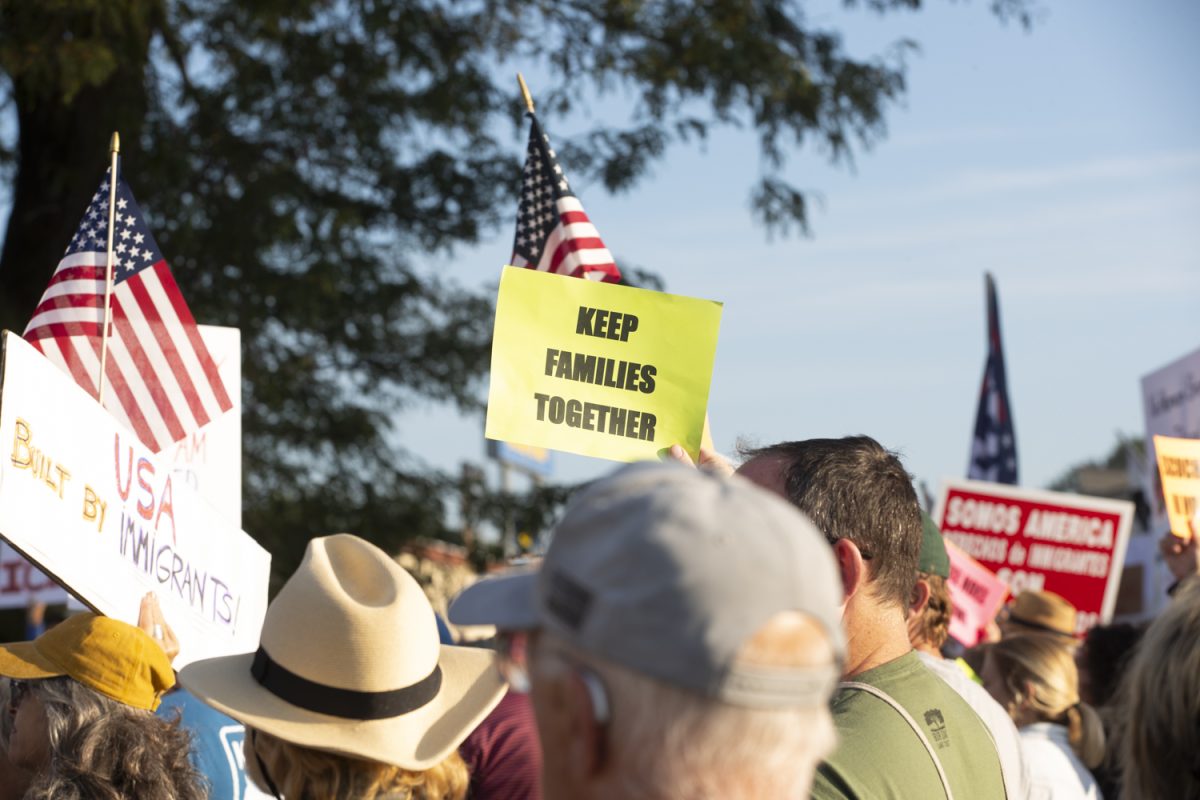
We’ve all heard the stories about the recent Immigration Customs Enforcement, or ICE, raids and the impact they’ve had on people’s lives.
We know the names of Renée Good, a Minnesotan tragically killed by an ICE agent; Luis David Nico Moncada, a Venezuelan who lost his life during a traffic stop; and Alex Pretti, a nurse who was killed while protesting.
While the effects of these murders are still felt today, not enough people think about how these raids affect children and teens.
I’m not just talking about kids like Liam Conejo Ramos, the 5-year-old boy who was detained with his father in Minnesota. I’m talking about children and teens like me: first-generation Americans who were born and raised in this country.
I’m talking about the teens who may not be facing the same discrimination, but are seeing the hate and violence against their friends and family. These raids are frightening for everyone.
According to The Marshall Project, there was an average of about 25 children detained per day by ICE during the Biden administration. However, the Trump administration had approximately detained 170 children per day, with some days recording more than 400 children in detention centers.
According to the information from the Deportation Data Project, there were 397 arrests and 280 deportations from ICE in Iowa alone in 2025. This is five times the amount from 2024. Most of the people being arrested and deported have been mainly men and young adults.
According to the Herman Logical Group, there has been an alarming increase in mental health issues among children and teens from immigrant families. A surge in conditions such as PTSD, chronic anxiety, and depression is not simply a coincidence; it is a direct consequence of the trauma inflicted by the military-style raids conducted in their communities.
How can we expect young individuals to experience a “normal” childhood when they are repeatedly exposed to the horrors of violent confrontations, including the terrifying sight of a parent or family member being taken away?
Federal agents have used helicopters, tear gas, and heavily armed tactical units to target innocent families and instill fear. These actions are acts of psychological warfare that disrupt families and also the mental well-being of their children.
I’m a first-generation American, and despite my parents having citizenship, I constantly live in fear that something could happen to us. The raids we see are neither fair nor logical. Authorities claim they are targeting illegal immigrants, yet there are numerous instances where individuals labeled as such have never violated any laws. For example, everyone knows the story of Liam Conejo Ramos, the 5-year-old who was detained by ICE along with his father, Adrian Alexander Conejo Arias.
According to CNN, Liam’s family had arrived in the U.S. from Ecuador and had legally applied for asylum. They followed all the proper protocols to be in this country. However, the Department of Homeland Security mistakenly believed Liam’s father to be an “illegal alien.”
The U.S. Department of Homeland Security and ICE had no valid reason to arrest him or his son, as Arias had no criminal record in Minnesota or Ecuador. ICE had no justification for detaining this child or his father. Yet, we are promoting the idea that if you don’t fit a certain stereotype or image, you don’t belong.
We pride ourselves on being the land of opportunity, promoting the concept of the “American Dream.” But is this truly what the American Dream looks like? Separating families, traumatizing children, and sending the chilling message that unless you fit a specific image, you don’t belong here? That’s not the America I believe in.
Daniel Rodgers, a second-year student at the University of Iowa, is angered by recent attacks targeting multicultural communities. He shared how his experience growing up adopted in a small community influenced his understanding of the challenges faced by those who feel different, especially in light of these recent events.
“When I hear stories of families being affected, I think of family friends and co-workers who do nothing but support and love this country,” he said. “They are truly what makes America great.”
For Rodgers, the feeling of being overlooked simply for being different is one that many people fail to grasp. This sad reality highlights the discrimination and division prevalent in society.
“A lot of ignorance comes from the fact that they don’t know people who look like us or have firsthand experience with being thought of as less than because of our culture or appearance. I just think it’s sad that they’re worried about regular hard-working people instead of the real problem, which is perpetuated by violent crimes,” he said.
It’s crucial to acknowledge and realize that unless you’ve truly felt the impact of minimal representation, you may not fully grasp the fear and pain experienced by many young people today.
Eleanor Hofmeister, a first-year student at the UI has witnessed the impact of recent ICE raids on her community. While she has not been personally affected, she has seen firsthand the fear instilled in close family and friends who could potentially be targeted. For her, watching someone she cares about experience that fear — and feeling helpless to stop it — is traumatizing in its own right.
“As an American, I am absolutely revolted by the recent issues,” she said. “I want everybody to feel safe and welcome in their own homes, on the streets, in schools, and at work.”
Hofmeister has observed many protests in response to the raids. In February, the Iowa City Community School District organized a “Melt the ICE” walkout that brought together UI students, attendees from three local high schools, and even middle schoolers.
The united front demonstrated powerful solidarity against what many consider an unjust situation. Even those not personally impacted felt compelled to stand with their friends and neighbors.
The fact that students are organizing walkouts speaks to how seriously young people are taking this situation. They are recognizing the harsh realities faced by many in their communities and refusing to stay silent.
“I definitely think this shines a negative light on the United States,” Hofmeister said. “With laws becoming more strict and brutal, it sends a message that the country doesn’t want immigrants coming in. The U.S. was a place that welcomed immigrants in the 1800s. It’s sad to see that it has come to a place where people are now scared to try and start a life here.”
Hofmeister’s perspective is a reminder that the fight for justice is not confined to those directly affected — it resonates with all who value human dignity and community.
“Immigrants are what make this country great,” she said. “It’s unethical not to consider human rights and lives when thinking about immigration laws.”
Fear should not be what shapes the next generation’s understanding of difference. Those differences deserve to be celebrated.
Failing to do so risks not only the well-being and mental health of young people and their communities, but the very values our nation claims to uphold. Embracing diversity enriches us all — regardless of background, skin tone, or accent.