


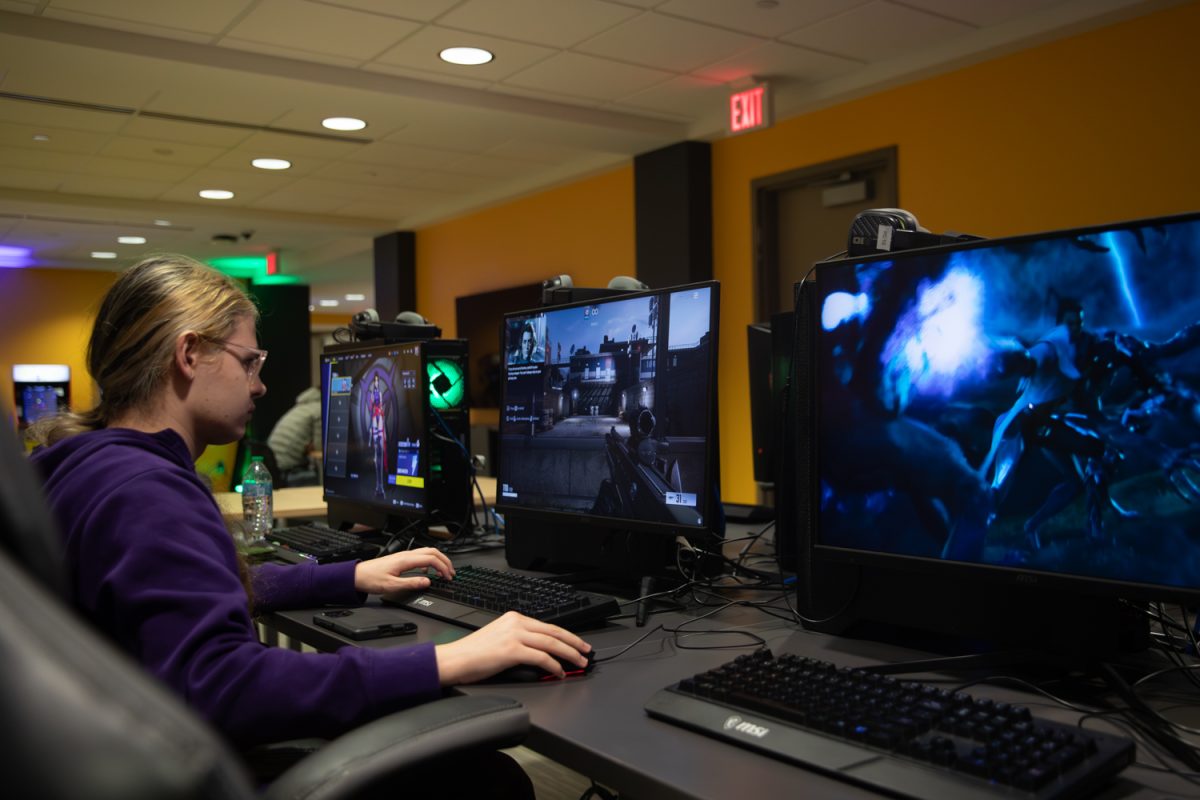
The Coralville City Council voted unanimously in its Feb. 24 meeting to approve a master development site plan for an esports arena. The project, located near Lowe’s Home Improvement and Interstate 80, will be built in two phases and will include restaurant and retail spaces.
The property is roughly 15 acres, and will consist of five buildings, including the esports arena, a storage building, and three other retail and restaurant buildings. Specifics of these restaurant and retail spaces have yet to be announced.
The cost of the project is not yet available.
Kelly Hayworth, Coralville city administrator, said phase one of the site work is scheduled to begin in summer 2026 and will focus on constructing the first three retail and restaurant buildings on the property.
“We are looking forward to the start of this project, but we don’t currently have a schedule on when the second phase will begin,” Hayworth said.
RELATED: Coralville city councilors end Flock camera contract
The approval highlights continued momentum for competitive gaming in Iowa, where high school participation has grown rapidly in recent years.
When Iowa High School Esports Association President Levi LaRue began coaching his esports team at North Tama High School four years ago, a position he still holds today, his school was the 23rd in the state to join the association. Today, more than 160 Iowa high schools participate in esports leagues statewide, LaRue said.
“This can only be a positive,” LaRue said. “Not just for the esports community in Iowa, but for the community in general.”
Like a football or basketball program, esports teams practice regularly. Students participate in warmups, scrimmages, and opponent scouting.
“I would say anything that a student gains from a traditional sport also applies to esports,” he said. “Communication is a big one, learning to talk to each other, give clear instructions, follow instructions.”
LaRue said research consistently shows that students who participate in school activities see improvements in grades and attendance. On his team, esports is a powerful motivator for students.
“Esports might be the only reason they show up to school that day,” he said. “It might be the only reason they’re working on that assignment for their English teacher because if they don’t, they don’t get to play.”
Event-specific esports arenas have already gained national attention in large cities like Las Vegas and Miami, and esport arenas can be found in midwestern states including Kansas, Illinois, Wisconsin, and Iowa, LaRue said.
Queue Esports Arena is located in Pella, Iowa, and is the only other esports arena in the state that is not affiliated with a college or university.
“It’s really cool seeing one being built,” LaRue said. “It will help legitimize esports and the work that high schools and colleges in Iowa have been doing for a number of years.”
The development will have 467 parking stalls, as required by the City of Coralville, per the size of the project. For sports facilities, the city requires one parking space for every five seats. The councilors also approved the final plat for the development, which is a detailed map of the proposed project that has information on utilities and systems in the site.
Nathan Keene is a first-year student at the University of Iowa and played esports throughout high school. While he is not playing at the collegiate level, he said accessibility has fueled the rise of competitive gaming.
“If you talk to any kid nowadays, it’s extremely likely that they have a console or personal computer that they use to play games on a consistent basis,” Keene said. “Unlike sports, video games don’t need a dedicated field or tons of expensive equipment. It’s easy to pick up your controller or mouse and play.”
Keene does not see it replacing traditional athletics, but rather creating an additional space for students to belong.
“It provides a space for people who generally are not interested in traditional sports to engage in competition,” Keene said. “It’s important for these people to have a space where they feel comfortable expressing their competitive nature and not be judged because it’s outside the norm.”