


A spontaneous donation drive that began in Iowa City has grown into a month-long effort to support Minneapolis residents affected by heightened Immigration and Customs Enforcement, or ICE, activity in their city.
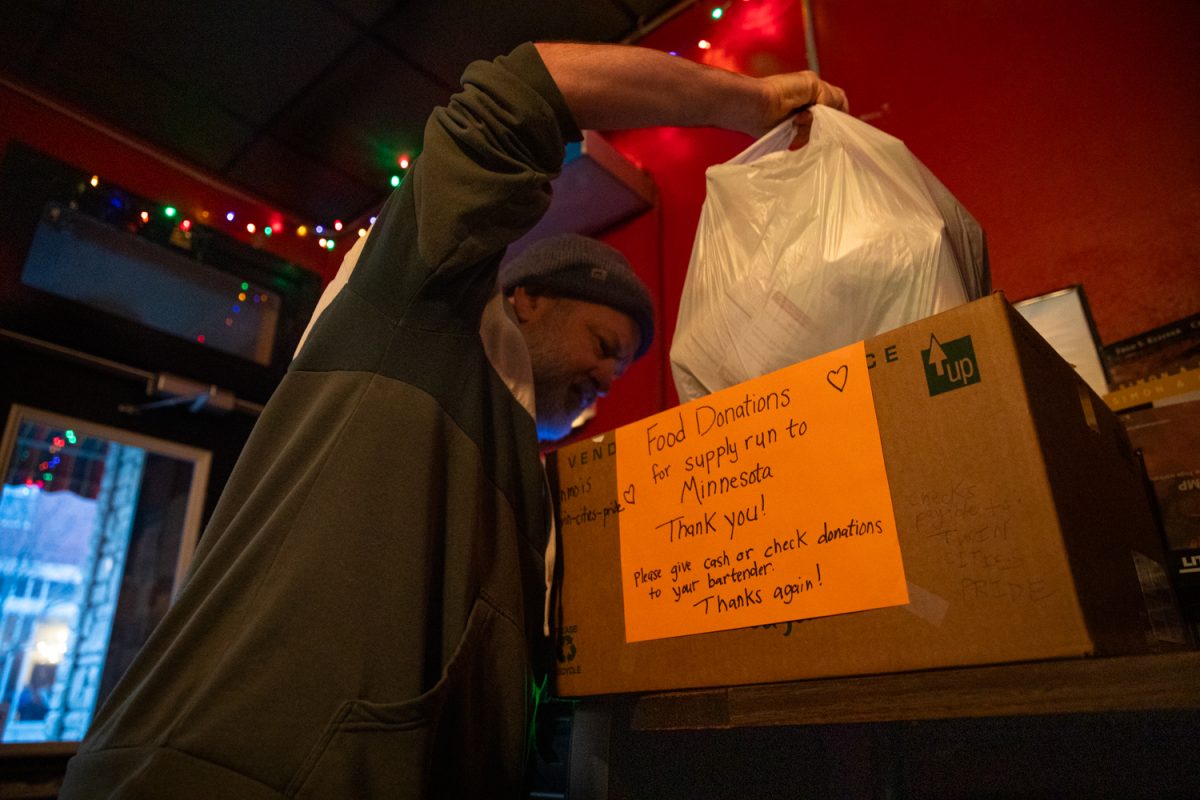
Local businesses and community members, such as Brix Cheese Shop and Wine Bar and George’s Buffet, have led the ongoing donation efforts.
The donation effort in Iowa City was sparked by Iowa City resident Charlie Morris, who said his first trip on Jan. 16 came together in a matter of hours with roughly 60 pounds of donations from the community.
“That’s how spontaneously I decided to go,” Morris said.
Morris said his motivation behind driving to Minneapolis was to understand the situation firsthand. As more people became aware and involved, the scale of the donations grew.
“We got $1,750 worth of financial donations, and enough physical donations to completely pack a Subaru Forester,” Morris said.
Donations were collected for Twin Cities Pride, an LGBTQ+ nonprofit that has shifted its purpose in the community since ICE activity began in Minneapolis.
Up until a month ago, the organization had been operating as an advocate for LGBTQ+ individuals, putting on events including a pride festival in June, a pride parade, and a 5K race. The organization hosts the largest free pride festival in Minnesota, according to their website.
“Our bread and butter has always been community belonging events, but we’ve evolved to meet what the community needs,” Kelsey Alto, the director of programming for Twin Cities Pride, said.
When ICE activity began in Minneapolis in December 2025, Twin Cities Pride began collecting food, hygiene products, diapers, baby formula, and other necessities. During the last month, the organization has been distributing these resources to the community.
“When the ICE occupation started, it was supposed to be a weekend pop-up, and that was three weeks ago. This has been our everyday since,” Alto said. “The need was just so clear, and once we started, we knew we had to keep going as long as we could sustain it.”
Twin Cities Pride plans to operate as a donation center for as long as needed. Alto said the organization prioritizes accessibility and safety; they try to stay as under the radar as possible to continue being a safe space for Minneapolis residents who utilize their services.
“We don’t collect identification or data,” Alto said. “We just ask, ‘What do you need?’ and let people take what they need.”
Alto said the organization has received support from people around Minnesota and from neighboring states.
“Being a neighbor doesn’t end at state lines,” Alto said. “It’s been really powerful to see people drive in from outside the community to help.”
On Feb. 6, George’s Buffet offered to collect and house donations in their restaurant, giving people a place to drop donations off, with Brix Wine and Cheese Shop collecting donations through Feb. 1.
“Brix had wrapped up its supply drive and asked if George’s would be willing to continue collecting supplies,” Corin Hoyer-Zeimet, a manager at George’s Buffet, said. “We said yes.”
Hoyer-Zeimet said it is difficult for her to watch what ICE is doing in Minneapolis, and said she wanted to find a way to help Minnesota.
“I feel that many people have heavy hearts with what is going on and being able to help in any way gives us hope,” Hoyer-Zeimet said. “We hope the recipients of this aid will have some relief and know that they matter and people care about them.”
Hoyer-Zeimet said George’s Buffet has collected roughly 75 pounds worth of donations, and around $700 in donations, as of Feb. 9.
“We are so lucky to live in a community like this,” Hoyer-Zeimet said. “It has been very heartwarming to see customers come in with their donations.”
Morris’s next trip to Minneapolis will be Feb. 13, where he will take the donations George’s Buffet has collected, staying to volunteer with Twin Cities Pride following the drop.
Twin Cities Pride offers a service where volunteers can drive donations directly to their houses. Morris said he has handled several deliveries to families who do not feel safe to leave their homes.
“Seeing the fear in people’s eyes was the moment it really clicked for me,” Morris said. “People were peeking out of their windows when we pulled up, and they were scared.”
Morris said the organization frequently receives calls from families who need basic necessities delivered, including food, hygiene products, and diapers.
RELATED: UI alum opens new record store in North Liberty
“Even when you have legal paperwork, you’re still rightfully afraid to go outside,” Morris said. “I’ve talked to families who haven’t left their homes in weeks and have run out of groceries.”
Morris said many families’ fear stems from the possibility of having to abandon their children. He said if a mother goes grocery shopping and gets detained by ICE, her children will be left alone with no one to take care of them.
“I really didn’t understand how it all worked until I was in Minneapolis, talking to people and being in the neighborhoods where ICE had been,” Morris said. “People are losing their jobs, they’re getting evicted, and these are people who were already living so close to the poverty line.”
Morris said the fear extends beyond individual ICE encounters and has completely reshaped how entire neighborhoods function on a day-to-day basis.
“Immigration enforcement never has to look like this,” Morris said.