


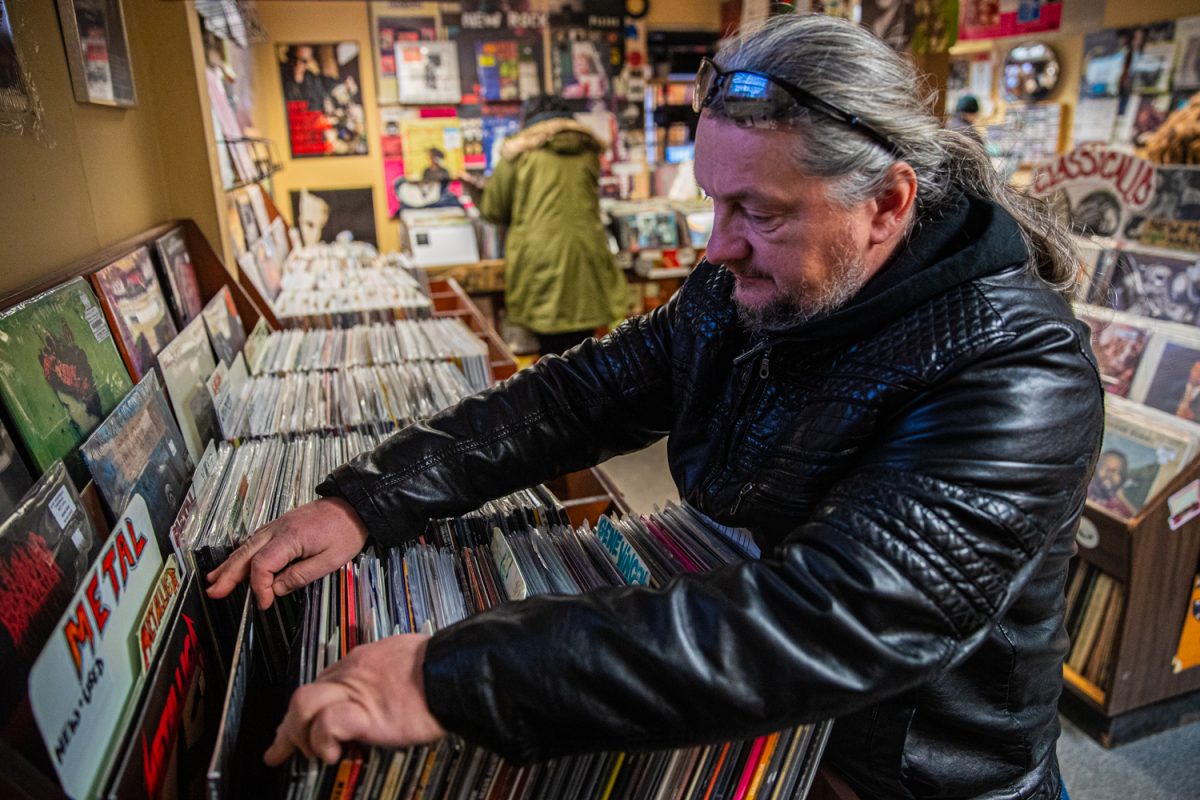
Tucked away in the back of an unmarked commercial unit off Ranshaw Way in North Liberty, Isaac Smith sat among boxes of records and CDs, combing through his collection and pricing each item.
With less than a week left, he had a laundry list of tasks to prepare for the grand opening of his record store, Zig Zog’s Records, on Feb 14.
Smith, who currently boasts a collection of what he estimates to be about 5,000 vinyl records and 1,000 CDs in his shop, has been buying and selling records for 10 years at various record shows and conventions across Iowa, but his story of collecting albums goes back to when he was 13 and received a box of records from a neighbor.
From there, Smith’s collection continued to grow, and along with collecting records, he recalled amassing collections of baseball cards, comic books, coins, and PEZ dispensers.
“I do miss having candy involved with collecting,” Smith said. “But once you start getting to that age when you start discovering music, you’re finding yourself, and it’s cool. Every phase I’ve gone through, music has always been there.”
RELATED: Local businesses lean into Gen Z’s love of nostalgia
After a decade of selling his records without a permanent location and using the funds to pay for college, it seemed like the next logical step to open his own record store after graduating from the University of Iowa in 2024. North Liberty became the perfect location for his shop due to it being conventionally located between Cedar Rapids’ Analog Vault and downtown Iowa City’s Record Collector, and the rent being more affordable than both cities.
Oscar Rodriguez, a sales associate at Record Collector, said they were excited for a new record shop to be opening up nearby, especially because record stores are becoming more of a rarity as the popularity of music streaming services like Spotify and Apple Music continue to grow, accounting for 84 percent of U.S. recorded music revenue in 2024, according to the Recording Industry Association of America.
Alongside competing against music streaming services, Rodriguez also attributes the lack of music stores in Iowa City to the rising cost of rent for businesses, with current listings on LoopNet, an online listing website for commercial properties, pricing available units at $8 to $33 per square foot per year. For one listing on South Linn Street, this means paying roughly $74,880 per year for 2,250 square feet of space, or $6,240 per month.
“I’m sure for a lot of other downtown businesses, the rising cost of rent and having to maintain a shop like this is getting to be really demanding,” Rodriguez said. “I don’t think landlords or the city realize just how tough it is to make it as a business.”
While music streaming services account for a majority of recorded music revenue, the Recording Industry Association of America also noted that revenue from vinyl sales grew 7 percent in 2024, marking its 18th consecutive year of growth, and outsold CDs for the third year in a row.
Gen Z has even decided to return to physical media like vinyl and CDs, sparking a trend on and offline, with many young people upset about music streaming services not properly paying artists and Spotify previously playing ICE recruitment ads.
While the average cost of music streaming services, which ranges from $10 to 12 a month, is cheaper than the average cost of vinyl, which ranges from $15 to $40 depending on if it’s a standard or deluxe album, Rodriguez points out that many younger people are also searching for a sense of ownership and individuality with their purchases.
“Just because you have an app or Spotify doesn’t mean you actually own the music,” Rodriguez said. “You have no right over that. I think a lot of young people now are looking to build their own individuality and have something to show for it.”
Physical media and the shops that sell them also offer a sense of community to shoppers, something Gen Z seems to be searching for amid conversations around third spaces, a term coined by sociologist Ray Oldenburg to describe public locations where one can participate in informal, often free social interactions.
“I didn’t really know anyone in high school who collected or shared that sense of going to concerts or shows, but it’s cool now,” Smith said. “It’s a very personal thing, and that’s great for conversation as someone who has trouble with conversation. It’s a good icebreaker for a lot of people.”
This was one of Smith’s favorite parts of being at Sweet Livin’ Antiques, Art, & Records in Iowa City, where he worked among a collection that Paul Young, the store’s owner, estimates to contain 35,000 LPs.
“I don’t worry about the streaming stuff because there’s something that you miss in that,” Young said. “When you get an actual record, there’s a visceral interaction — you see the pictures, you see who’s playing, you read the lyrics notes. I meet new people every day, and you don’t do that with streaming.”
Smith started working with Young shortly after moving from the Quad Cities, where he was attending community college, to Iowa City so he could finish school at the UI. Young said he’s going to miss working with Smith, whom he often had to remind to take breaks while working.
“I would say, without him, I probably wouldn’t be doing this,” Smith said. “It was a bit of a pipe dream in high school, but as of now, it is a reality.”
In a full circle moment, Smith decided to name his shop after the first short film he ever created during his time in school, Zig Zog’s, closing one era and opening a new one. The shop, whose collection includes records that span across the decades, is set to open Feb. 7 and will be open to all Tuesdays through Saturdays from 11 a.m. to 5 p.m.
“This is something I have wanted to try since I was a kid,” Smith said. “I’ll be proud when it opens.”