


The University of Iowa is piloting a new course, Artificial Intelligence Fundamentals, serving as the required introductory course for the undergraduate certificate in AI that will launch in fall 2026.
According to the UI’s Office of the Registrar, the certificate requires students to enroll in the introductory course and four to six elective courses.
For the fundamentals course, students will be introduced to basic AI concepts and gain experience with using AI tools such as ChatGPT, image generation, and video generation, Ali Hasan, associate professor and department chair of philosophy, said.
“They’ll actually get some hands-on experience using these tools,” Hasan said. “The idea is to have them practice using these tools and learn what’s possible and learn how to effectively use them.”
The fundamentals course is open to any student of any major.
Tyler Bell, associate professor of electrical and computer engineering at the UI, is teaching the fundamentals course and said students all have their own reasons for pursuing a certificate in AI.
RELATED: New AI certificate program to be introduced in fall 2026
“We want to equip the students with ways to think about these technologies for their future careers, future lives, and fully acknowledge that AI is still accelerating and still growing and changing day to day,” Bell said.
The fundamentals class, Bell said, has a full enrollment of 60 students and a waitlist.
“I think there’s enough to show that people are interested and excited to learn and explore with these technologies,” Bell said.
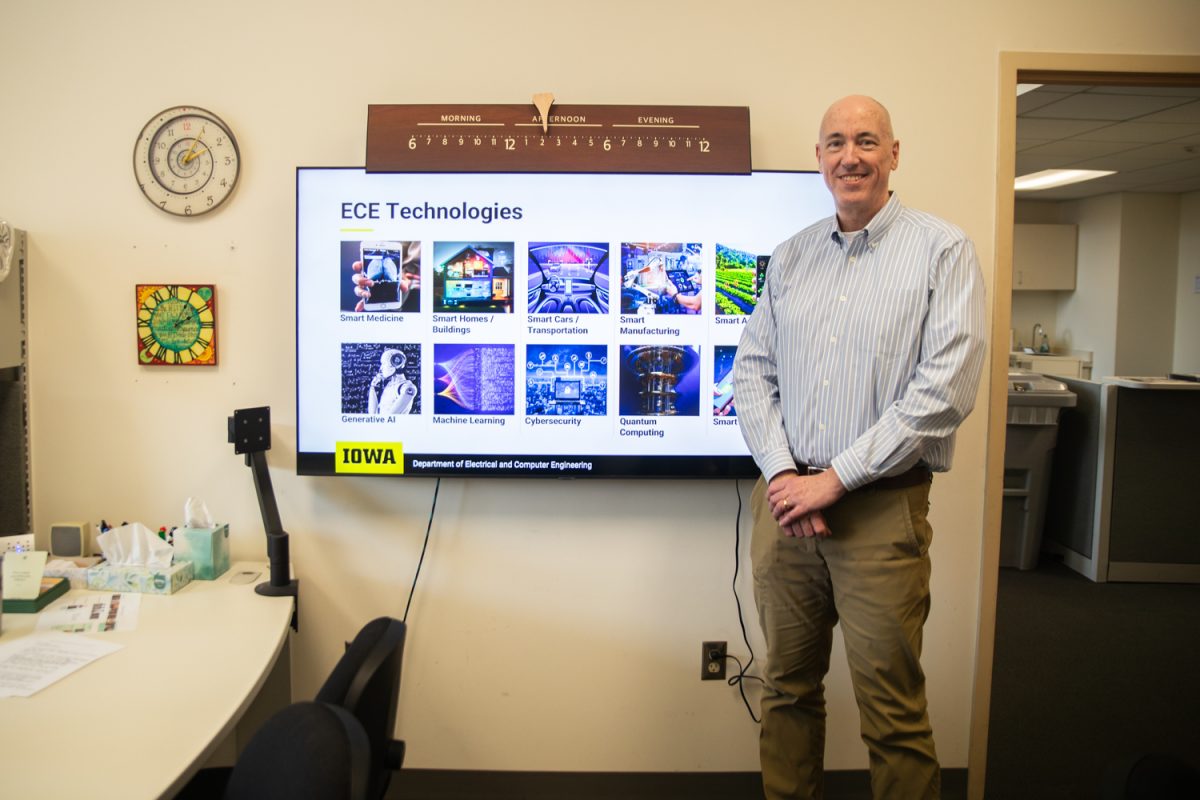
Within the UI Department of Electrical and Computer Engineering, the existing minor also gives students an engineering-based understanding of AI.
According to the College of Engineering, the AI minor — Artificial Intelligence: Theory, Methods, and Applications — allows students to gain skills to analyze, design, and integrate AI into devices, robotics, finance, health care, agriculture, transportation, and other systems.
Gary Christensen, professor of electrical and computer engineering, said the minor is accessible to any student regardless of major.
“If you’re in business, you might have a business analytics AI course, and so that can count towards the AI minor,” Christensen said. “We really try to open it up. It’s kind of suited to your interest. Like it’s self-selecting what you want to learn in AI, and we’re continuously updating our courses.”
The increased usage of AI in different courses comes with concerns about over-reliance on the technology and the minimization of self-learning skills.
“We want students to be learning how to use these tools, but also think, ‘OK, what are some of the ethical risks in using these tools?’” Hasan said. “Ethical risks not just with the tools that they’re using but thinking more broadly about AI tools.”
Christensen said AI is expanding rapidly, and computer engineering students should also understand how to generate code themselves in classes.
“It’s a great teaching tool,” Christensen said. “But it can also be used in a generative type of way that generates code, and you don’t know what’s going on. So we’re trying to balance this line about teaching people how to be more efficient using generative AI, but not trusting it.”
Hasan said students with different majors in the fundamentals course can apply the technology to their discipline responsibly while understanding any ethical concerns.
“Some of them are studying medicine, or business analytics, or computer science, or journalism,” Hasan said. “And they are going to be thinking about ‘OK, how does AI intersect with my field?’ And hopefully if they’re working on the certificate, they’ll go on to take other courses that specialize in those particular disciplines.”