


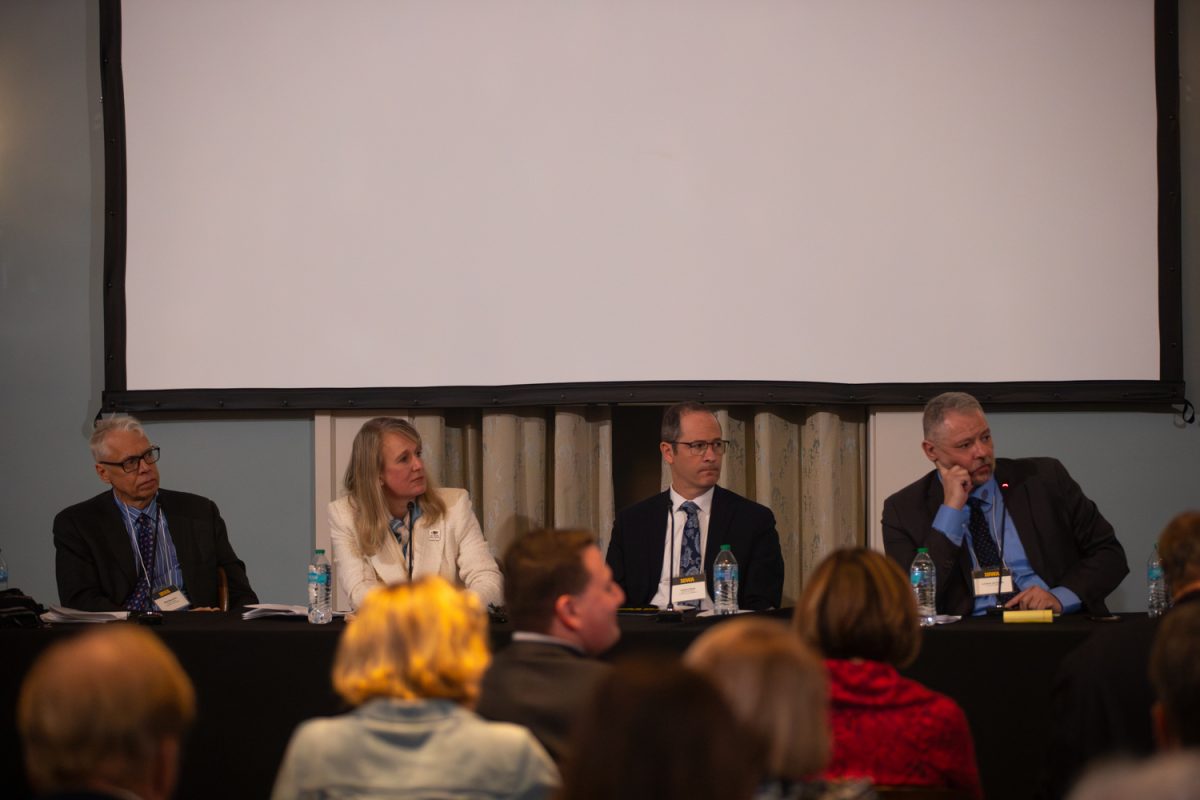
The University of Iowa’s Center For Intellectual Freedom hosted its inaugural event at the Old Capital Museum, hosting panels with several speakers, including Iowa Gov. Kim Reynolds and former Iowa Board of Regents member David Barker, now Assistant Secretary for the Department of Education, with UI President Barbara Wilson not in attendance.
The center will begin offering classes to students in the spring.
Luciano de Castro, interim director of the center and author of the center’s bylaws, thanked attendees for coming, and asked that the audience remain respectful to panelists. Castro said the opening of the center felt like a new life was entering the world.
“Let me be very clear, it’s not my baby, it’s not the baby of any single person in this room,” he said. “This center is the child of the people of Iowa.”
The center was formed after House File 437 was signed into law in April, which states that the center will teach classes pertaining to historical ideas, traditions, and texts and will “work to expand the intellectual diversity of the university’s academic community.”
The event took place from Dec. 5-6, consisting of several panels hosting professors and administrators from universities around the country. The panels covered topics about the center and what it intends to address, including: “What is wrong with universities?”, “Can universities be reformed?”, and “Possible actions and next steps.”
Both Barker and Reynolds thanked attendees and expressed excitement for the future of the center.
“With the launch of the Center for Intellectual Freedom, we aren’t just creating another academic initiative,” Reynolds said. “Instead, we’re laying the foundation for a new generation of Americans who are knowledgeable about the history of the country, appreciative of its values and traditions, and above all, committed to its legacy of freedom.”
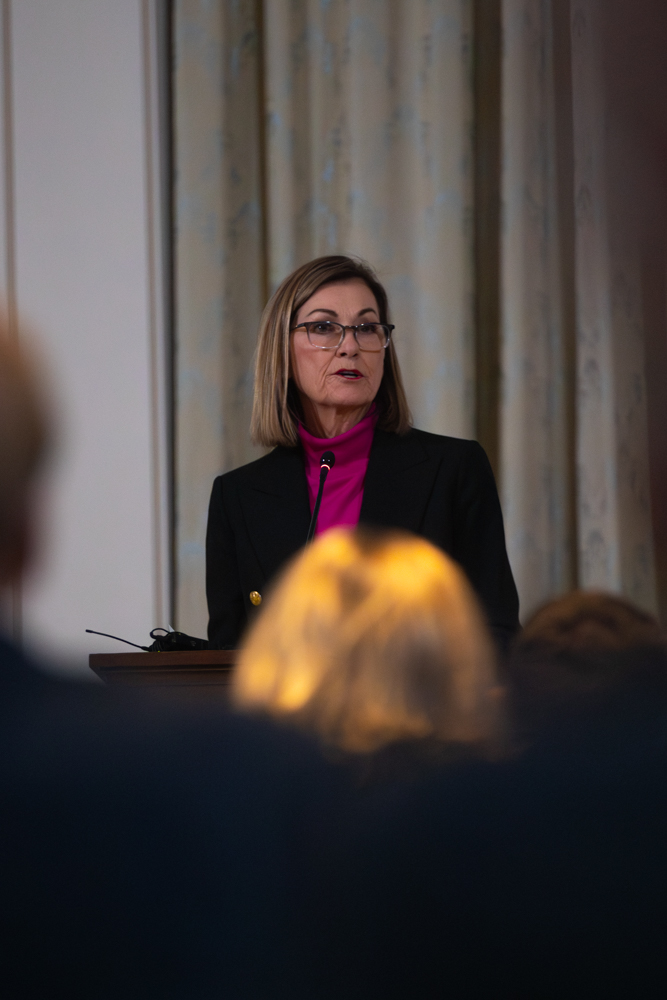
Reynolds said she believed the center would have a positive impact nationwide and said the most important thing to do for Iowa is to empower young people to thrive.
Reynolds also said civic education is “paramount” to future success, and that in recent years, the state has “witnessed what happens without it.”
“Here and now, we’re charging a new path forward,” she said. “I am confident that the University of Iowa and the Board of Regents will stand firmly behind this work and the promise it holds for our students and our state.”
Barker shared similar sentiments to Reynolds about the center, calling it a “model for the country.” Barker said the center is an example of what happens when “an American university takes seriously its highest calling to pursue the truth without intimidation, without exclusion, and without apology.”
Barker thanked several lawmakers for their involvement in the center and higher education bills in general. Barker also thanked de Castro for his “vision” for the center and said the vision had excelled in the last year.
“I think it will be a beacon of sanity in a crazy academic world,” he said. “The Trump administration believes that intellectual diversity is not a partisan aspiration. It is a civic necessity.”
Christopher Rufo, a keynote speaker at the event and conservative activist, writer, filmmaker, and Senior Fellow at the Manhattan Institute. spoke about the center and his relationship with fellow conservative activist, Charlie Kirk, who was killed at an event on Utah Valley University’s campus earlier this year.
“I think what it really demonstrated in the most horrific way possible is that conservative speech has been so forbidden from American campuses,” he said. “It’s such a threat to the dominance of these institutions that feel like they are entitled to have a left-wing orthodoxy and nothing else is accepted, that the only way to confront conservative ideas is with the barrel of a gun.”
Rufo prompted lawmakers to use their power and authority to step in, and gave several examples of action taken by other states where governments took action with academic institutions. He also thanked the lawmakers in the room, and said that what they were doing, beyond the center, was incredibly important.
“This is a problem that our society doesn’t know what it’s supposed to be, doesn’t know what it’s supposed to teach our young people, and hasn’t given them those foundations where they feel like they can live a good and productive life,” he said.
Rufo commented on the fact that neither UI President Barbara Wilson nor the university’s provost were in attendance at the event and asked what could be more important than “the beginning of an academic research institution that was commissioned by the legislature that has the really highest aspiration of the university at its core?” Wilson told The Daily Iowan in an interview in November that the university is supportive of the center’s opening, but that the center is not something they are currently directly involved.