


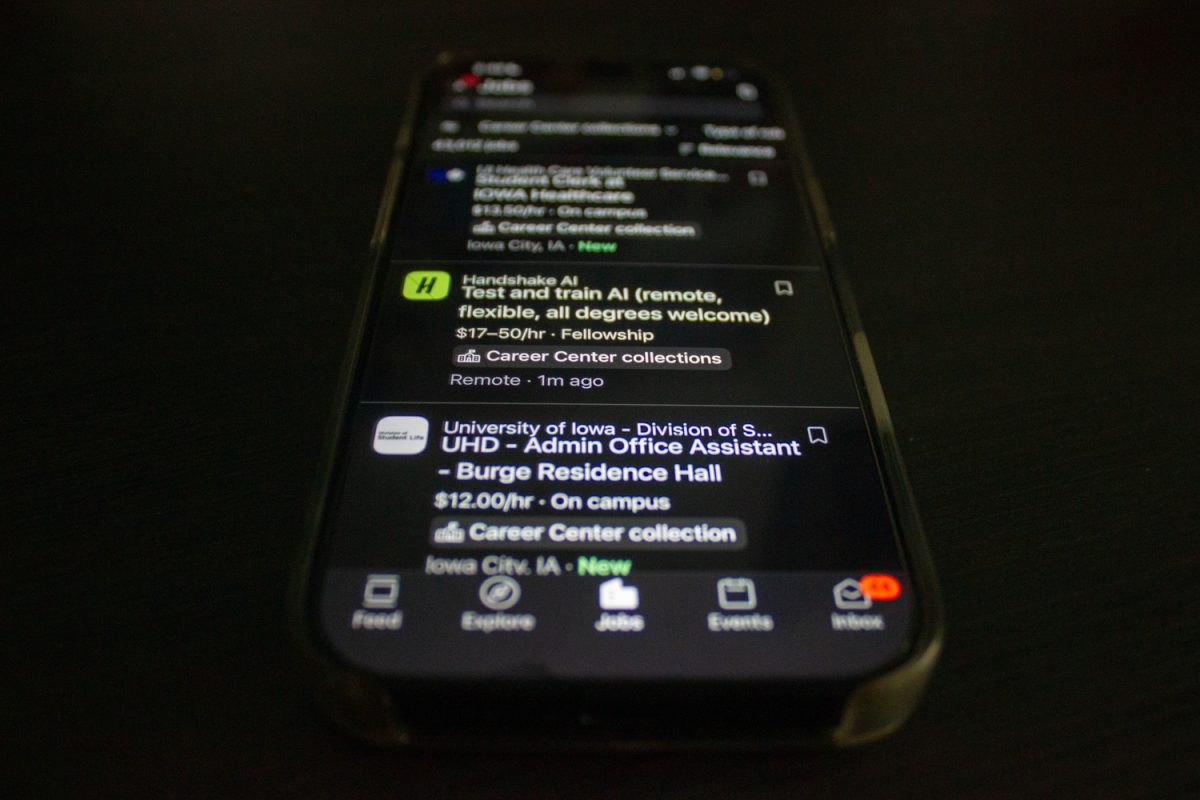
Finding a job in college was a completely new experience for me, as I had never applied in a formal setting before. As I was about to start my first year of college, I began researching various websites to secure a job as soon as I arrived on campus. The website I used the most was Handshake.
I’m assuming that most college students are familiar with Handshake, as it is widely recommended for finding nearby job opportunities. But it is not as reliable as its reputation claims.
I first learned about Handshake when my mother recommended it to me. She found it was constantly recommended for students at the University of Iowa. I started applying for jobs at least a month before I arrived on campus and mostly targeted positions offered by the UI.
By the time I moved into my dorm in mid-August, I had applied for approximately 15 positions. Although there was a common theme among most of the jobs, some were quite basic, such as selling merchandise at football games.
I noticed most of these positions didn’t reach out until weeks after the application deadline. Some simply informed me they had chosen another candidate, while others never contacted me at all. The only indication I had was the big red “Rejected” notification in my application status.
I struggled to understand what I was missing. I even tried applying for simpler jobs. In the end, I submitted applications to 25 jobs on Handshake. Many of them rejected me in the same way, or I never received any response at all.
I was surprised to discover I wasn’t alone in this issue. When bringing this up with my classmates, I found many of them echoed my frustrations; they, too, had been navigating the challenges of Handshake. As we shared our experiences, it became clear that the longer we were left without responses, the more difficult the job search became. The urgency began to mount as positions filled up quickly, leaving us feeling as though we were falling further behind.
My first realization of the difficulties students were experiencing with job searching occurred during a career fair held at the beginning of the semester. I approached the table hosted by the Career Advising team at the Pomerantz Center and asked why Handshake wasn’t effective for me in finding available positions.
To my disappointment, they simply advised me to keep trying, as Handshake was their primary recommendation. Unsatisfied with this vague response, I decided to consult a career peer advisor for more insight.
Isabella Nelson, a career peer advisor at the Pomerantz Career Center, explained how many students face challenges with Handshake due to applying too many filters.
“My solution is to stay flexible and to only add one to two of your most important filters when searching to fix this problem,” she said.
Nelson said LinkedIn is a great resource for job postings and networking.
“You could also always reach out to teachers, staff, or other professionals who are in fields of interest; they may know potential leads,” Nelson said.
Despite the challenges students face with Handshake, it’s crucial to recognize there are other resources available.
Platforms like LinkedIn serve as excellent alternatives for job searches, especially for incoming students. The Career Peer Advising Program in the Pomerantz Career Center is filled with individuals eager to assist students.
While the reasons behind Handshake’s inefficacy remain unclear, we are fortunate to have a wealth of supportive resources throughout campus.