


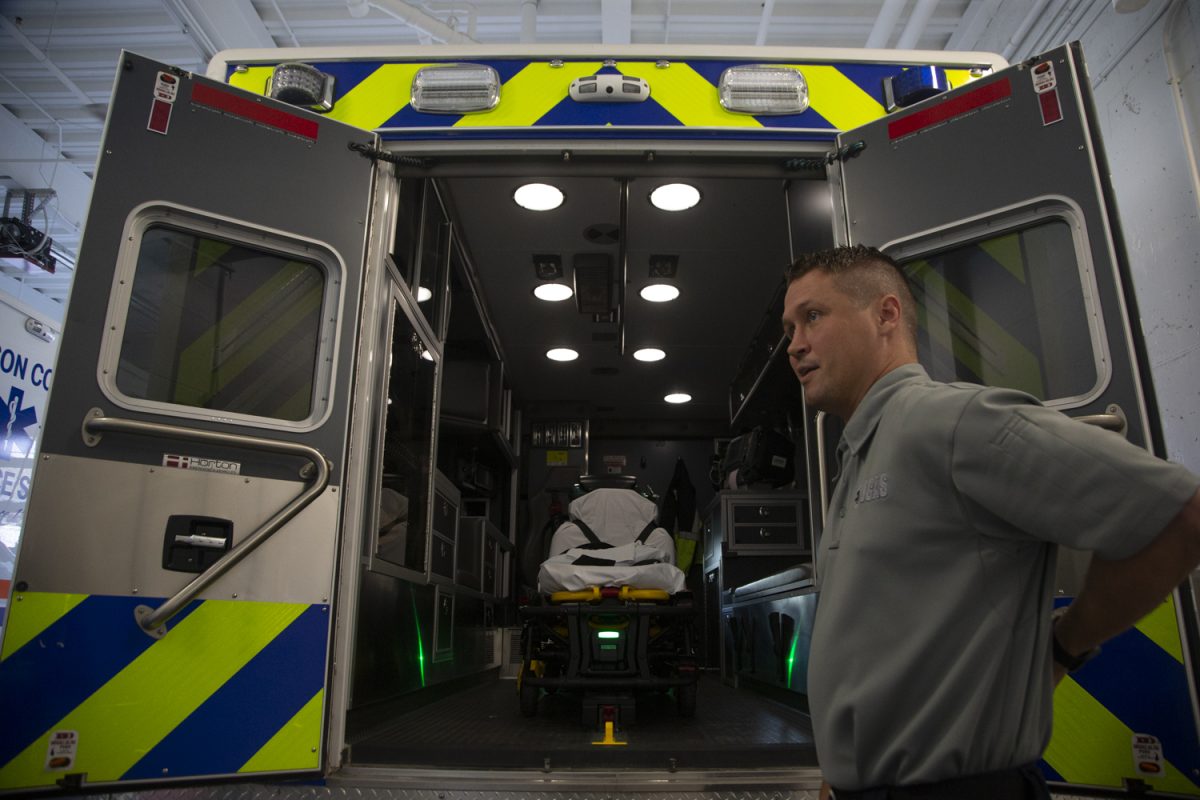
When every second counts, the Iowa City Fire Department, or ICFD, and the Johnson County Ambulance Service, or JCAS, expanded the departmental partnership to improve response times within the city and are teaming up to help get to residents faster, especially on the west side of town.
This partnership with JCAS has allowed ICFD to maintain its standard basic-level EMS response while giving advanced life support crews a chance to reach patients faster.
The partnership launched in late September, and both departments have reported a strong start.
A long-running partnership is spreading life support units across Johnson County, cutting travel times and boosting emergency care. As of 2023, the average ambulance response time sits at 10 minutes and 24 seconds, according to Johnson County’s annual EMS report. 2025 response times have not yet been released.
Battalion Chief Zach Hickman said ICFD has always had a tiered response with JCAS, meaning the fire department provides basic-level EMS care while Johnson County Ambulance handles advanced life support and patient transport. This system ensures the right level of care reaches patients as quickly as possible.
“We obviously want our citizens to be able to get the quickest, best medical care that they can,” Hickman said. “But the reality of it is, the fire department is still coming. We’re still coming and still providing our basic level of EMS care. What has gotten better with this move is the advanced level of EMS care that Johnson County Ambulance provides by being spread out more throughout the county.”
The ongoing partnership between ICFD and Johnson County predates Assistant Director Ben Symonds’ time at JCAS.
Symonds said being able to continue to disperse response areas has been very helpful when it comes to improving response times.
“Just as you’re getting up into going down Melrose, it can be a little bit more difficult. Then you factor in the crowd on that side during Iowa home football games,” he said. “I do believe it is immensely helpful to have our response area dispersed like that.”
RELATED: Iowa City Fire Department installs new alert system for road safety
Symonds said because Iowa City is so diverse in its residents, with families and college students in the same areas, and call types, from fire alarms to medical service, it is most beneficial for ambulances to serve a wide area.
“I think it’s best to help us address the challenge of getting there, timely,” he said, “But it’s always going to be continuing to grow with the service to meet the best interest of the constituents.”
Dre Wilz, a paramedic field operations supervisor, said the additional truck is running about three calls a day.
“Every day that there are calls that are being paged out, that are being handled by that additional truck of staffing that’s been moved out there geographically,” Wilz said. “So we’re seeing that the utilization is present.”
In 2017, when the ambulance service rebuilt its main downtown station, it temporarily moved one of its ambulances into Fire Station 4 at City Hall. After the new station was completed, they decided to keep the ambulance there because the location proved valuable for serving the northside of the city.
Hickman said ICFD already provides basic levels of emergency medical service. However, they do not transport or provide advanced life support services, or ALS, leaving the responsibility to the Johnson County Ambulance Service.
“What this does is get an ALS unit to get to the scene quicker, and a transport unit to the scene quicker,” he said. “It’s really beneficial to the citizens that Johnson County Ambulance can take their ambulances from just being based out of one building in the middle of the city to spread them out.”
Symonds was able to work with Iowa City Fire Chief Scott Lyon to ensure the new ambulance would be mutually beneficial to everyone involved in the process, including citizens.
“We will always look to expand when opportunities arise,” he said.
Wilz said that Johnson County ambulance services track statistics about calls, like where they are coming from, to help them decide where to place trucks and how to staff certain locations. He added that the services are always looking for the best way to optimize to the best of their ability.
“We’ve kind of redesigned the response map to where now the crews will have a quicker response time when they’re responding to calls that are in that specific region of Iowa City,” he said.