


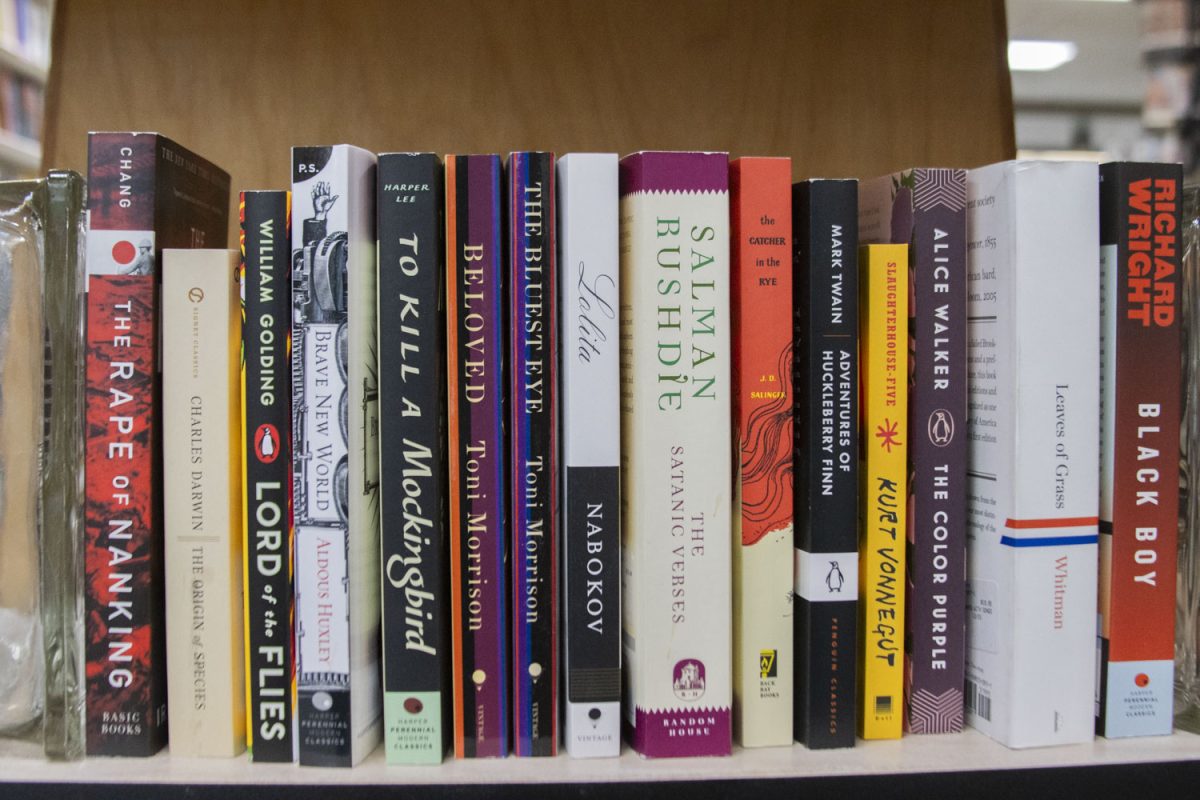
The 2024-2025 school year marked a sharp decline in book bans from the 2023-2024 school year, according to a report from PEN America, but Iowa City residents still believe Iowa’s rank as the state with the fifth highest book ban rate is concerning.
PEN America, a nonprofit that advocates for free speech, published a report on Oct. 1 that found Iowa banned a total of 113 books throughout the year, compared to 3,761 in the 2023-2024 school year.
Pressure from Senate File 496, an Iowa law that banned books that depict sex acts and requiring all materials to be “age appropriate” along with instruction about sexual orientation and gender identity in grades K–6 could be the fuel behind these numbers.
Tim Budd has worked at Prairie Lights for nearly 30 years and said when he was growing up in Iowa, the state valued education. To Budd, the PEN report shows a divergence of those values.
“Thank you, Kim Reynolds,” he said. “Iowa is number two in the nation for cancer, but we’re not too concerned about that. It’s more important that people don’t read. I don’t understand it.”
Sam Helmick, community and access services coordinator for the Iowa City Library, said the state of Iowa has core values rooted in reading.
According to the State Library of Iowa, Iowa saw more than 12.6 million visits to public libraries throughout 2024, an increase of 6.2 percent from fiscal year 2023.
Helmick said the PEN report shows how far afield Iowa has come from its core values as a state.
“We’re trying to reconcile as a country right now, particularly in the state of Iowa, whether we want to teach our children what to think versus how to think,” Helmick said.
Helmick was also the president of the Iowa Library Association, a professional organization for Iowa’s librarians and library workers, when the association helped sue Iowa Gov. Kim Reynolds and put an injunction on SF496 in December 2023.
The injunction was renewed in February 2025.
“The books belong on the shelves because they haven’t had their day in court,” Helmick said. “And the chilling effect, which is a form of censorship, I think [the Senate file] probably scared a lot of administrators and school boards into removing the books despite the injunction.”
Budd said book banning has never been a valid way to diminish the influence of authors, noting books considered classics such as Catcher in the Rye and Bluest Eye were banned during their publications.
“The books that they are banning just make kids want to read them more, because there must be something really, something in there my parents see, which makes it more attractive to them,” he said. “Those books are going to be the classics of tomorrow.”
Budd said while it is important to keep access to books age appropriate for younger audiences, there isn’t a need for the state to get involved.
RELATED: Iowa libraries bring awareness of banned books amid recent funding cuts
“I think everyone in those schools or libraries is very cautious about that and responsible but for some reason that’s not enough,” he said. “I’m encouraged, because I think [the bannings ]will eventually get better.”
Mitch Gross, principal at Iowa City West High School, where three students started a banned book club after SF 496 was first put into effect during the 2024 school year.
“I think those students are the epitome of a West High student,” he said. “They have some concerns and are curious about what it says when a government starts banning books and the consequences those intended and unintended are, and we encourage students to be intellectually curious.”
Gross said while SF 496 has given the issue more attention, banned books have always been a source of conversation among community members.
“It’s not a recent phenomenon,” he said. “We’ve been having banned book weeks in our library for many, many years, because it’s been a societal issue for many, many years.”
Gross said the majority of texts the school removed after SF 496 were being taught in literature circles and optional readings, not required texts within the curriculum.
“No educator is teaching a text because it has sex scenes in it,” he said. “There are pieces of literature or pieces of writing that have sexual situations in them that are taught, but that’s not the purpose for why they are taught.”
With the implementation of most of the law being halted, Budd hopes that in the meantime, local libraries don’t cave in and ban books out of fear.
“I would just hate for somebody to miss out on a great piece of literature because there’s a sex scene on page 64,” he said. “It just seems sad.”
Helmick said now marks a time when Iowa will decide to live up to its values of caring for libraries or abandoning them.
“This is a community’s library, and we trust our neighbors and each other to make those choices for the individual and the family,” she said. “And libraries are serving the community and will impact their thoughts about intellectual freedom and the pursuit of information.”