


University of Iowa researchers are facing uncertainty amid the Trump administration’s call for cutting NASA’s budget by approximately 24 percent for the 2026 fiscal year proposed in May, decreasing the agency’s budget from around $24.8 billion to $18.8 billion.
NASA may face cuts to its science programs, exploration projects, and research funding depending on the final budget agreement after this year’s lengthy government shutdown.
NASA’s space science research funding would face the steepest cuts of all, a 47 percent cut according to the proposed budget.
UI researchers such as Jacob Payne, a graduate student and research assistant at the UI’s Department of Physics and Astronomy, said the uncertainty over NASA’s budget cuts puts UI projects at risk of being discontinued from a lack of funds.
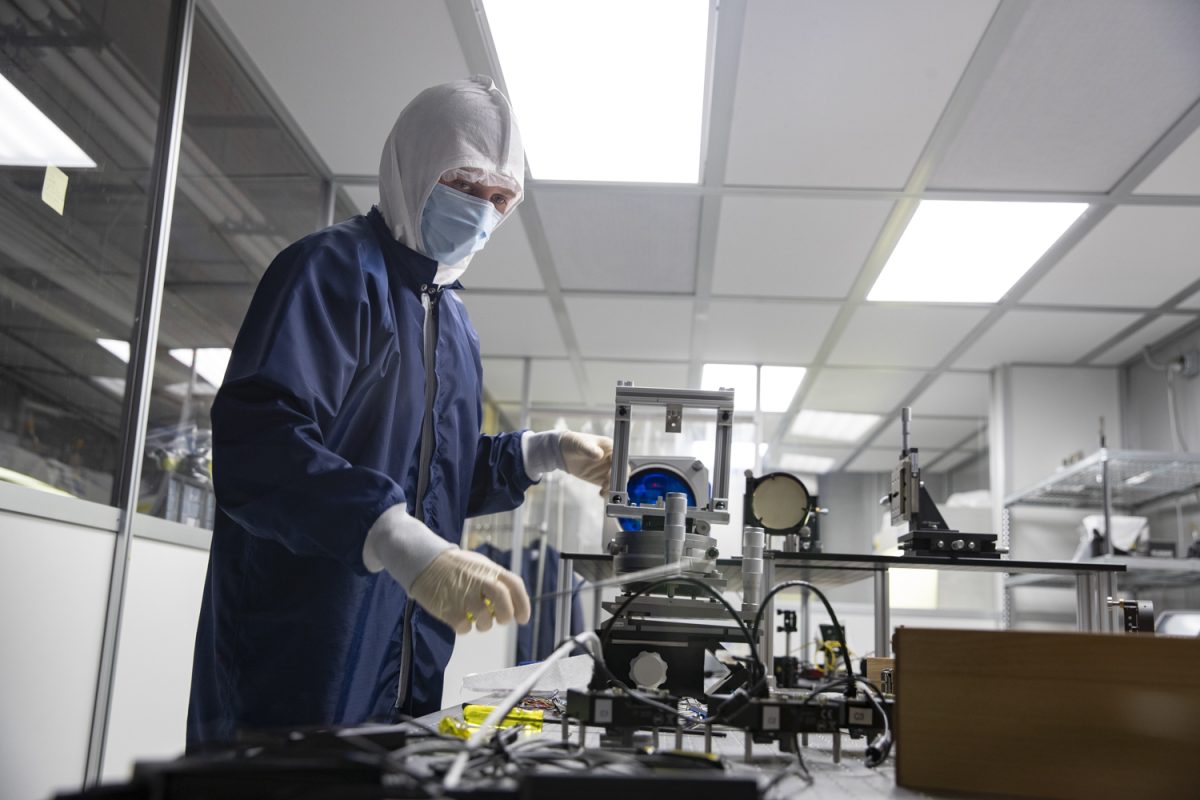
Payne received a three year, $150,000 grant over the summer from the Future Investigators in NASA Earth and Space Science and Technology, or FINESST program to build a lightweight prototype of an X-ray telescope that can assist with deep space navigation.
Payne said it’s unclear what university research projects across the nation may be affected.
Payne’s prototype is funded through the agency’s planetary science, Earth science and astrophysics research funding, making up NASA’s Science Mission Directorate, which is set to see $6 billion in cuts.
“All of those are areas that could be cut back to focus on missions to the Moon or Mars,” Payne said. “This is a project that can contribute to space flight and exploration of the solar system using timing signals as part of a natural GPS system so my hope is that this project is seen as applicable and valuable.”
The proposed telescope will be a more compactible version of the Neutron star Interior Composition Explorer, or, NICER telescope, operating on the International Space Station Since 2017.
2025 marked the third year Payne applied for the FINESST fellowship. Barring any changes to funding, Payne will begin on the project Jan. 1, 2026.
Casey DeRoo, associate professor in physics and astronomy at the UI, said there isn’t one flat proposal for NASA’s future budget. DeRoo said the different budget proposals make it hard for many researchers to predict if their projects will continue to be funded.
“There are other budgets that have been passed by the House and Senate that keep NASA’s funding essentially flat,” he said. “The House Budget is flat with still realizing a 20 percent cut to science, and so all of those different scenarios make it really hard to know how to proceed doing the science that we do.”
DeRoo has colleagues involved in the Maven mission, a spacecraft orbiting Mars tasked with studying the loss of its atmospheric gases, and the Juno mission, a spacecraft sent to explore Jupiter.
DeRoo said such missions take a long time to see results, but many are already deep into the mission’s progress.
“I don’t think ending them now makes a lot of sense,” he said. “I don’t think it maximizes the return on investment for taxpayers that they’ve already made for this investment. Infrastructure wise, it’s like the equivalent of building a bridge and then closing it after 10 years and not letting anyone drive on it.”
DeRoo said the Trump administration’s proposal puts the future workforce at a disadvantage. DeRoo said much of NASA’s research budgeting goes toward student training and especially training graduate students to acquire the technical skills required to enter the space workforce.
“The single highest cost right of any research proposal or even NASA mission is not hardware, it’s the people,” he said. “You can’t divorce science from the people that animate it.”
DeRoo cited a 2024 study published in the Federal Reserve Bank of Dallas finding that nondefense Research and Development, or R&D, like national research started by NASA, found an economic return on investment of 140 to 210 percent.
Andrew Fieldhouse, one of authors on the study, said due to this return on investment, rates of non-defense R&D are high enough to the point that they pay for themselves.
“If you generate more economic growth because of innovation from R&D, you end up collecting more tax revenue because of that,” he said. “So I think cutting R&D in particular is a very short sighted approach to fiscal consolidation.”
Fieldhouse said while cuts to NASA research would slow economic growth, those trends could take seven to eight years to emerge.
“Unfortunately the benefits of R&D take a long time to materialize, longer than our four year electoral cycles,” he said. “That could be why R&D is often one of the early things on the chopping block. The federal budget is a slow ship to turn.”