


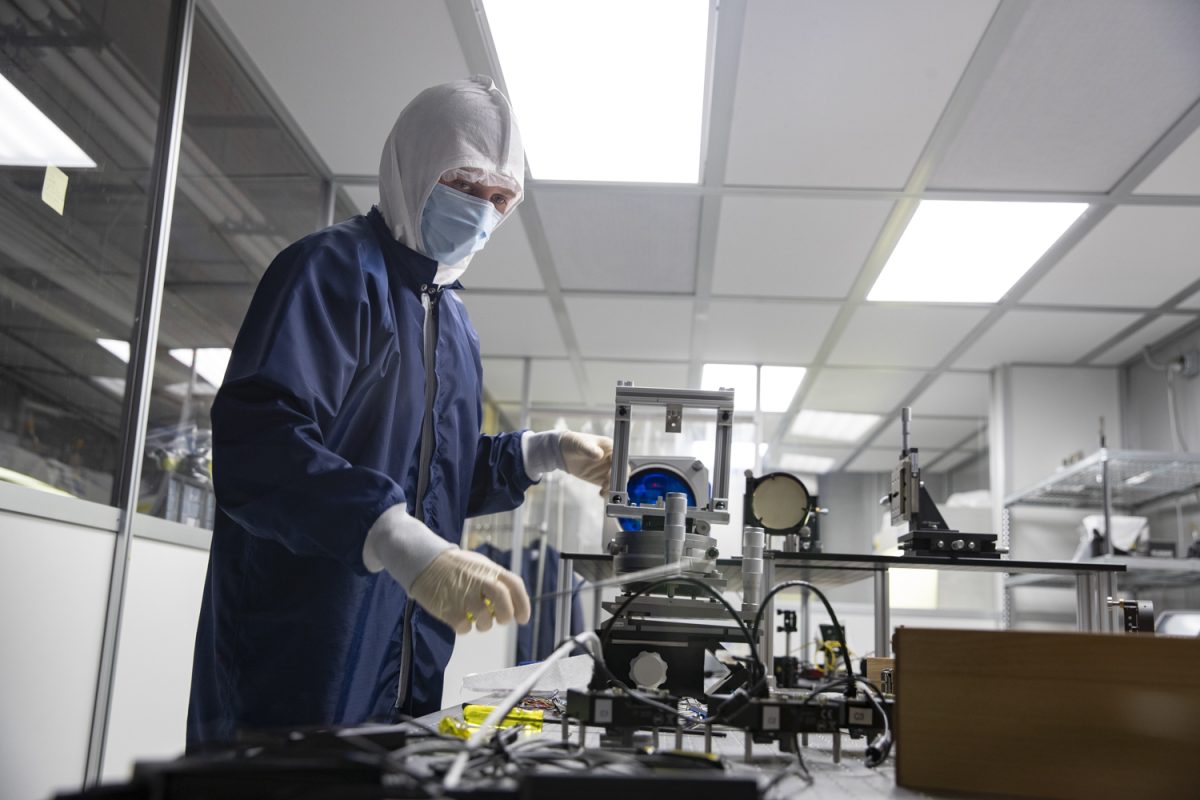
Jacob Payne, a graduate student and research assistant at the University of Iowa’s Department of Physics and Astronomy, landed a NASA grant to build a small X-ray telescope that can assist with deep space navigation.
Neutron Star Interior Composition Explorer, or NICER, launched in 2017, is an X-ray telescope aboard the International Space Station that studies neutron stars, black holes, and other cosmic phenomena.
For this three-year project, Payne will receive $50,000 a year for from NASA to design and create a lightweight prototype
This interview has been edited for length and clarity.
The Daily Iowan: What’s your background in space science? How did you get into this kind of research?
Jacob Payne: I went to school at Georgia Tech, and there, my undergraduate academic advisor encouraged me to apply for their continuing master’s program. I got into a master’s program at that time [at Georgia Tech], but I had to pick something that sounded science-y as a master’s thesis topic. So, I was just looking at cool space news. There had been a new telescope launched in 2017, and they were reporting some results from that, and they were showing, in particular, a cool experiment where they demonstrated a new kind of navigation. So I was like, whoa, this seems really cool, and it sounds very science-y to do something related to interplanetary navigation using X-ray emission from pulsars. So, I picked that as a topic.
Explain what you’re building to me as if I was a 5-year-old.
GPS uses satellites to tell you where you are. You use these reference signals from satellites, and that works when you’re on Earth. But if you want to fly to Jupiter or Saturn, you need a different kind of
tracking system.
There is a kind of star that blinks or pulses very consistently, called a pulsar. We can use those like a natural reference point or a natural GPS satellite.
If we can see them, we have to be able to see them very clearly. That’s the problem right now. They’re out there, they’re blinking, but we can’t see them very well.
So, I’m working on a telescope where I can see specifically the pulses we want to see very clearly. We’re working on choosing the right kinds of mirrors and the right coating to make them shiny and reflect specifically the light emitted from these stars, but not the light emitted by other sources, so that only the stars show up
very clearly.
Hopefully that means we can build a small and efficient telescope for this so it could be used by spacecraft, and it doesn’t take up too much room.
How will this technology change how we navigate space?
The 2017 demonstration of pulse navigation showed that we can do radio ranging out past Jupiter, but the radio ranging gets less accurate the farther you are from Earth. Pulsar navigation is the same level of accuracy throughout the entire solar system. So we could have a consistent position estimate anywhere in the solar system or even interplanetary space.
Where do you see yourself in 10 years after working on this project?
When I showed up, I was sure that I wanted to go be an engineer and work for a company that was working on spacecraft, but now I kind of think I need to work on this project full-time.
Three years of funding will get a prototype, but then we have to work on the actual hardware. It feels like the path I can see most clearly is trying to start a lab at a university to do that.
Right now, my goal is to be a professor or research faculty to continue working on turning these into actual [tools] on future missions.