


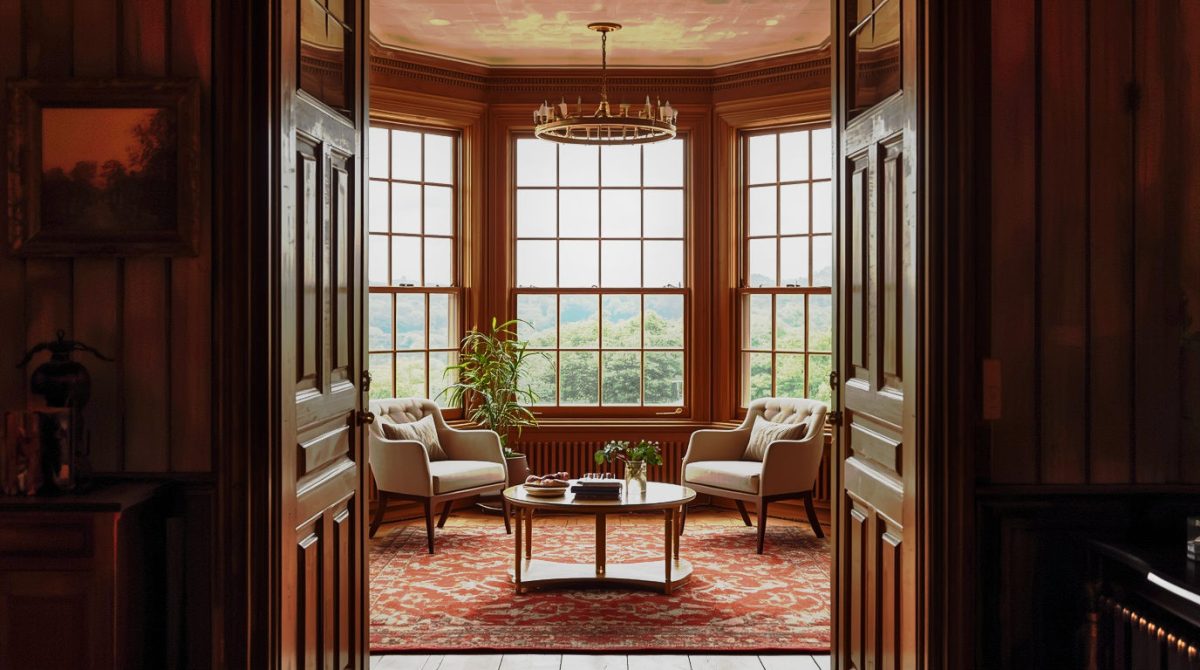
Ask someone outside the Midwest to name a state with a serious design culture, and Iowa won’t be the first answer (probably not the tenth, either). Cornfields, caucuses, a football program: those come up first. Furniture fairs and internationally recognized architecture usually don’t. But spend any time around the Iowa’s buildings, and a different story starts to take shape.
For a fresh-faced design enthusiast from Iowa, getting one of their own pieces of furniture in front of the most important names in the design industry, be it Edra or Herman Miller, can feel like an unreachable dream. Yet this has happened year after year, with young designers exhibiting their work in the same spaces where the world’s best designers show up every season, from Milan’s Salone del Mobile to New York’s ICFF.
What America’s Most Famous Architect Left Behind in Iowa: Two Houses Worth Seeing in Person
Long before any of this, Frank Lloyd Wright was already treating Iowa as a testing ground. Between 1908 and 1957, the most famous American architect designed eleven buildings across the state: more than in most Midwestern states outside his home turf. Most are private homes, closed to visitors: the Meier residence in Monona, the Miller residence in Charles City, the Grant residence in Cedar Rapids, the Alsop and Lamberson residences in Oskaloosa, the Sunday residence in Marshalltown, the Trier residence in Johnston, and the old City National Bank and Park Inn Hotel in Mason City. Two, though, reward an actual visit rather than a photo search:
Stockman House, Mason City (1908). Wright’s earliest built version of what he called the “Fireproof House for $5000,” a plan published the year before in Ladies’ Home Journal with the explicit goal of proving good design didn’t require a fortune. The open floor plan wraps around a single central chimney, with ribbons of windows blurring the line between living room and yard: early signatures of the Prairie School style. It’s now a museum, furnished with period Arts and Crafts pieces (several by Gustav Stickley) alongside a handful of original and reproduction Wright designs, sitting inside the Rock Crest-Rock Glen district, a small neighborhood built by Wright’s former associates along a limestone bluff.
Cedar Rock, Quasqueton (1950). Businessman Lowell Walter reportedly gave Wright a blank check and total creative control, and the result is one of only about twenty-five Wright buildings worldwide to carry his red-tile signature. His personal mark that everything inside met his exact specifications, down to the furniture, the rugs, and the draperies. By this point Wright had shifted from the horizontal Prairie houses of his early career toward what he called Usonian design: smaller, more affordable homes built in close harmony with their site. Cedar Rock does exactly that on its bluff above the Wapsipinicon River. It’s now a state park, open for tours from Memorial Day weekend through mid-October.
The furniture habit didn’t stop at Wright’s own front door, either. The Figge Art Museum in Davenport holds an actual collection of his work: drawings, furniture, fabrics, and decorative objects pulled from projects across his career, including pieces from the Arthur Heurtley House, the Avery Coonley House, the Frederick C. Bogk House, the Johnson Wax Headquarters, and the Price Tower. None of those projects were built in Iowa; the furniture ended up there anyway, inside a museum whose current building, opened in 2005, was designed by British architect David Chipperfield, who went on to win the Pritzker Prize, architecture’s highest honor, in 2023.
The Museum in Iowa Every Architecture Lover Should Know About
Two hours south in Des Moines sits the clearest architectural argument for Iowa’s design pedigree: a single museum built in three completely different styles, on purpose.
Eliel Saarinen designed the original building in 1948, a low, stone-clad structure that settles into its hillside almost as if it grew there.
I.M. Pei followed nearly two decades later with a Brutalist wing of raw, bush-hammered concrete, built for taller ceilings and larger sculpture.
Richard Meier closed out the sequence in 1985 with a bright, geometric expansion of white porcelain-coated panels and glass, angled to catch attention from the street below.
Walking all three wings in sequence, a few minutes from the John and Mary Pappajohn Sculpture Park downtown, means walking through three distinct chapters of twentieth-century architecture without leaving Greenwood Park, and general admission to the permanent collection has stayed free the entire time.
Iowans and the Design World: To Be Continued
None of this makes Iowa a design capital in the way Milan or Copenhagen are design capitals, and nobody involved would claim otherwise. What it does suggest is that the distance between a cornfield state and the upper tier of international design culture is shorter than most outsiders assume; and that the gap has been closing for over a century, not starting with any single program or architect.
Over the past decade, Hawkeyes have carried their work not just to Chicago, Milan, and New York, but as far as Brazil and Turkey. That’s the real measure of the connection between Iowa and the design world it keeps returning to: not a one-time class trip, but a loop that keeps sending people back in, on both sides of the table.