


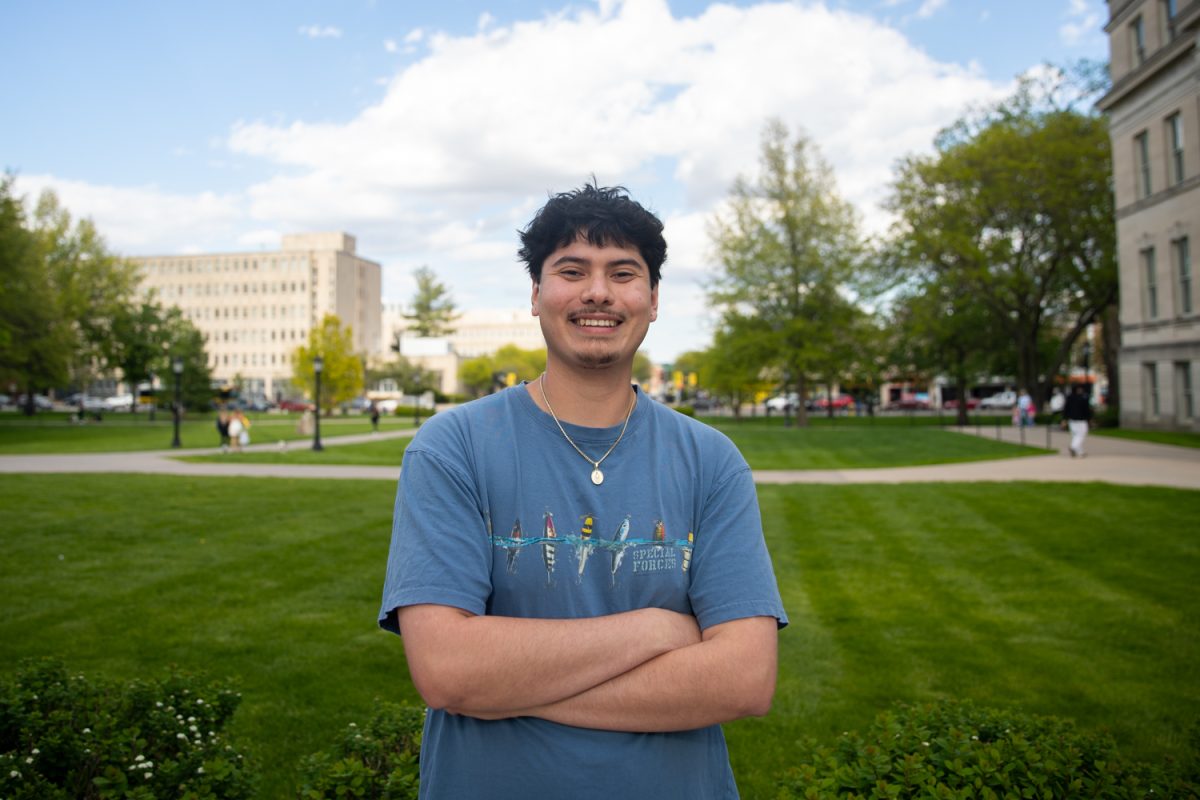
For Dave Cacho, politics was never meant to stay inside
a classroom.
Over his past four years at the University of Iowa, the fourth-year has become one of the defining figures behind the growth of the university’s chapter of Young Democratic Socialists of America,
or YDSA.
Serving as co-chair for the organization, Cacho helped transform what members once described as a small discussion-based club into a more active campus
organizing group.
Friends and fellow organizers describe Cacho not only as a political leader, but as someone who built community through humor, creativity, and an ability to make people feel welcome.
“Dave stepped up,” said Nate Royer, incoming co-chair of YDSAand third-year UI student. “He was really the person to realize that things needed to get done.”
Cacho, a political science and ethics and public policy major from Elkton, South Dakota, said he came to Iowa looking for new experiences while remaining relatively close to home.
Alongside politics, he spent his college years pursuing photography, videography, music, and DJing — interests friends say reflected the same creativity he brought into organizing.
His political beliefs, he said, developed more fully during his first year at the UI after joining YDSA through his friend and roommate at the time.
While he already considered himself progressive, he said he began moving further left after becoming frustrated with mainstream Democratic politics and looking for ways to turn political beliefs into action.
“I thought it was a foot in the door for me to be able to practice my politics,” Cacho said.
At the time, YDSA was much smaller than it is now.
Royer said when he and other members first joined the organization, meetings often consisted of only a few students and rarely extended beyond
planning conversations.
Over time, he said, Cacho became one of the driving forces behind rebuilding the organization into a more visible presence on campus.
“Dave is really the person who helped coordinate with all the other members and figure out what we needed to do,” Royer said.
Now, members estimate the organization has grown to more than 30 active participants. Grey Parfenoff, the other incoming co-chair and third-year UI student, described Cacho as a stabilizing figure during that transition.
“In a lot of ways, Dave is a rock for the organization, providing continuity from what was a very much collapsing outdated political discussion club to what it is now, which is a pretty committed student activism organization,” Parfenoff said.
Parfenoff said Cacho handled logistics, coordinated with the university, and helped organize events while also remaining approachable to new members.
“It would be easy for a co-chair in a position of power to be intimidating,” Parfenoff said. “Dave was never that.”
Outside of organizing, friends described Cacho as energetic and deeply thoughtful.
Kylen Phillips, who roomed with Cacho during his second year, said some of his favorite memories came from listening to Cacho make music late at night.
“He would always have all these ideas and really cool thoughts about what he wanted the song to make people feel,” Phillips said. “He really cared about making people feel good.”
Phillips described Cacho as high energy, kind, and passionate about helping others. He said that sense of care carried into both friendships and political work.
This emphasis on community also shaped Cacho’s politics.
“I value a lot of community and friendship,” Cacho said. “That’s also one of my guiding beliefs toward why I practice socialism.”
Fellow organizers said those values became central to the culture of YDSA itself.
Royer said that consistency between Cacho’s politics and his personal behavior are what made his leadership style stand out.
“His leadership just applies to his actions,” Royer said. “He truly lives what he believes. He is consistently thinking of ways to improve the community.”
Royer also credited Cacho with helping expand the organization’s activism beyond campus meetings. He pointed to organizing efforts surrounding Oliver Weilein’s campaign as one of the first major projects that helped rally members around a shared goal.
He believes the younger generation has a responsibility to think critically about the information they consume online and to remain engaged with politics in meaningful ways. He has concerns about misinformation spreading through social media and said political engagement requires people to actively question and research what they see online. After graduation, Cacho plans to pursue graduate school in political science or public policy, with hopes of eventually working at a nonprofit organization or public policy institute.
As Cacho prepares to graduate, the incoming co-chairs of YDSA said his influence will continue long after graduation — not only through the organization’s growth, but through the sense of community he helped create.
“The org would not be what it is today, both in capacities of membership, but also in the strength of the dedication without Dave,” Parfenoff said.