



As costs for land, equipment, and other inputs remain high, agriculture leaders in Johnson County say fewer support systems resulting from USDA cuts could make it harder for farmers to produce and sell locally grown food, despite consumer demand for local food increasing.
The USDA announced the cancellation of the Increasing, Land, Capital, and Market Access Program, a USDA $300 million grant program designed to aid beginning and underserved farmers in accessing land, effective March 26.
Emmaly Renshaw, the senior program director of the Iowa Valley Resource Conservation and Development, a regional nonprofit supporting rural development and local agriculture projects, she said Iowa Valley was well-equipped to host the land access program before it was canceled.
“We really had the setup to be able to host the fellowship here,” she said. “The goal was to have this really intensive one-year program where, by the end of the program, the second year, farmers would have gone out to a regional farm of their choice.”
Iowa Valley had begun training new farmers with the grant money at Johnson County’s Historic Poor Farm two weeks before the cancellation notice.
“These were individuals who had left their livelihoods,” Renshaw said. “They left jobs to come join the Iowa Valley, and that was really hard. We had about three days from the day we received our letter to our staff work date. It was a heart-wrenching and difficult time for brand-new employees.”
RELATED: Iowa farmers grapple with high input prices, cost of maintenance
The program termination follows a line of USDA cuts in Iowa. In 2025, the Local Food for Schools program and the Local Food for Schools and Child Care programs were terminated, costing Iowa $11.3 million.
The USDA’s cuts come despite an increased demand among Iowans for locally grown foods.
The most recent Iowa Farm Bureau Food & Farm Index, an annual survey conducted by The Harris Poll that gauges consumer attitudes toward food purchasing, found that 40 percent of the 501 Iowa adults surveyed look for a locally grown label on the foods they purchase, 8 percent higher than the previous 2024 survey.
The most recent survey also found that 69 percent of grocery shoppers have purchased groceries directly from farmers or networks of farmers through their websites, farm stores, or farmers markets.
Ilsa DeWald, Johnson County’s local food and farm manager, said demand for local food in Johnson County has been increasing since the COVID-19 pandemic proved the resilience of local food costs when grocery store prices became volatile.
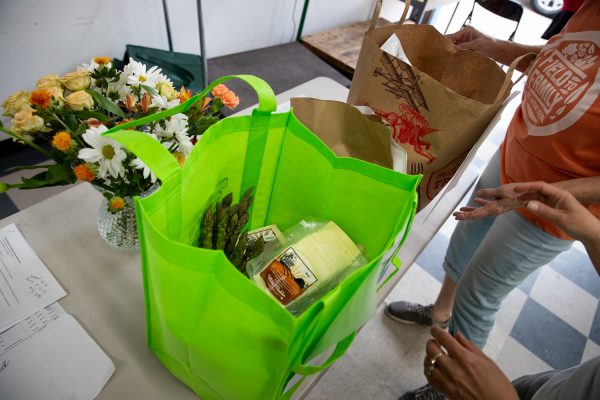
“There’s definitely an increasing demand for local food products,” she said. “The demand is there, the interest is there, but we do not have enough farmers to fill that demand. Farming is an entrepreneurial business, and it is difficult to start and sustain any entrepreneurial business.”
Renshaw said Iowa Valley mainly assists vegetable farmers, most of whom are first generation and struggle to secure land access. Land access is the ability of new farmers to secure land for producing crops.
“If you don’t have family ties, the road to land access is seven to 10 years in Iowa,” she said. “It is a long, grueling walk to get there. Even if farmers do get land, our agricultural system in Iowa is not set up for vegetable farming. That farmer might have to shell out $50,000 to put a well in for irrigation.”
Renshaw said in light of global tariff instability, crop markets such as corn and soybeans have been volatile, incentivizing a new generation of farmers to train and grow diverse arrays of crops to stabilize their farms.
“Looking at what farming could be in Iowa, when we ask what is conducive to the next generation, maybe it’s not the 500 acres of corn and soy, but maybe it’s the 20 acres of diversified specialty crops the next generation is interested in,” she said.
Renshaw said the Increasing Land access grant cut is a heavy blow for local farmers wanting to get involved in Johnson County’s locally grown food market.
“This grant and other USDA programs are an investment in Iowa,” she said. “If we want farmers who are ready to produce and be part of that local economy, we have to have these programs in place to get them trained and ready to sell into our local communities.”
Michelle Kenyon, director of Field to Family, a nonprofit organization that increases access to healthy local food, said the USDA cuts are harmful because beginning farmers need sustained funding for years to stay afloat.
“We have lost a lot of food farmers over these years,” she said. “They’ve been at the point where they’ve gotten started, and they’ve had a year or two to grow food and find markets and be successful. But ultimately, you can’t scale up super fast and still survive.”
Kenyon said Field to Family helped local farmers sell their food to 26 school districts through the Local Food for Schools program in 2025. Field to Family was expecting to distribute $800,000 worth of food in 2025 but only distributed about $330,000 due to the program’s termination.
“It was a big cut from what we were told to expect and plan for,” she said. “But people are still purchasing local food when they can. We work with colleges, universities, and other institutions. We’re working with a lot of different producers still. We’re still getting a lot of food out.”
Kenyon said while there are not enough local farmers to meet the demand for locally grown food in Iowa, the demand could help to increase the number of farmers, as higher demand typically leads to increased supply.
As demand for local food grows and USDA support declines, local agriculture groups are adapting to fill the gap.
Renshaw said Iowa Valley is working with Johnson County businesses by surveying employees to understand what types of local food they want, and connecting them with farmers who supply those products to workplaces.
Meanwhile, DeWald said at the Historic Poor Farm, Johnson County will continue to focus on growing a wide variety of crops, especially specific foods not typically found in grocery stores, such as leaves of sweet potatoes and different parts of eggplants.
She said the county will also continue to encourage direct-to-consumer farming, a model where farmers sell their products directly to consumers rather than using any intermediary retailers.
“It become harder for farmers when farm operations have to be so big in order to survive,” she said. “Direct-to-consumer farming is a way for farm enterprises to begin small and to be able to grow for the community.”