


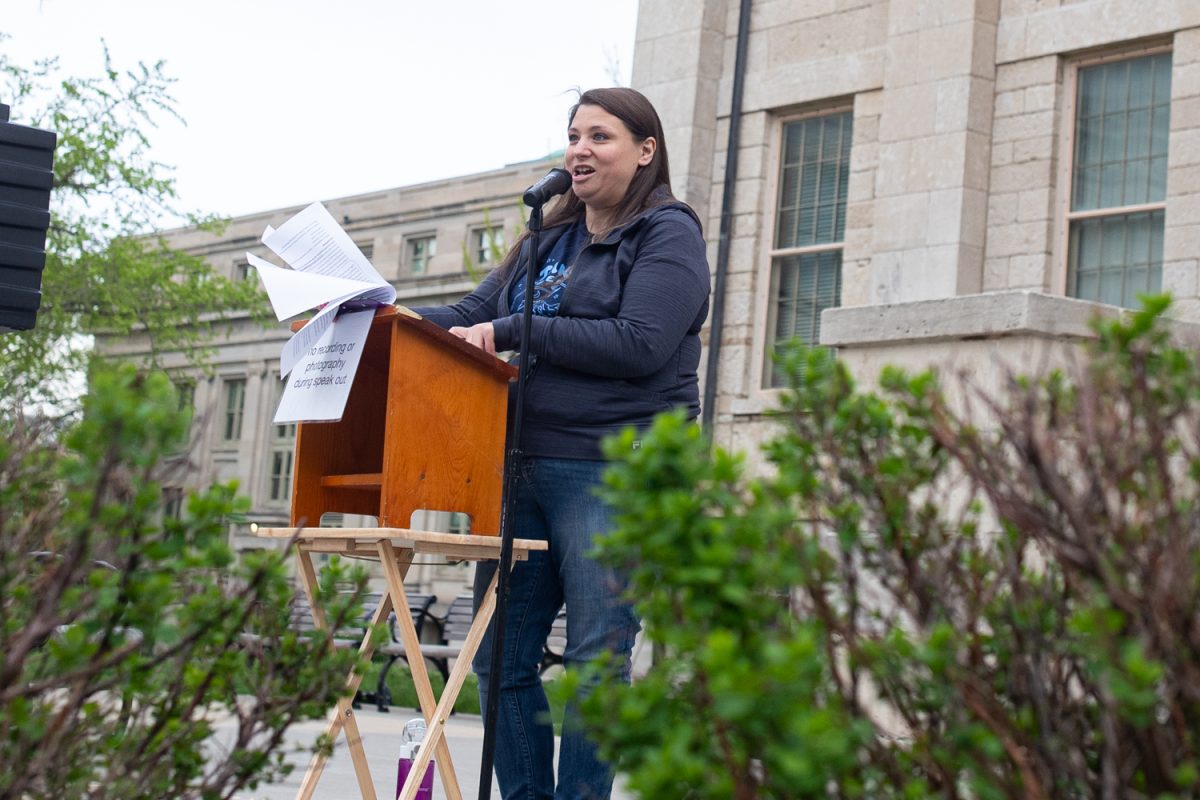
For 55 years, the University of Iowa’s Women’s Resource and Action Center, or WRAC, has been a staple in Iowa City, offering support for women, men, the LGBTQ+ community, people of color, and individuals with disabilities.
Originally founded in 1971 as the Women’s Liberation Front, WRAC was established to counter gender-based institutional discrimination during the second-wave feminist movement by providing women a safe space to organize around important issues that needed to be addressed on and off campus.
WRAC Director Linda Stewart Kroon said she was first involved with the organization during the late 1980s as a UI graduate student. In 1992, she officially joined the WRAC staff and has served as its director since 2011.
Kroon said WRAC began as an all-volunteer force with no university funding until 1976, but is now completely part of the Division of Student Life, which aids the entire UI community.
According to its website, WRAC provides a multitude of services across demographics. These include confidential counseling and care, a dialogue and empowerment-focused community network, violence prevention training, and the Iowa N.E.W. Leadership Institute for individuals who want to participate in politics and public service.
“It all revolves around our mission to help folks gain skills, relationships, work together to improve things, and celebrate their successes, ” Kroon said.
Kroon said WRAC reaches thousands of students each year with an emphasis on educating healthy interactions to create a safe campus environment for all. Much of the center’s work is involved with UI fraternities and sororities, student athletes, both the undergraduate and graduate professional governments, and various student organizations.
Kroon believes the highlight of her career has been the opportunity to participate and witness the growth of WRAC over the past few decades. Throughout her time, Kroon has been able to work collaboratively with other feminist-driven organizations, such as the Emma Goldman Clinic, to improve resource outreach for communities in need.
“I came here as a volunteer and a student, not knowing much about the center, but what I discovered here was that I could do more than I thought I could, and it changed my life,” she said. “My greatest joy is every time I see similar experiences for other folks who are involved here, and it warms my heart.”
Despite the center’s hard work, Kroon said there are still a lot of gaps and issues to continue to address, such as childcare shortages, rising domestic violence, and existing wage gaps.
According to a 2025 report from the First Five Years Fund, a federal child care advocacy organization, approximately 229,122 children ages five and below were in need of child care and early learning in Iowa. However, the supply for child care centers and homes has significantly decreased since 2023.
The Iowa Coalition Against Domestic Violence also found a 52 percent increase in domestic violence from fiscal year 2022 to 2024. As for wage gaps, the United Health Foundation ranks Iowa at number 30 in the country, with 81.1 percent of women’s median annual earnings as a percentage of men’s median annual earnings for full-time workers ages 16 and above.
UI second-year graduate student at the College of Public Health, Morgan Fisher, hopes to see improvement in campus reporting of sexual assault and in believing victims who share their experiences.
The UI Crime Alert logs show eight cases of sexual assault have been reported from Sept. 1 2025, to April 3, 2026.
“I think the university could find a lot of ways to sanction better too, sanctions that actually correct and address the behavior,” Fisher said.
UI operates under Title IX of the Education Amendments of 1972. Some violations of this statute include sexual harassment, domestic violence, stalking, and retaliation for sexual assault reporting. UI’s policy for non-Title IX sexual misconduct is within Chapter 4 of “Sexual Harassment and Sexual Misconduct,” which issues sanctions in either suspensions or expulsion.
Fisher believes the hands-on work she and fellow WRAC members have done helps counter these problems.
“A lot of the time, I feel like with everything going on in the world, we kind of just see these issues through a screen, and it’s hard to actually figure out what you can do, but WRAC gives you a place to figure that out,” she said.
WRAC Violence Prevention Coordinator and first-year graduate student Bella Vondracek said she’s been with WRAC since her undergraduate years as a certified peer educator for violence prevention workshops.
“I’ve been very focused on what influences the culture of sexual violence that we’ve seen on college campuses and just in general,” Vondracek said.
Her favorite part of working with WRAC is the people. Vondracek said she feels fulfilled and inspired being alongside people who share the same values and are committed to violence prevention. She also enjoys coordinating events like the annual anti-sexual violence protest, Take Back the Night.
“We also have a commitment to creating a safer campus within our student body, our faculty, and our staff here, too,” Vondracek said.
Dana Dominguez, WRAC’s assistant director and engagement coordinator, described her time with WRAC as “wonderful” but said some people have misconceptions that sexual violence occurs only in specific places.
“People need to understand it happens everywhere, especially on college campuses. And, it’s not something that we need to hide. We have several resources that you can come and talk to somebody,” she said. “We want our Hawkeyes to thrive. We want them to have all the support that they deserve.”
Domginuez said that besides university funding, much of WRAC’s resources come from donors like the Iowa Family Planning Council and the Domestic Violence Intervention and Rape Victim Advocacy Program, which frequently partner with WRAC.
Donations include menstrual and contraceptive supplies that students can obtain by simply walking into the WRAC headquarters on 230 N. Clinton St.
“I’m a mother, I have two kids, and I have a teenage daughter,” Dominguez said. “These supplies are expensive, but we have free reproductive kits that include emergency condoms and pre-pregnancy tests. All things that students sometimes can’t afford.”
WRAC works with many graduate students in psychology and mental health counseling programs.
UI second-year graduate student Lexi Horaney said her internship with them has been great and described the center as a very welcoming place that advocates for minority groups.
“WRAC was built on a foundation of feminism and advocacy, and that really bleeds into everything it does, so it’s incredibly motivating to be a part of that house, and I will always, always cherish my time with them,” Horaney said.
UI second-year graduate student Gihun Im said he is an incoming practice student for the WRAC and applied because he believes they are uniquely suited to marginalized populations.
“I identify as a queer person and am an international student,” he said. “So I really value WRAC, and I hope to help sustain it as much as I can.”
UI fourth-year doctoral student Megan Prass said she’s grateful for WRAC and her time working with the staff.
“It’s based in a house, it’s a very homey feeling which I think is great for populations we serve to make it feel welcoming and like we’re a community,” Prass said. “Given everything that’s going on politically in this country, and in Iowa, like the dissolution of African-American studies major, I’m just glad WRAC has a space for students that are having other spaces taken away from them.”