


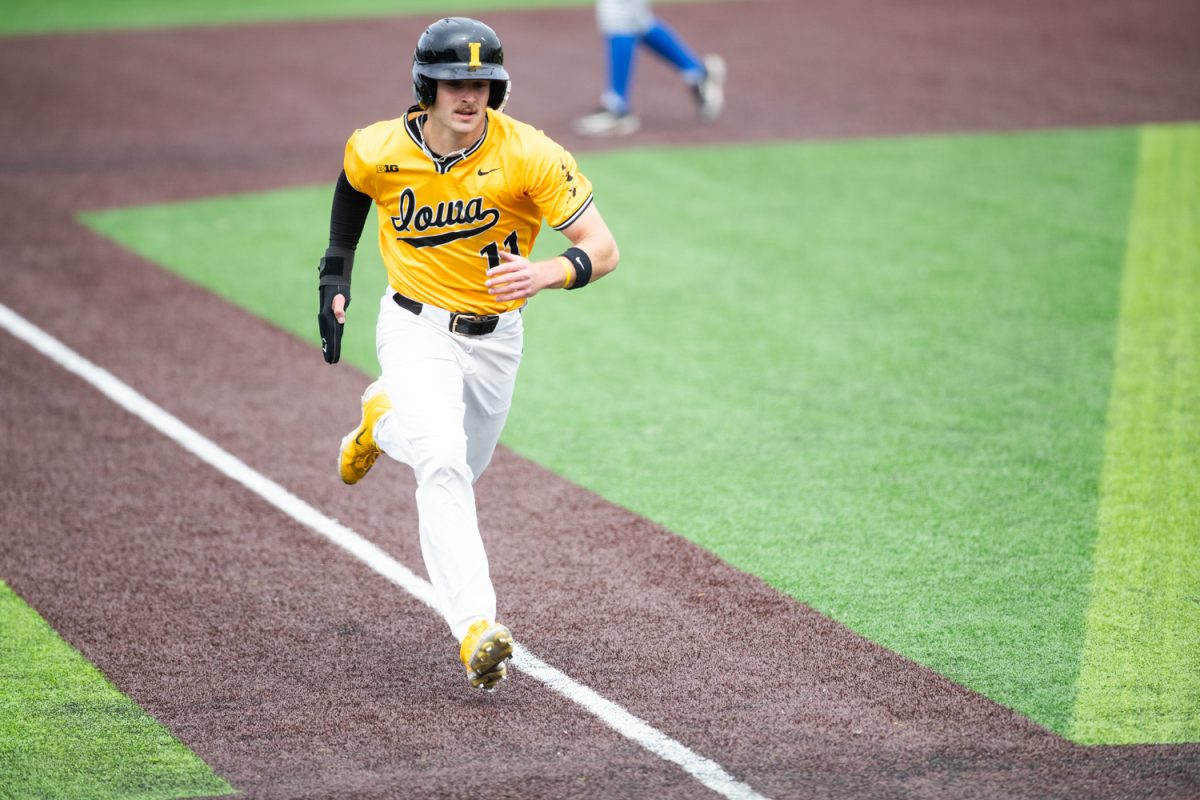
The University of Iowa baseball team is home to players with a variety of journeys to get to Iowa City. The roster is filled with players who spent time at junior colleges. It features 11 players who played at a junior college before making their way to Iowa.
Head coach Rick Heller has used junior colleges to fill holes in the lineup since he started in Iowa City in 2014. The starting lineup is littered with players who grinded away at lower levels before making the jump to Division I.
Miles Risley, a transfer from Kirkwood Community College, and Caleb Wulf, a transfer from Southeastern Community College, have been middle-of-the-order bats ever since they joined the Hawkeyes.
Heller has built a culture that makes the UI enticing for players coming from all levels. The emphasis on culture and fundamentals has been a key reason recruits have sought out the program. The strong culture Heller has created has made the adjustment smoother for players coming in.
“I think it’s a great culture. We all love each other and want to play for each other and just win a bunch of ball games,” Risley said.
Risley has been the poster child for a successful transition from the junior college level to the DI level. After an illustrious high school career at Johnston, where he was first-team All-State and Iowa High School Player of the Year as a senior, Risley took his talents to Kirkwood Community College and was an Honorable Mention All-Region selection in his sophomore year. Risley was already on Heller’s radar out of high school, but his stellar career for the Eagles solidified the decision to bring Risley to Iowa City.
“We loved Miles Risley in high school, but we had Kyle Huckstorf here, and it didn’t make any sense to bring Miles into that situation as a freshman,” Heller said.
Risley has posted a .995 OPS through 32 games with four home runs and a .500 on-base percentage.
This flexibility with the roster is one of the positives of bringing in junior college players. Players such as Risley can hone their skills at a junior college for two years and immediately make an impact when they transfer in.
The ability to bring in players who have significant game experience has been massive for Heller and the Hawkeyes.
Having players from junior colleges is not something new to the Iowa baseball program. Over the last four seasons, Heller has had 10 players or more on the roster every year who came from a junior college.
Recruiting junior college players has been convenient for Heller due to the state of Iowa being a hotbed for high-level junior college baseball. Programs like Kirkwood in Cedar Rapids and Southeastern in Burlington have seen success year in and year out.
The proximity and the winning pedigree at these junior colleges provide the perfect combination for a recruit that Heller is looking for.
“Having the benefit of a bunch of great junior colleges in our state that do a great job developing players, it would make no sense not to,” Heller said.
When the Hawkeyes walked away with a 5-2 victory over the Maryland Terrapins on April 18, the impact of junior college transfers was felt across all aspects of the game.
The centerpiece of that win was Maddux Frese, a junior who is in his first year at Iowa after spending the past two years anchoring the pitching staff at Southeastern Community College. Frese tossed seven innings of one-run ball with six strikeouts to propel the Hawkeyes to a victory.
The opportunity to come to Iowa was not only a chance to jump up to the DI level, but an opportunity to follow in his father’s footsteps. Frese’s father played baseball at the UI and was drafted by the Cubs, where he made it all the way to Triple-A.
Wulf is in his second year at Iowa and has excelled since making the transition from Southeastern. Wulf has continued his excellence this year with a .388 average and 59 hits, which are both second-most on the team. Southeastern gave Wulf an avenue to prove himself after not joining the Hawkeyes out of high school.
“I went to junior college and just grinded every day with hopes I would end up here someday,” Wulf said.
The grind of junior college baseball not only gives the players a chance to improve but also a new dose of perspective on the game of baseball that helps prepare them for the DI level.
“It taught me the emphasis of being myself and the best version of myself every day, and knowing that no one game is more important than each one,” Wulf said.
The jump up from the junior college level to the DI level is large, but the experience the players get at the junior colleges sets them up well. The system and culture Heller has put in place have made it seamless for players coming in.
“They don’t have as hard an adjustment as you would think,” Heller said. “The academics and how the system is set up at a bigger school is really the thing they have to get used to the most, but most of them adapt well.”
The pipeline from junior colleges to Iowa has continued to stay strong during the transfer portal era. The ability to get players from other DI schools has added a new layer to constructing a roster.
Many teams may bypass junior college athletes now, but Heller and the Hawkeyes are not one of them. While Iowa is now adding transfers from all levels, it hasn’t affected the number of junior college players on the roster.
Many unique cases exist where a player has experience at a junior college and a DI university. Graduate transfer Logan Runde is now at his fourth school, after spending time at Iowa Western Community College, Kirkwood Community College, and FIU.
The Iowa baseball team is forged by players from all levels. The junior college pipeline created by Heller and his staff has no signs of slowing down.
Key contributors arrive each year from a junior college, and this year is no different. Wulf and Risley have continued the standard of elite junior college transfers that was created years before them.
As the college baseball landscape continues to change, Heller has only reinforced his belief in recruiting junior college players.
“Ultimately, it is where we can find the best bit from a cultural standpoint, a makeup standpoint, and also fill the need of the position that we’re lacking,” Heller said.