


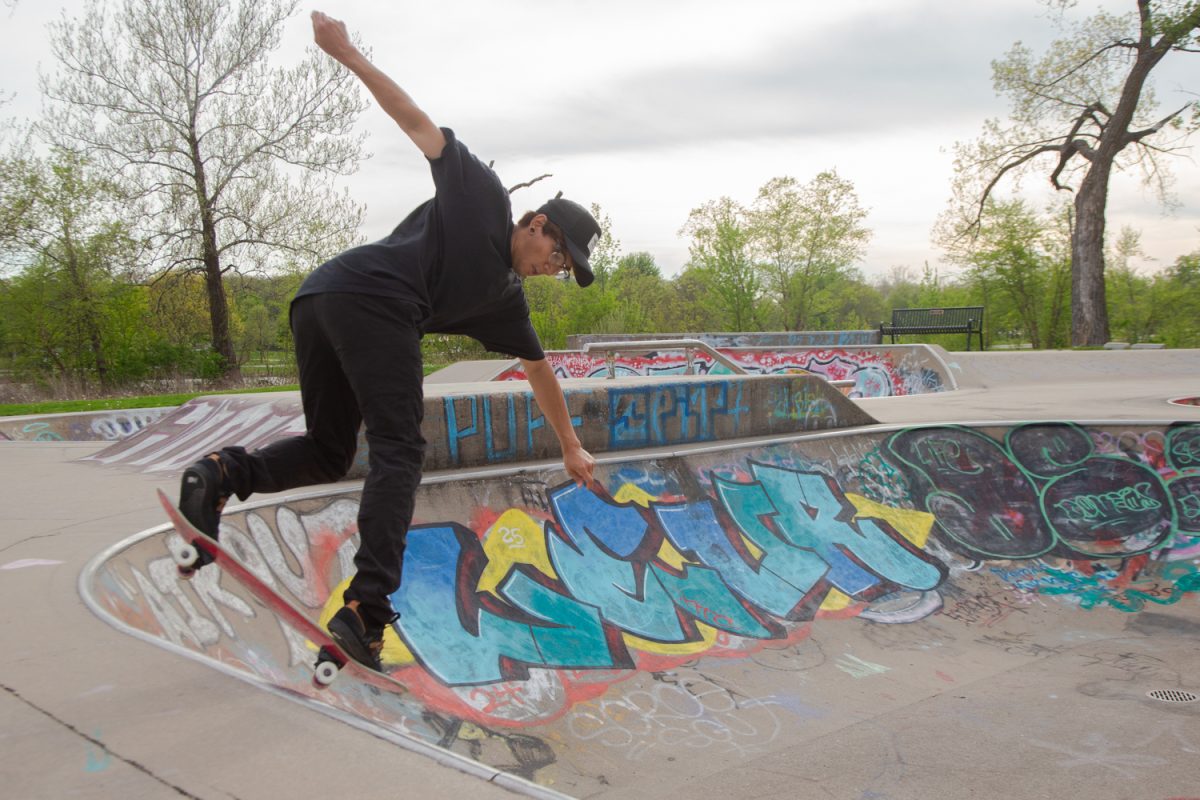
While walking through Iowa City or the University of Iowa campus, the distinct noise of rubber wheels approaching the uneven concrete pathways is not an unusual sound. From getting around town faster — or simply just showing off and practicing some tricks — skateboarders dominate the sidewalks and skateparks whenever the sun is out.
For skaters who prefer a skatepark setting, local boarders gravitate to the Iowa City Skatepark in Terrell Mill Park on N. Dubuque Street, opposite Mayflower Residence Hall, where they can drop into deep bowls and grind across metal railings. With a new million-dollar addition to the park just north of the current set-up, built in the shadows of the Beckwith Rowhouse, local boarders are amped up at the prospect of more space, tracks, and rails to increase trick combinations and accessibility for skaters of all skill sets.
This decision comes after a recent surge in skating popularity, primarily due to the rise of skate culture on social media and the inclusion of skateboarding in the summer Olympic Games, which transformed the primarily youth-led counterculture into a globally recognized sport. Additionally, the United States Skateboard Market is projected to reach $ 1.33 billion by 2033, with a 2.93 percent compound annual growth rate, proving the popularity of skateboarding isn’t just on social media but in the markets as well.
With a $250,000 grant from the Federal Land and Water Conservation Fund, the $1.5 million renovation is planned to conclude in November 2026 after workers began construction in April 2026. Despite the heaping mountains of dirt piled up around the area, the skatepark will remain open for public use throughout the entire renovation duration.
The Iowa City Skatepark is open from dawn to dusk and already features several bowls, grinding rails, walls, and acceleration bumps for people to practice tricks on. Being near the park often comes with the impactful sound of rubber hitting cement and excited cheers from onlookers whenever an impressive trick has been completed.
The skatepark also features two picnic tables, allowing people to hang out in the space even if they’re not skating. As the closest skatepark to the UI campus, the place is frequently crowded with people who utilize it for a variety of reasons.
“Skating is a thing that anyone can get into. I’ve met people of all ages, and I meet people in different majors,” Kyann Miller, first-year UI student and skateboarder who frequents the Iowa City Skatepark, said. “I’ve made a couple of good single-day friends, and I’d say the community is very welcoming.”
Even with large crowds of people at the skatepark, Miller said that the people she’s met have all been respectful and inviting. For beginners looking to get into the sport, a welcoming community such as the one at the Iowa City Skatepark can be a crucial part of gaining confidence, especially for women.
“A lot of people, especially girls I know, are scared to get into skating because it’s a very male-dominated field. Also, just with the stereotypes around skateboarders that they’re kind of rough people,” Miller said. “Well, they’re not. Everybody’s super chill, so anyone really can start skating.”
While a skatepark can sometimes be seen as an intimidating place for beginners, regardless of their gender, Miller expressed how people at the Iowa City Skatepark can be helpful and supportive to everyone, regardless of their experience level.
“We all know how hard it is to get on the board and start trying. Being able to show up and give what you can, we respect that,” Miller said. “Everybody’s just trying to make sure, like, if you fall, you get back up good.”
In addition to fostering an environment for skaters to learn and practice their tricks, the Iowa City Skatepark is also a place for creativity to shine. One of the most notable examples of this is the graffiti that covers the skatepark, adding bright colors and bold designs to the otherwise dull, gray cement the park was built with.
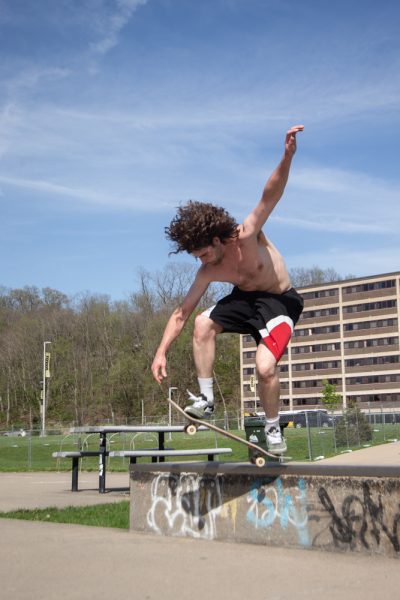
“There’s a lot of art,” Miller said. “So many people add onto the graffiti, so it’s great to watch it evolve as more is added.”
Even for people who aren’t involved in the skating scene, the graffiti of the Iowa City Skatepark can be a welcoming sight, especially for Mayflower residents who see the skatepark regularly.
“I’ve never really looked at the graffiti up close, but whenever I drive by it, I love seeing the pops of color, especially in winter when everything else is so dull,” Evie Philip, first-year UI student and Mayflower resident, said.
Additionally, while the top of a board is often covered in black grip tape, the underside of a deck can be home to wildly personalized artworks and creative designs. From spirited sea-creatures of vibrant hues to bold graffiti lettering ready to make an impact, a skater’s board illustrates both their creativity and personality.
Outside of the graffiti and personalized boards, another art form emerges in the skating itself. With numerous tricks and skating styles, being on the board can open up a wave of inspiration for many skaters.
“I use skateboarding as an outlet for creativity,” Miller said. “The creativity part of skating is kind of like dancing. You get to go around in circles, doing tricks, and just doing whatever comes to you, and it’s like letting your body choose the movement.”
With countless tricks and combinations, learning new tricks is a foundational part of skateboarding for many skaters. However, each skateboard is different, and depending on which subcategory a skateboard fits into, it can quickly determine the style of tricks that can be accomplished on it.
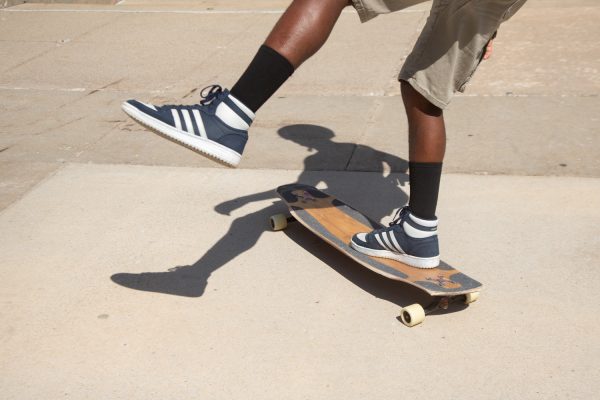
The classic skateboard is a versatile piece of equipment best suited for both casual skating and performing tricks. These boards are typically between 28 and 32 inches long, making them flexible and easily maneuverable, and able to handle kickflips and ollies with ease.
While the classic skateboard is a common choice for many people, the longboard can also be a popular pick for more casual skaters. Featuring lengths anywhere from 32 to 44 inches, longboards have more stability than the classic skateboard but are less agile for performing tricks on.
“I’ve been longboarding for six years,” Alvis said. “I started with skateboarding, but I’m from a small town with bad sidewalks. You’re less likely to get thrown off a longboard from a small crack.”
Even though longboards are typically designed for casual cruising, tricks aren’t entirely out of the picture. For local longboarder and third-year UI student Jordan Brown, he’s determined to make the most out of his longboard.
“I decided I was going to ride my board around to class after I spent all this money on a board and helmet and stuff, but then I was like, let me learn how to stop,” Brown explained. “That brought me to YouTube stuff, and I was like, okay, there’s a whole world out here.”
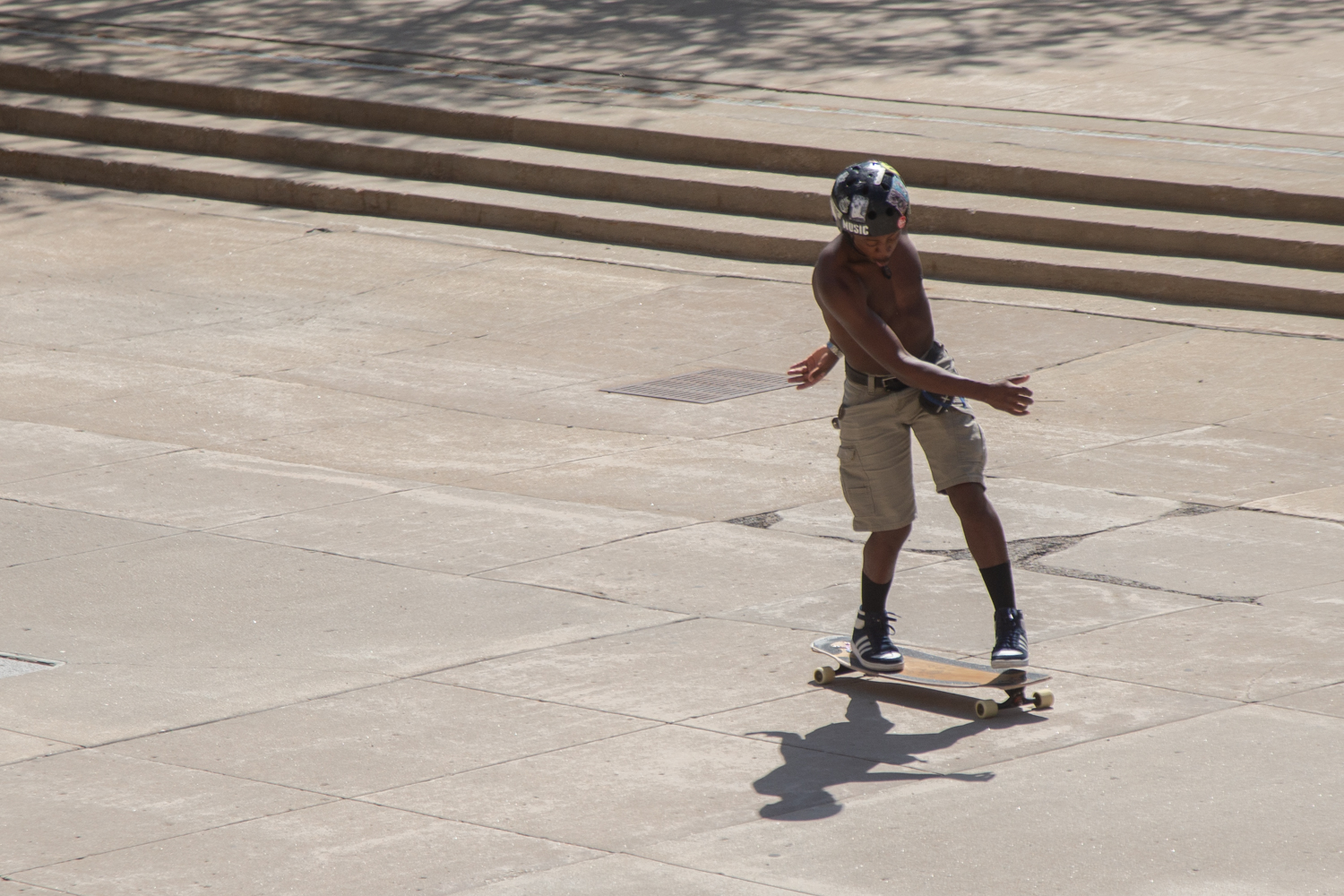
Brown can often be seen practicing his tricks between Burge and Catlett Residence Halls, down T. Anne Cleary Walkway, downtown in front of the Ped Mall, and many more places across campus. Brown always has his music playing to accompany him as he skates, performing intricate dance moves on top of his board and shifting his weight around so that the board glides across the pavement in weaving arches, and is practicing to hopefully go into the professional scene after graduation.
“I want to go pro, that’s why I’m always out here training,” Brown said. “The pro scene is insane, there’s probably less than a thousand pros in the world. It’s still super niche in the U.S., and there’s maybe like twenty companies in it.”
Brown practices several days a week, with the goal of one day earning himself a sponsorship, an indication that he has made it into the professional scene. To gain traction for his longboard dancing, Brown promotes tricks, such as a pirouette, one of his favorites to perform, and training progress on his Instagram page.
Even though the world of tricks is endless for the skating community, many casual skaters also break out their boards for convenience. With limited time between classes and long distances between buildings, skateboarding is both a quick and accessible way to get around the sprawling campus.
“I skate to class every day. I love it because it turns a 20-minute walk into a 9-minute skate,” Emma Barwin, local skateboarder and second-year UI student, said. “I’ve mostly had good experiences, and I’ve been seeing more people skating to class since the weather got warmer.”
As the weather warms and summer rolls in, traveling by skateboard has become more common on campus. However, with an influx of skaters and other people out on walks, issues can arise.
“Noise-canceling headphones can be annoying because people can’t hear when I’m saying ‘on your right’ or something. I imagine students who bike have this problem too, but unlike bikes, you can’t brake as easily on a skateboard; you have to drag your foot to stop,” Barwin said. “Thankfully, I’ve never had too bad a fall on campus, though.”
Even though bikes may have an easier time braking than skateboarders, complications can still arise for bikers downtown and around campus. Penelope Alvis, a UI second-year student, utilizes her electric bike as her main mode of transportation, in addition to her longboard.
“There are normally a lot of people on the sidewalks, so the bike lane is the only option in most areas,” Alvis said. “It gets really hard to get around near the Ped Mall because Ubers and DoorDashers park in the bike lane, and cars are still driving in the lanes next to the bike lane.”
With riding skateboards on Downtown Iowa City sidewalks prohibited, the bike lanes are the only option for skaters to ride on without having to pay a $15 fine. This decision comes as part of the “Walk Your Wheels” campaign, which forbids the usage of skateboards, bikes, scooters, and other wheeled modes of transportation on the sidewalks to prevent the likelihood of both rider and pedestrian injuries.
For skaters, this ban only increases the desire for more skating accommodations, such as the eagerly awaited Iowa City Skatepark renovation. With a devoted community throughout Iowa City, skateboarding is on a roll, and there’s no stopping the sport’s thriving culture on campus anytime soon.