


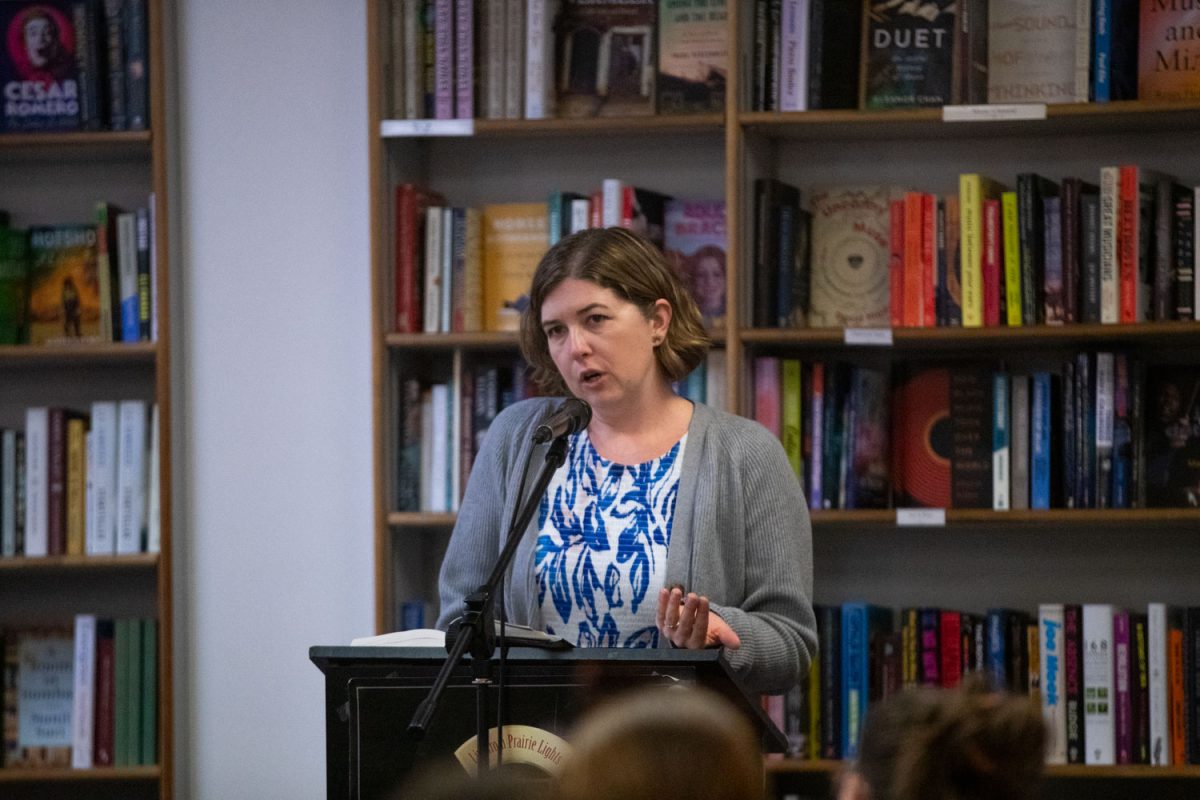
Rebecca Lehmann, author of “The Beheading Game: A Novel,” is also an award-winning essayist and poet. She holds an MFA from the Iowa Writers’ Workshop. She read her newest story, “The Beheading Game: A Novel,” at Prairie Lights Bookstore on April 22.
The Daily Iowan: What inspired you to write “The Beheading Game,” and why did you decide to write historical fiction instead of poetry?
Lehmann: I really wanted to retell the story of Anne Boleyn and show her in a more complex light because she’s often given a pretty two-dimensional depiction as a homewrecker who breaks up Henry VIII’s first marriage, and gets what she deserves when she’s beheaded. In reality, she’s a very intelligent woman who spoke multiple languages, was a religious reformer, and, in fact, most scholars think she was falsely accused of the charges that resulted in
her execution.
I’ve thought about the different ways to retell her story and ultimately decided I wanted to keep the beheading in the story because I think it’s what really resonates with people looking at Anne Boleyn and that she’s this great example of a very powerful woman through history. So I thought, what if she could wake up after her execution and come back to life? There’s a tradition of these kinds of head carrier stories, the Headless Horseman, and several saint stories where they continue living after being beheaded, and I wondered, why can’t Anne Boleyn do that?
What do you feel is so special about Anne Boleyn and her death, and in the case of “The Beheading Game,” her return to life?
I think she’s an example of a woman who was really ahead of her time and didn’t conform to gender stereotypes for women or gender expectations at the time, when women were submissive, quiet, obedient, and basically the property of their husbands. They were to do as they were told and keep their mouths shut — in the case of queens, produce male heirs.
She, instead, is this woman who is really outspoken with a lot of big political ideas who wants to help usher the Renaissance into England.
Since this is historical fiction, do you believe as an author that you’re allowed to take creative liberties with history?
It is historical, but the keyword is fiction, and different people who write historical fiction can go in different directions. There are people who try to be really true to how things happen, and just dramatize the characters, and those who will take liberties. Obviously, with this book, it is taking a pretty big, imaginative leap.
What if Anne Boleyn came back from the dead, which kind of rests on the assumption of what if people could come back from the dead, which in real life, of course they can’t. So in that way, it’s a book that’s taking a lot of liberties.
I did try hard to make the world of the book as accurate and as historically true as I could possibly make, both in terms of the backstory for Anne and her relationship to the Tudor dynasty, which is a complicated family history.
I also wanted to get details of the everyday life, like what would it have smelled like or looked like? I wanted to understand what the common people did, and how much money did somebody make in a day when they were a laborer? Things like this were the kinds of details I thought were important to get right, and I think every writer has to decide for themselves when they’re writing historical fiction, how far they’re willing to stray.
Where do you find inspiration for your characters and the actions they take?
In the back of “The Beheading Game” there is an author’s note where I’ve acknowledged some of the facts of history beyond Anne Boleyn coming back from the dead, and other little effects of history I’ve changed. Some of it is moving something small, like a gift she received from one year to another, or that I combined her brother’s and her trial to be at the same time. This can change some of the little actions in the world. I tried my best to base the actions in historical context, especially since Anne Boleyn lives on.
Everything after her execution is imagined, and she didn’t really come back from the dead, so I had to take what I knew of her as a historical figure, such as how she was very smart, had a sharp tongue, and a very hot temper, and she could sometimes be a little bit of a snob. So when she meets, for example, Alice, at the beginning of the novel, which is a totally invented character of the book, I had to scrape together what I knew of Anne Boleyn, and of the world, as well as their interactions with each other.