


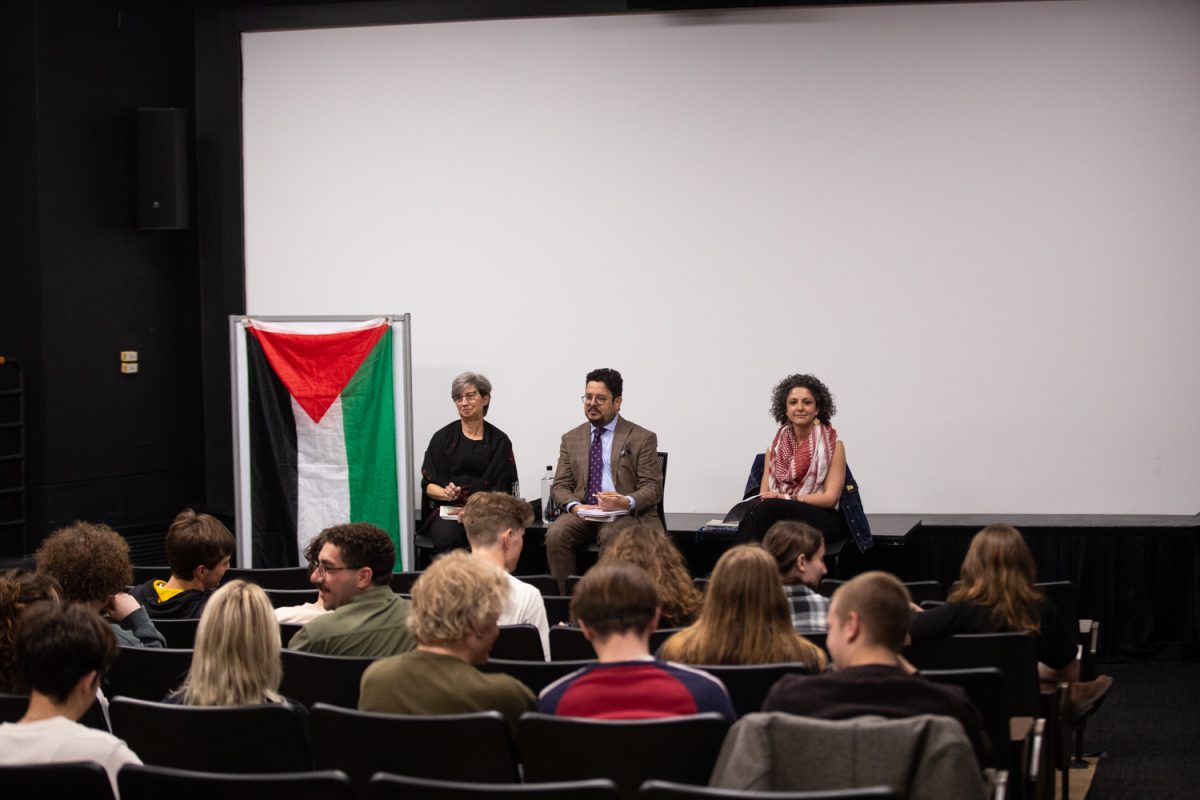
The University of Iowa’s Young Democratic Socialists of America chapter, UI Jewish Seeds for Justice, and the Iowa City Action for Palestine brought together a Palestinian journal panel featuring Palestinian Lebanese author and San Francisco State University professor Omar Zahzah, Palestinian Lebanese American UI College of Public Health professor Rima Afifi, and Yasmine Ramadan, UI associate professor and Arabic affiliate faculty member, as the event moderator.
They discussed issues concerning technology influencing Palestinian censorship, cross-cultural identity, and how they’ve managed to share the narratives of fellow Palestinians and their own.
The event brought together over 100 attendees on April 24 at the UI Iowa Memorial Union’s Big 10 Theater dressed with keffiyehs, a traditional Middle Eastern scarf that has been used as a symbol of solidarity with the free Palestine movement.
The three organizations have worked together to bring awareness to ongoing violence in the Gaza Strip.
Zahzah specifically discussed his work, particularly trying to balance his identity as an academic, organizer, and activist in his book, “Terms of Servitude: Zionism, Silicon Valley, and Digital/Settler-Colonialism in the Palestinian Liberation Struggle,” which discusses the role of U.S. technology companies and platforms that assist with Israel’s effort to censor Palestinians.
“I think really getting into organizing with my primary education in a lot of things was the foundation,” he said. “One of the things I learned when I started organizing with students for justice in Palestine was the use of narrative interventions. We’re constantly up against various forms of propaganda and messaging that are very two-dimensional and flattening. And so we’re often using narrative to oppose that.”
Zahzah’s approach to his independent journalism has focused on humanizing in response to the dehumanization that occurs in particular political projects.
“I was often working with people who had really had their careers ended or their livelihoods, you know, really challenged. through various forms of harassment, you know, either because of their organizing for Palestine or because they have been outspoken,” Zahzah said.
Zahzah said Palestinian activists have managed to use hegemonic platforms such as Facebook, Twitter, and Instagram to break through the “narrative embargo” they’ve faced in corporate media. However, he warns that when these activists become too effective, mass censorship takes place.
“There’s an active choice on the part of these American big tech companies that are willingly partnering with the Israeli state,” he said. “I wanted to trace out as many instances of suppression and think about a broader framework, which is ultimately how all of this is tied to a colonial process.”
Afifi focused her narrative on the journey her and her family endured as Palestinian refugees and ultimately Lebanese and American citizens.
Afifi shared how her identity shaped her interest in public health. She said public health is more than just a field about our genetics and behaviors, but it includes social, economic, and political factors, and tries to uplift equity and justice to counter systemic barriers to well-being.
This relates strongly to the political barriers that have hindered medical aid in Gaza. She said being born to a Palestinian Lebanese father and an American mother exposed her to diverse perspectives and cultures that shaped who she’s become today.
“Their marriage crosses boundaries of culture and religion, and I really often thought about, and with great pride, how my grandparents, who came from such different backgrounds, in the 1950s and 1960s, supported my parents’ marriage,” Afifi said. “Their openness to difference and change, and to the power of love, actually influenced everything about who I am and what my life is.”
Afifi has roots as a Palestinian refugee in Lebanon, but said her family has not faced the same extent of discrimination and limitations from policies against Palestinians due to her father’s acquiring Lebanese citizenship. Afifi also recognized her privilege as an American with what she described as an “immeasurable” amount of opportunity.
Throughout the years, Afifi has helped publish her late father’s work to shed light on Palestinian narratives as well.
Fourth-year UI student Misha Misyuk is the president and founder of Jewish Seeds for Justice and a member of Iowa City Action for Palestine who helped gather the panelists.
“We wanted to talk about the power of storytelling and how it can be used as a form of resistance and bringing people together, to uplift Palestinian stories and voices,” they said.
Misyuk’s Jewish identity has played a part in their actions to make a space where Palestine is acknowledged.
“My Jewish identity has meant a lot to me, and I am an anti-Zionist, and a lot of people think those two things cannot exist at the same time, but that is a huge misconception. My organization is here to create spaces for Jewish students who do not align with Zionism, don’t want an org that directly funds the state of Israel, or don’t have those direct ties,” they said.
RELATED: JoCo Board of Supervisors finalizes fiscal year 2027 budget, despite public disapproval
A member of Iowa City Action for Palestine, Misyuk, and fellow members have protested against UI’s connections to American Ordinance and Collins Aerospace, which have provided military assistance to Israel.
Misyuk said the organization has tried to contact the College of Engineering to sever ties with both companies at UI career fairs, with no response. Iowa City Action for Palestine has fundraisers to provide on-the-ground aid to Gaza in partnership with the Hope Foundation.
Misyuk believes the panel offers great insight for the UI community to understand the lived experiences of Palestinians who have long advocated for this issue.
“Dr. Zahzah is an amazing professor,” they said. “He just has a really great perspective that we want to highlight. Dr. Afifi is in public health, who has brought together her father’s book, and I’ve heard her brilliant speaking at past events too, but we picked them both because they’re amazing scholars, amazing writers, and they have a lot of beautiful perspectives that we want to share.”
Third-year YDSA Co-Chair Grey Parfenoff believes the U.S. remains complicit in the Israel-Hamas war and described attacks on Gaza as a “genocide.” Her goal is to continue educating people at UI about the matter, and she is grateful for Jewish Seeds for Justice and Iowa City Action for Palestine’s contributions to the event.
“At universities, there are many opportunities to teach people about the violence happening, but simultaneously, there are attempts to silence and prevent discussion about what’s going on in Gaza,” she said.
As casualties increase in Gaza, Parfenoff said it is America’s responsibility to resist the attempts to silence those who speak out against Israel. She particularly references the billions of dollars in aid the U.S. government provides to Israel, which enables them to act.
According to the Quincy Institute, since the Palestinian militant group, Hamas, conducted attacks and kidnappings against Israel on Oct. 7, 2023, and up until September 2025, the U.S. has given Israel over $21.5 billion in military aid.
Parfenoff also believes it is hard for some individuals to be involved politically due to constant media exposure of the crisis. She said some people have developed a sense of apathy as a result of political exhaustion.
“They may feel like they’re getting into politics all the time and that everything is always bad. So getting people to want to come to an event and learn more about issues like the genocide is a struggle in its own right,” she said.
Third-year YDSA Co-Chair Nathan Royer said the group felt strongly about the issues occurring in Gaza and that all of Palestine, which includes both the Gaza Strip and the West Bank, should be freed from all Israeli occupation.
“Having Palestinian narratives kind of counters the messaging around the current genocide going on, and I think that has been unique,” he said. “In the past few years, we’ve seen a real change in opinion, from civilians, through documentation of Israel’s crimes, and that’s what we’re trying to bring home and kind of summarize here.”
Royer said the collaboration with Jewish Seeds for Justice and Iowa City Action for Palestine was very generative, and the panel brought expertise from people whose voices need to be heard during this conflict.
“I think just hearing stories of people that live, are from Palestine, or have known people that have lived in Palestine, takes us away from the different caveats, whether it be what the algorithm decides to show you, or whatnot, is a very valuable thing. I think it’s lacking in the current discourse,” Royer said.
Parfenoff and Royer acknowledge that people may get lost in the number of casualties, possibly becoming desensitized. However, they believe numbers do not convey the holistic realities of people’s lives in the war.
“You know, 50 years down the line, we will look at us now and think, ‘What the hell were we doing?’” Parfenoff said.