


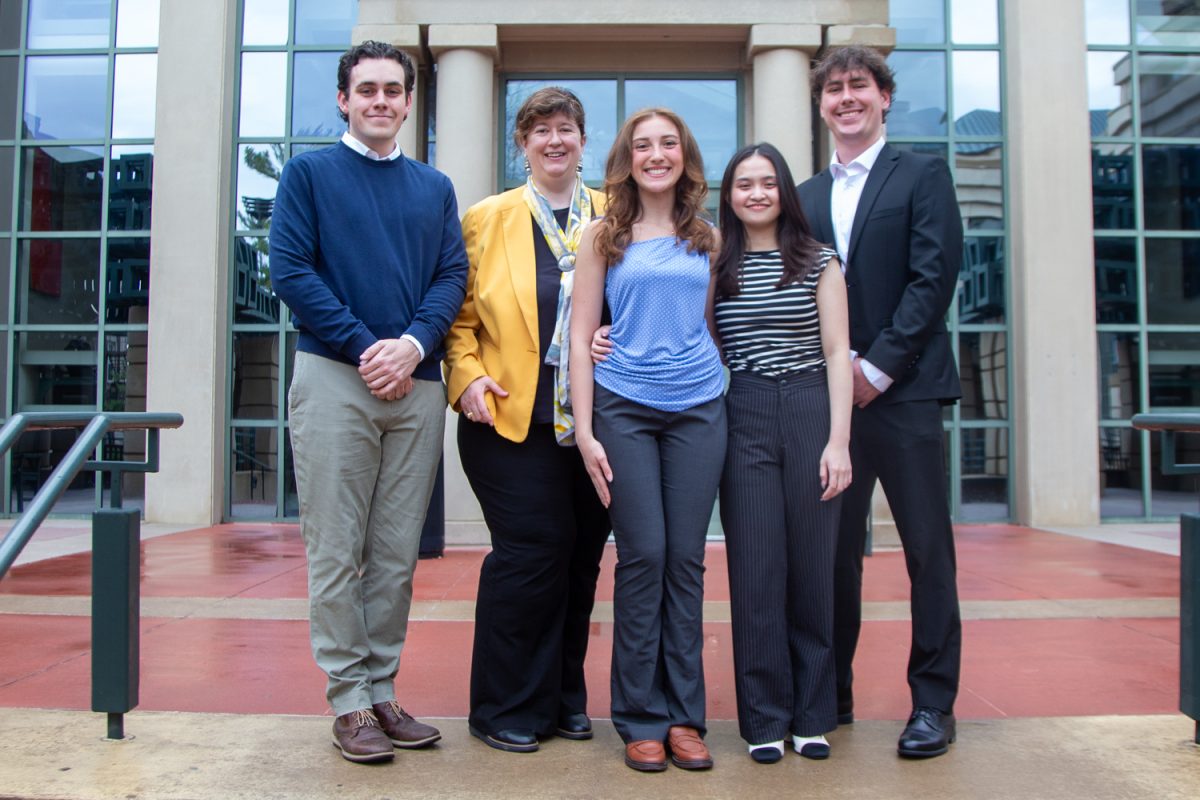
Eight University of Iowa students brought home the 2026 national title for the Fiscal Challenge in Washington, D.C., as concerns arise surrounding how the U.S. government will handle its national debt and deficit crisis.
Fiscal Challenge is a nonprofit educational organization where students from six universities across the country are chosen to present their ideas to economic experts and debate the best course of action to address the issue.
The team, made up of fourth-year Captain Thi Nguyen, members fourth-year Timothy Ottesen, fourth-year Emma Kajtazovic, third-year Kasey Ludlow, fourth-year William Lynott Hawbecker, third-year Jack Kuehl, and alternates third-year Abigail Morf and fourth-year Brent Lumpkin, attended.
Tippie College of Business professor and Director of Undergraduate Studies in Economics Alexandra Nica served as their advisor.
“We were tasked with bringing the national debt to GDP ratio to 95 percent within 30 years,” Ottesen said. “It’s all about putting our country on a more sustainable path fiscally so that we can have a balanced budget for future generations.”
Nguyen said the team’s proposal would bring down the national debt-to-GDP ratio, a measure of a country’s output compared to its national debt, to 89.04 percent in their proposal. This metric compares a country’s public debt to its annual gross domestic product. However, if the U.S. government continues with its current fiscal policy, its debt-to-GDP ratio will be at 175 percent by 2056.
Brookings said the last time Congress successfully passed a full budget bill with full required appropriations measures was in 1996. These are 12 separate bills that cover funding for every federal agency. This is largely due to the extensive time it takes to formalize how the budget will be structured, partisanship division, and the Senate filibusters.
The team’s proposal focused on areas they believed would help manage the nation’s debt. It includes demographic measures to increase population growth and high-skilled labor through immigration and child care reform.
RELATED: UI research student awarded with prestigious national scholarship
They also dealt with Social Security and Medicare, as the programs are some of the largest federal spending categories. Lastly, they proposed tax revenue reforms and artificial intelligence investments to help with labor efficiency.
On average, they worked over 30 hours a week individually, and the project itself took over 2 months to complete.
“It would be reasonable to say it was a full-time job outside of being a student,” Ottesen said. “We would be doing group meetings for anywhere from four to six hours a day, but then we had a lot of work to do outside of it. I think I was easily spending eight to 10 hours a day and five days a week for the last few weeks leading up to the competition.”
Kajtazovic said the team felt even more motivated after finding out they made finals during spring break, and part of it came from making it to the semi-finals at the 2025 College Fed Challenge, another rigorous national competition where students present monetary
policy recommendations.
“It was really nice because we had already built up that momentum from the Federal Reserve Challenge from last semester. It was me, Thi, Kasey, and Jack that participated, and Iowa hadn’t made semis in like over 10 years, so when we did it, it was like such a big deal. We were just hungry to do it again,” Kajtazovic said.
Hawbecker believes their team effort is what sets them apart from other universities at the competition.
“We talked to other people, and we’ve seen from past years’ submissions that you might often have a team where you have one or two people that are kind of leading the team and putting a lot of work in,” he said. “But we are all engaged. Everybody really was interested and cared about the problems that we’re discussing, so we were able to build a really good group dynamic.”
The group was able to meet multiple experts throughout their trip to D.C., such as the founder of Fiscal Challenge, Mike Aguilar, and Christi Hawley Anthony, who is the Deputy Director of the Budget Analysis Division at the Congressional Budget Office.
“It’s just nice after putting in so many hours of research to be able to bring a proposal in front of some of the preeminent experts in this field,” Ottesen said.
Nguyen and Kajtazovic both said they were anxious but encouraged each other despite it all.
“When we left the room I had a big smile on my face,” Nguyen said “ I felt really good, and I was really proud of the team. Emma was jumping up and down, she really hyped me up, and I was jumping with her, too, we had a lot of fun.”
The group expressed their gratitude to Nica for reviewing their work and providing support as they researched.
“She’s been such a great academic resource during all this, but more importantly, she’s been there through our ups and downs,” Kajtazovic said. “It truly couldn’t have been done without her help either.”
The group also received help from other faculty members and the UI economics department, who accommodated their coursework, attendance, and gave additional resources throughout the semester.
“All of our professors were flexible with us with such a huge time commitment, helping us make sure that we’re still students in other classes. They let us get our class excuse and push some of our exams back,” Ottesen said.
“Dr. Nica was a big part of this. We had the entire econ department letting us present in front of them, Econ students listening to our presentation, and Tippie people for letting us reserve rooms,” Nguyen said, “Originally, our alternates weren’t going to be able to join us in D.C., but Dr. Nica advocated for them, and they were able to come with.”
Nica said her biggest highlight as an advisor was seeing the team progress during their research.
“I am so proud of what they have accomplished. This has been an amazing team, and they’ve worked so hard,” Nica said. “We can look at the log of how many rooms I reserved every day, not all of them could be there at the same time because of schedules, but there were always some of them working on those things, and then I was joining them whenever I could.”
Nica said because she was also the advisor to the College Fed Challenge, it was natural for her to become the advisor for the Fiscal Challenge as well. She believes the competition is a necessary opportunity to challenge the next generation on problems like the national debt.
“This type of challenge is so important because we are in a situation right now where we’re running big federal budget deficits, and we have a huge demographic problem on our hands,” Nica said. “This disproportionately affects the younger generation. So, they have to have a say in it.”