


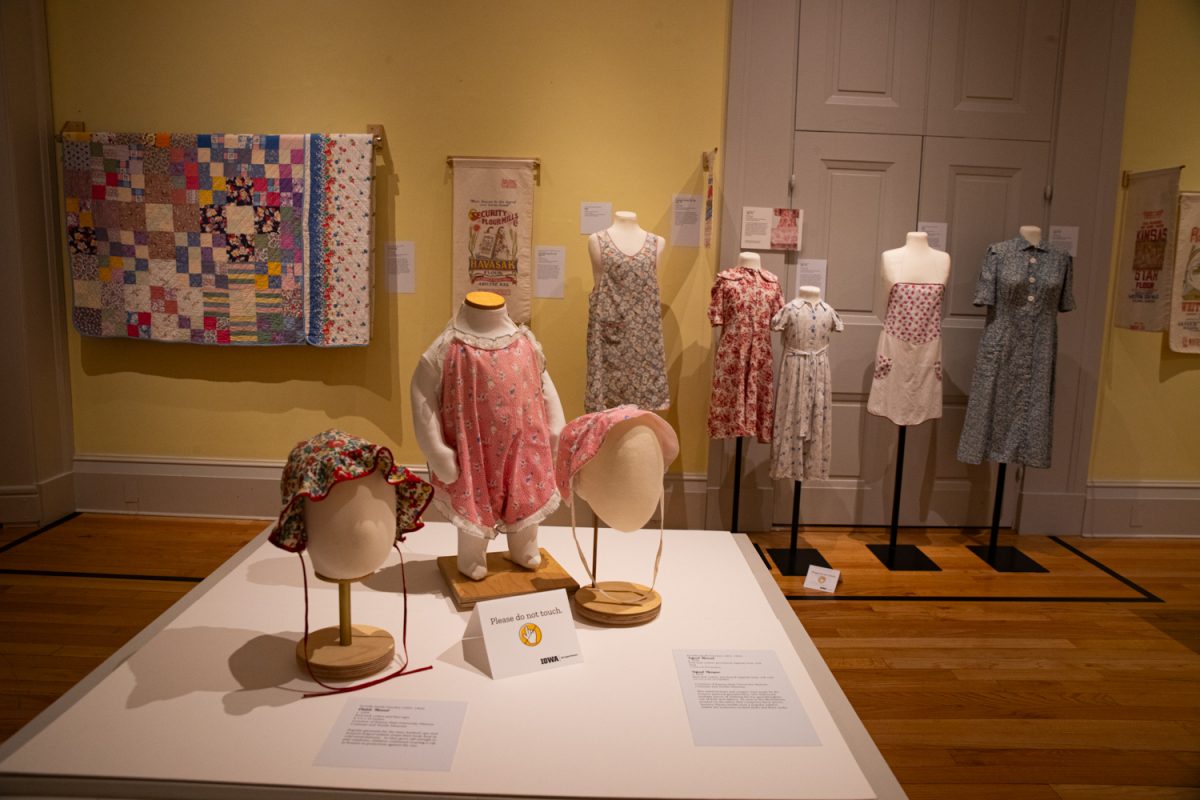
“Thrift Style” is the newest exhibition in the Old Capitol Museum that details how people used feed sacks to make clothing and other items during the Great Depression and World War II. A traveling exhibit as part of a program by ExhibitsUSA, the 41 piece exhibit has been displayed in museums throughout the country since October 2020. The Pentacrest Museums will host it until Aug. 11.
My first impression of the exhibit was how colorful it was. The walls had a pale yellow color, which highlighted the pinks, blues, purples, and other colors. I chose to walk clockwise through the room, so I started with the panel about the history of upcycling around the world. Since the exhibit focused on how feed sacks were converted into clothing, it was the perfect place to start.
History was also one of the themes, as posters in the room highlighted notable events from various time periods. The first one traced back to the 19th century, with Elias Howe’s patent for the 1863 lockstitch sewing machine and the final one concluded with the 1940s and how companies started including more colors in the patterns of the bags.
Since the garments are aged and fragile, there were signs everywhere instructing viewers not to touch anything. However, the exhibit did have an interactive element: a panel with a photo of a brown dress that, when flipped, revealed the image of the flour bag used for the underlining. Where the head would be in the dress, there was a mirror to give the illusion of viewers wearing the dress.
Feed sacks hung from racks throughout the room, printed for flour companies. The first feed sack on display, dated in 1940, for Stafford County Flour Mills was accompanied by a zinc printing plate from 1942. The plate was located on a small pedestal in the far right of the room. The bag itself had a simple design of a cow and the logo, but I could see the etchings of the cow in the printing plate.
Two more items in the room that were connected was the 1935 feed sack that was white with a blue design that had figures resembling women wearing blue dresses. Standing against the back wall were five busts, two displayed women’s aprons, two displayed girls’ dresses, and one wore a woman’s dress. All of them were made from feed sacks, and one of the girl’s dresses had the same exact pattern as the 1935 feed sack.
Dresses and aprons were not the only items people made from sacks. Three large quilts hung on the walls that looked so realistic, it was hard to believe they were made from sacks.
RELATED: Ask the Artist | Mirzam Pérez talks about joy and perseverance in her new exhibit
The first one was a 1937 white quilt embroidered with pink nursery rhymes, such as “Hush a bye baby.” The second was an explosion of colors, called a “four patch quilt” from 1930. As the name suggests, each square in the quilt was made up of four smaller, colorful squares. The third was an “applique quilt” from 1940, a massive quilt that had a pattern of flower bunches made from different colored and patterned sacks.
One of my favorite items in the exhibit was a flour sack called “Rag Darling” by Eagle Milling Company. It was a small sack printed with a design of a doll with dark hair and wearing a green dress. Dotted lines surrounded the doll so once the bag was empty, the pattern could be cut out and stuffed to make a toy for children. I thought it was very creative and endearing.
My second favorite item in the exhibit were baby clothes from 1938 found on one of the pedestals. Two small busts were on display. One wore a child’s bonnet with red, blue, green, and yellow flowers, and the other was a matching set with an infant’s bonnet and romper that was pink with figures resembling dolls in blue and green for the pattern. Much like the quilts, the baby clothes did not look like they were made from sacks.
I concluded the exhibit with a rack of sacks with various prints. The patterns included fruit, flowers, animals, colorful triangles, and one with a nursery rhyme of the cow jumping over the moon. Seeing the range of colors and patterns in the exhibit had me in awe of the creativity during what would have been a very difficult time period.
Editor’s Note: “Thrift Style” is a program of ExhibitsUSA, a national division of Mid-America Arts Alliance, in partnership with the National Endowment for the Arts.