


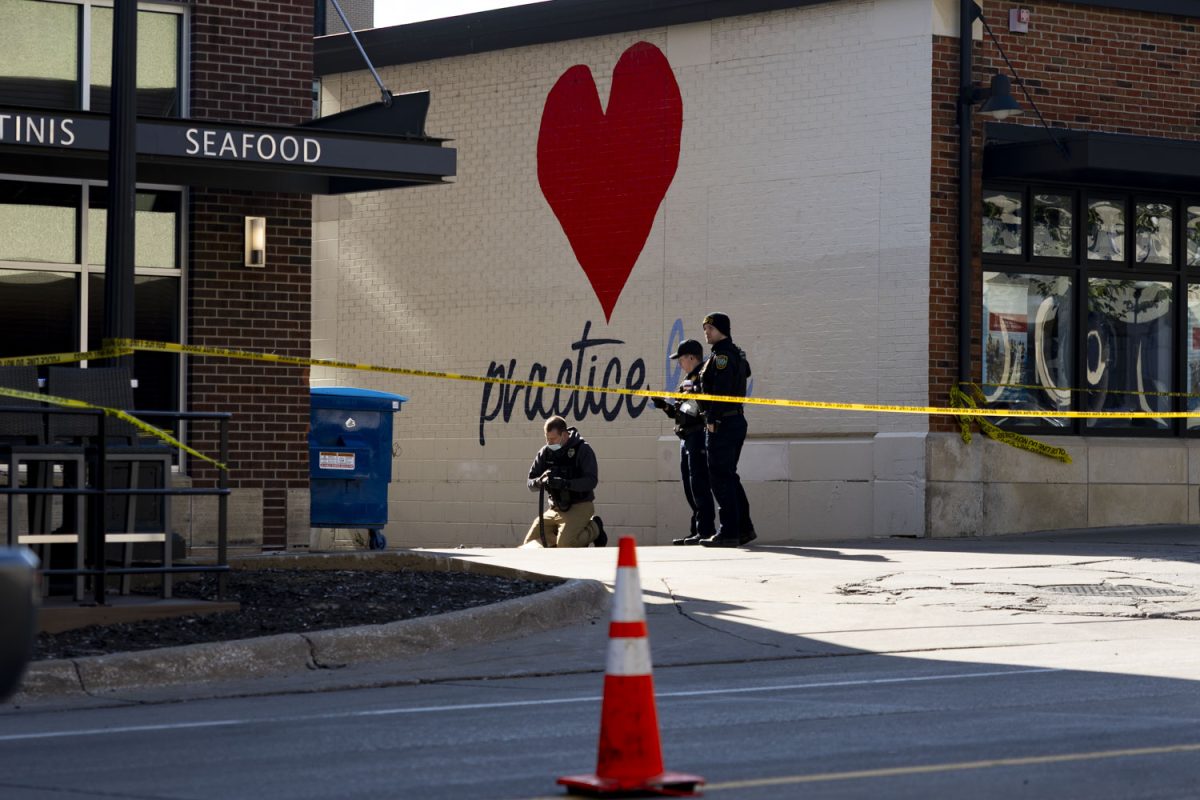
Driving through downtown Iowa City on Sunday afternoon was disorienting. Groups of girls took their graduation pictures on the University of Iowa Pentacrest, while others sat on the lawn sipping Starbucks.
People went about their day, going on runs down Jefferson Street or walking their dog past them; it seemed pretty lively for an average Sunday in Iowa City.
But as I passed Yotopia and the Wells Fargo bank, it was eerie. I didn’t see a single student or resident walking down the 100 Block of East College Street, as if avoiding the area would resolve the real problem.
It is true that America has a gun problem, but it doesn’t end with the number of firearm owners.
America has a perpetual cultural problem. Our empathy has limits, and too often it begins and ends with national headlines, skipping over the space in between.
That middle ground is the space where communities process the events and check in on one another. This is where our attention should be.
The national conversation around guns often swings between policy debates and “thoughts and prayers.” In the immediate aftermath, people are grieving and we should not reduce those emotions into a national statistic. But both matter; both are in the center of the violence.
Right now, we should be asking a simpler question: are the people around us OK?
UI graduate student Miriam Sandeen found herself helping a girl wounded by a bullet, urging someone nearby to use a shirt to stop the bleeding.
UI first-year student Mozz Mozzammil was awakened by the Hawk Alert at 2 a.m., and spent the night calling friends, making sure they were safe.
The next day, Mozzammil went to work at the CVS near the Pedestrian Mall, right across from where the shooting occurred.
“The entire day, I was very anxious, thinking it would happen again. I kept looking at every customer who walked in, making sure nothing could go wrong because of last night. If somebody came in and stared at me from a distance, I felt worried, thinking I might be in trouble,” Mozzammil said.
Gun violence leaves behind anxiety and worry, not just statistics.
Sandeen, reflecting on the shooting, expressed a hope that the community would not simply return to normal, but would carry forward a stronger sense of responsibility for one another.
Empathy doesn’t just mean thoughts and prayers, it means the collective response to violence and how we treat it in conversation. It means centering the people whose lives were changed.
But that isn’t always what happens.
In the hours that followed, information spread the way it always does now. It was fragmented, emotional, and often wrong.
On apps like YikYak, speculation quickly turned into something uglier. After the City of Iowa City released a photograph with persons of interest, people started to point blame. One post read: “They need to ban Black people from Iowa City.” Others read “usual suspects” or “why is it always them” referring to the race of all five suspects.
Comments under the national news sites since Sunday have been disturbing as well. Under the Instagram post made by the New York Post, comments ranged from thinly veiled racial stereotypes to outright hate speech, with users rushing to assign blame before facts were confirmed.
Mozzammil saw all this discourse online, claiming someone accused a Black student for being the shooter just because he was Black. The student had no connection to the incident.
At the same time, it is bizarre to see students and staff at the UI return to normal, not even 24 hours after the shooting.
Classes are not canceled, many teachers haven’t spoken about the events, and students are expected to go back to work and school the following day.
Just as Iowa City residents avoided the 100 block for a single day, we mentally cordon off these events, convincing ourselves they are disconnected and temporary.
It’s a way of coping and easier than confronting how routine they’ve become.
On April 19, there were 18 shootings in the U.S, not including the one in Iowa City, with headlines of different cities and different circumstances. Yet, many residents have not moved on, nor should they.
A UI junior and Iowa City native, who asked to stay anonymous due to privacy and safety concerns, experienced the aftermath of gun violence firsthand long before the events of April 19.
In 2021, their boyfriend passed away due to gun violence.
The grief and trauma that followed changed the student’s life, from almost failing out of high school to choosing to pursue criminology in college.
“Seeing this type of violence happen in the place where I have always called home is really sad, but it’s not shocking. I’m kind of desensitized in a way. It is triggering in the sense that I know so many people are being impacted and hurting in the same way that I have felt,” they said.
Referring to the normality of the following day, the student said they were not shocked, since many of them might not be culturally aware of the cycle of violence. The anonymous source continued to speak about the online hate and racism regarding the suspects.
“The easiest way is to point blame at those around you, but the hardest thing to do is acknowledge that there needs to be change in some sort of way,” the source said.
That instinct to assign blame quickly — especially along racial lines — isn’t new.
It mirrors the broader national discourse, where conversations around gun violence often default to oversimplified narratives.
“Be empathetic to others, especially during a time where people have lost their loved ones,” the student said.
The anonymous source continued, “Seeing the pain families endure after gun violence is one I would never wish on my worst enemy. Understanding that it could’ve been you or someone you love and how that would impact you really helps put things into perspective.”
And that is the perspective missing from much of the national conversation. If we only acknowledge these moments in passing, we aren’t just failing the people affected – we are accepting that this is normal.
We cannot keep returning to normal, because “normal” is the problem. Without policy change, every conversation, every vigil, and every expression of empathy exists in the shadow of what comes next.
Iowa City is not an exception to gun violence. Breaking that pattern will require action that reaches into stronger gun legislation.