


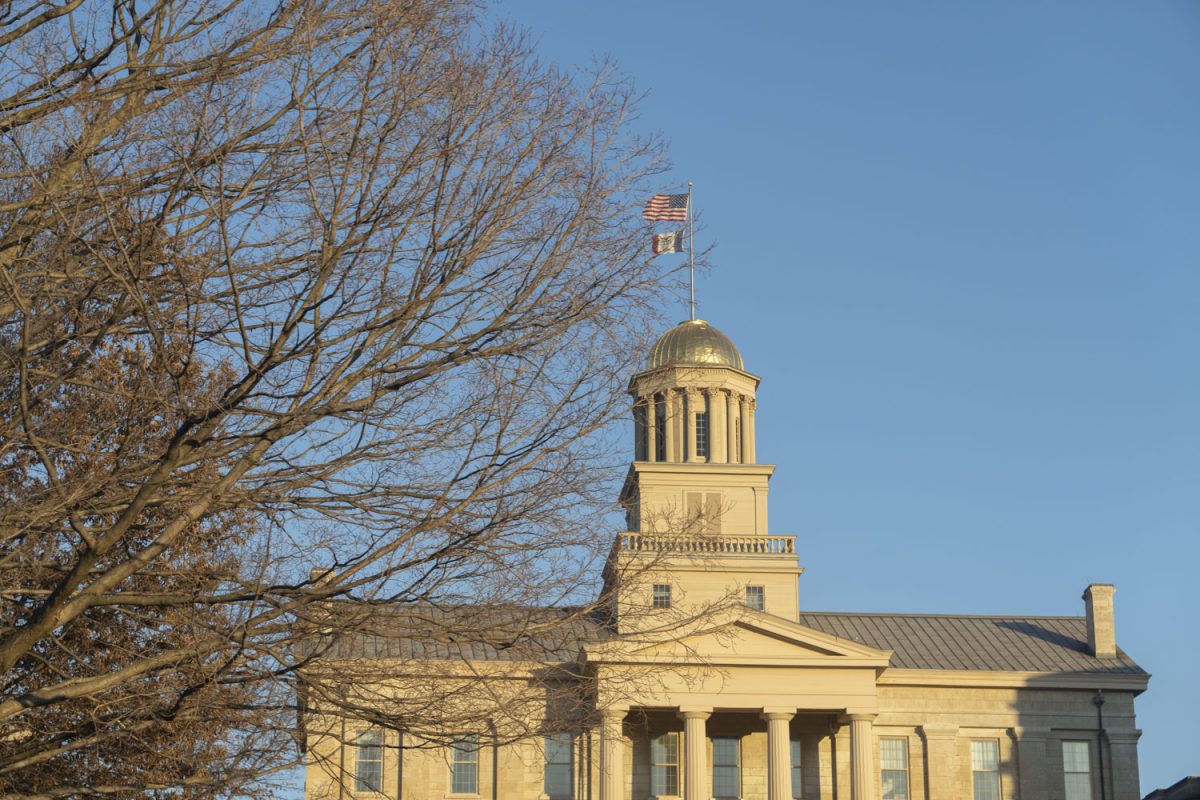
Over 70 historians and scholars who study the ancient world from around the nation gathered at the University of Iowa April 17-19 for the annual three-day 2026 Association of Ancient Historians Meeting.
The UI was set to host the conference in 2020, but the COVID-19 pandemic moved the conference virtually, making the weekend the first time the university has hosted it in person, on campus.
The conference primarily focused on ancient exchanges, or how people, ideas, and cultures moved and interacted across the ancient world.
The closing speakers of the conference highlighted their research, which delved into how ancient societies such as the Roman Empire defined migrants and those seen as “other.”
Sarah Bond, associate professor in UI’s history department, led the effort to bring the conference to the UI.
Bond said there are only about 100 ancient historians in the U.S. because the field is much larger in Europe and the Mediterranean, where the events they study took place.
Looking at other history specialties, Bond said there are thousands of archeologists and philologists — scholars who study the development of languages throughout history — in the country.
“This conference is a way of allowing the ancient historians specifically to come together and speak to each other,” she said.
Bond said the conference is particularly important in today’s academic landscape, when many departments are cutting back on the classics, with the UI is considering removing the classical languages major altogether.
“We want to make sure that ancient history is kept alive,” she said. “Yes, the classics are going through a very hard moment in time, but that doesn’t mean that we should forget about teaching the ancient world. That’s why the theme of the conference is to open it up to more people.”
Bond said the conference’s demographics were representative of a more diverse landscape of ancient historians, one open to all groups, rather than the stereotype of a male-dominated field.
Michael Kulikowski, a professor at Penn State’s Department of History and Classics, gave the final keynote of the conference.
He discussed how the Roman Empire’s dividing line between “citizen” and “barbarian,” which carried negative connotations of uncivilized behavior, was less distinct than many scholars realize today.
RELATED: UI professor repairs damaged ancient manuscripts with AI
“There are any number of people whose origin, whose birth, possibly whose childhood and adolescence are outside the Roman frontier, and yet who are not categorized as barbarians, not subject to the stereotypes, and were full participants in Rome,” he said.
Kulikowski advocated for greater nuance in distinguishing ancient people who were simply born outside the Empire from those subject to the negative identity of a barbarian.
Naomi Campa, an assistant professor in the University of Texas at Austin’s department of classics, presented the conference’s final research paper, which focused on reevaluating the broad term for an ancient migrant.
Campa said the ancient world experienced constant waves of migration, but scholars currently lack a consistent way to define and compare migration.
She advocated for a new framework that would distinguish itself from the often-interchangeable word mobility — or someone who moves — by defining a migrant as someone who moves from one cultural environment to another with the intention of living there.
Campa said she also aims to build a digital database to catalog and compare ancient migrations, helping researchers analyze migration patterns throughout history.
Kulikowski said that although scholars’ discussion of migration in Rome is heavily influenced by debates about migration today, the ancient world had a very different attitude to migration.
“The Roman Empire was enormously available for migrants to come into, and it’s in part because of the population,” he said. “The Roman world is maybe 70 million people in an area the size of Europe and North Africa. The entire empire has a population that’s less than a quarter of the United States.”
The entire conference explored a wide range of topics from medical and environmental history, slavery, and the Bible in ancient history.
Shane Bobrycki, an assistant professor in the UI’s History department and chair of a panel on medical and environmental history at the conference, said the conference sheds light on civilizations beyond ancient Greece and Rome, which have overshadowed scholarly discussions of other ancient civilizations.
“Part of the idea of this conference is to open the doors to a lot of other ancient societies,” he said. “So we both have some comparative papers that will look at the maybe more familiar Western cases and put them in conversation with East Asian or Near Eastern cases.”
Rosemary Moore, an associate professor in the UI’s Classics Department who helped open the conference as a welcome speaker, said she appreciates that the conference follows a single schedule, giving attendees no option to branch off into other lectures and miss out on discussions with the rest of the group.
“Everybody hears every paper, so that makes conversations really fun,” she said. “We all have a common point to go on.”
Bond said the conference coming to Iowa underscores that, while Iowa is far from traditional Ivy League universities, it still has a significant role in the study of the ancient world.
“The classics don’t just exist on the East Coast or on a few West Coast elite universities like Berkeley or Stanford,” she said. “Iowa is still very much an intellectual powerhouse, and we want to recognize that. Yes, we are in the Midwest, but we are a strong energy within the field as well.”