


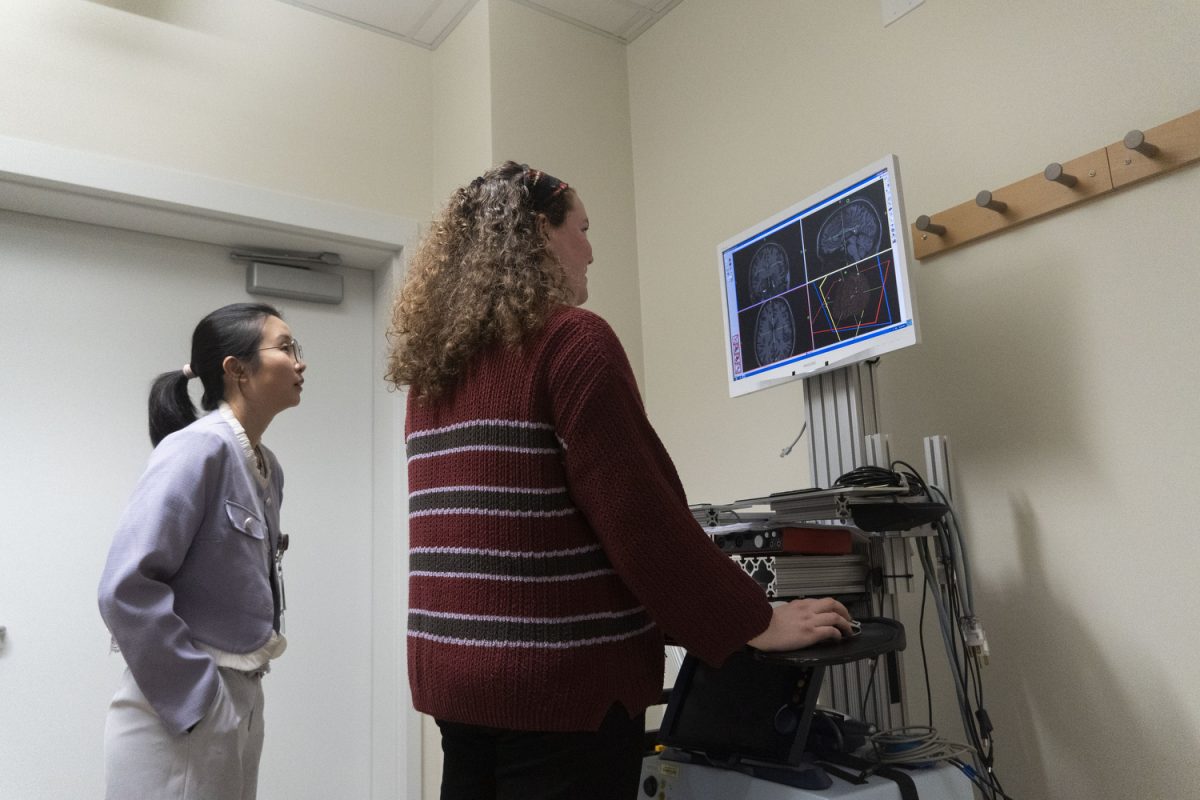
A University of Iowa research team is aiming to treat conditions such as depression, anxiety, and post-traumatic stress disorder without surgery or medication, but rather with magnetic pulses — aiding the hundreds of patients who utilize UIHC’s psychiatric outpatient clinics per week, along with the 88 beds designed for inpatient psychiatric care.
The team’s study, published in March, illustrated that the hippocampus — a deep region of the brain involved in memory and emotions — could be influenced through transcranial brain stimulation, or TMS, a noninvasive brain stimulation technique that uses magnetic fields to activate parts of the brain.
RELATED: UI study finds single workout session boosts brain activity related to memory
Jing Jiang, an assistant professor of pediatrics at the UI and the lead author of the study, said the findings challenge the presumption that TMS only influences superficial regions of the brain.
Jiang said if the hippocampus region is dysfunctional, it can cause mental health and neurological conditions, such as Alzheimer’s, depression, anxiety, and PTSD.
Aaron Boes, a neurologist at UI Health Care and a co-author of the study, said TMS is essentially a coil made of copper wires that, when introduced with electricity, creates a magnetic field.
“The idea is you hold a TMS coil right above the area where you want to stimulate the brain and then deliver pulses of stimulation,” he said. “It creates a small region of stimulation, maybe the size of a golf ball.”
The TMS method used in the study provides a new alternative to traditional ways of influencing the hippocampus, either through surgery or medication, the latter of which can often target a different region of the brain than the one the patient desires.
“If we can noninvasively modulate this region, it will have very broad benefits to the clinical population,” Jiang said.
Nicholas Trapp, a psychiatrist at UIHC and a co-author of the study, said the analyzed patients were divided into two treatments using TMS.
Trapp and Boes monitored one category where patients used TMS along with around 200 electrodes, small sensors placed inside the brain to detect electrical signals.
The other category, monitored by Jiang, used TMS along with MRI scanners, advanced imaging devices that create 3D images of tissue, organs, and bones.
The team programmed the TMS device in advance to briefly pause the MRI, deliver a magnetic pulse to the brain, then turn the scanner back on to capture how the brain responded.
“It’s a very unique thing we have here at Iowa,” Trapp said. “There are only a few other places around the country where you can look at brain activity measured with a functional MRI scan while doing TMS.”
Jiang now looks to influence subregions of the hippocampus in a future study, allowing her to influence the region with greater precision, possibly helping to mend damaged emotional regulation and memory formation.
Boes said researchers have long discussed the possibility of TMS influencing the hippocampus, but never had direct proof until this paper.
“We have real data showing that this is what’s happening, so that’s exciting,” he said. “I think it propels the next line of studies, which is now that we know that we’re actually modulating the hippocampus, how do we leverage that to the advantage of our patients?”