


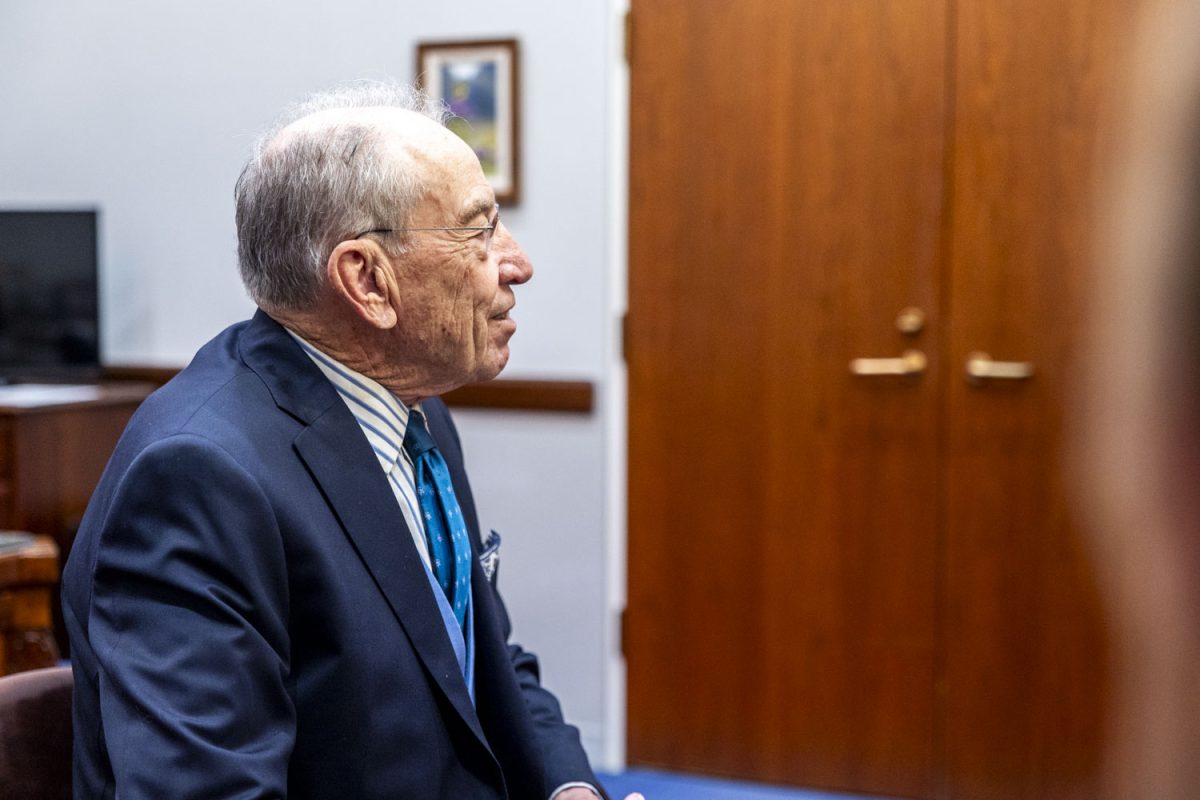
WASHINGTON — In an interview with The Daily Iowan, U.S. Sen. Chuck Grassley, R-Iowa, spoke on the SAVE Act, how to handle increasing fertilizer prices for Iowa farmers as planting season approaches, and the prevalence of farm bankruptcies in the state on April 15.
This interview has been edited for length and clarity.
The Daily Iowan: As a cosponsor of the SAVE Act, could you speak to why you support this legislation and how you think it will affect voter confidence and election procedures?
Grassley: I suppose I support it for the main reason it’s a top issue here in Washington, D.C. Polls show 85 percent of the people support it. They want fair and honest elections, and even 71 percent of the Democrats support it.
Do you anticipate the SAVE Act will clear the Senate?
You’ll have to ask Senator [John] Thune that whenever he forces the vote, and I think he’s looking forward to getting it passed, but you’ll have to ask him.
Critics of the SAVE Act worry it will disenfranchise voters, specifically married women, do you have a response to those claims?
Yes, I do. I think it’s pretty simple for people that can’t show the documents that you normally show your citizenship. There’s one final step that you’d have to take if you can’t have any of those documents, because we don’t want to deny anybody that’s a citizen of the United States the right to vote. You just sign a disclaimer that you are a citizen of the United States under the recognition that you’re saying the truth and voting under the law.
Iowa recorded the second most farm bankruptcies in the nation: what is your response to this?
It’s gone up. Yes. It’s gone up from six last year to 12 or 13 this year. Out of 86,000 farmers, I think that that’s a small percentage, but I think it is something that we definitely have to keep on top of. And I tried to do it through people that lend money to farmers and so three or four times a year we’ll have a dozen or so family and community bankers come in here, discuss the issue with them, and then I was traveling 25 counties during the recess. One of those meetings was in Winterset, with community bankers, and I flat out asked them a question, ‘Is there anybody that does business with each of your banks that couldn’t get loans?; And they said we were able to finance everybody, and they were surprised that sometimes the balance sheets of some of the bankers, or, I mean, some of the farmers they thought would be in trouble was pretty strong, but they said this admonition to me that they said, ‘We can’t continue very long with farmers losing $1 dollar 10 on corn and $2, $2.50 on soybeans, and so we’ve got to pay special attention to it.’
The reason that’s important for me to hear that from them is, during the agricultural depression of the 1980s, we were hearing similar things from bankers. We didn’t pay any attention to it. I mean, I’m talking about how Congress didn’t pay any attention to it. And then you got to 1986 and we had a terrific agricultural economy at that time. Farm land was worth a high of $2,400 and came all the way down to $700.
We lost probably 20,000 farmers, and we had farmers very indebted to their family farm, and probably five generations of it. They just got depressed and committed suicide. I mean, I don’t know the number, but you shouldn’t have any of that happening, and that’s why we need to stay on top of this, not wait two or three years later to take action.
Now this administration has given some the U.S .Treasury bridge money. So help people over a peak, because farmers are the bottom of the chain. You know, we pay everything that people need, want, for input, and then we take the price when we want to sell whatever they offer. [Farmers] don’t have a lot of bargaining power.
Do you see these farm bankruptcies reflecting a broader shift in agriculture and the future of what farming practices are going to look like?
Well, I think that’s an evolving thing. I mean, just look at me. My dad died in 1960. I started farming with tractors that were 30 or 40 horsepower. My son now has several tractors with 200-250 horsepower. We’ve generally had about a one and a half percent reduction in the number of farmers over the last 200 years, from 90 percent of the people farming in 1790 to about 2 percent of the people farming today. So it’s an evolutionary thing. You become more productive as an individual, the bigger tractors you have.
As the war in Iran continues, the demand for fertilizer is increasing. What are your thoughts on how this impacts Iowa farmers as planting season approaches?
What I’m trying to get an answer to one is company mosaic has 80 percent of the market for phosphate in this country. Phosphate is one of the three ingredients to growing corn, hydrogen or nitrogen, and potash the other. And so if they got 80 percent of the market, how come Biden put on a countervailing duty of 18 percent tariff coming in from Morocco. I don’t understand it.
I had an opportunity to ask that same question of a nominee for the International Trade Commission yesterday in my office, because they come around, we get a chance to ask some questions before we vote yes or no on our nomination, and that’s something I’m bringing up now. It’s good news to us that recently, [President Donald] Trump tweeted about fertilizer issues, and this is one thing that I’m hearing from in these 25 counties I was in over the Easter recess about high input costs and fertilizer was at the top of the list, even though diesel has gone from $4 to over $5 now as a result of input for the tractors and all that.
So we’re hearing a lot about it, and I have a fertilizer research bill that gives the Secretary of Agriculture the authority to keep on top of the inventories for phosphates, if there’s any questions of antitrust in fertilizers. But there’s one thing that is at the highest level here to help the American farmer, and that is E15 year round nationwide. Now eight counties or eight states in the Midwest, because of a EPA waiver, can have E15, and Iowa was one of them. The rest of them are mostly Midwestern states.
The other 42 states, if we can get that established by law now, are established by presidential waiver under Biden and under Trump one and under Trump two, for about six years. But you can’t get retailers to invest in the more expensive pumps if it’s not by law, and you’re going to have certainty that investment is going to pay off. So that’s why that law, and the Iowa Corn Growers [Association] economist says it’s [E15] going to bring $14 billion more into income from selling your corn.
Republicans are facing internal divisions and democratic opposition over DHS funding. How do you plan to tackle this issue?
I think that you’ll find that next week, we’re going to do it through the reconciliation process, and you’ll find Republicans totally united on what we’re doing, and we’re going to do it for funding for ICE and Border Patrol, because, it’d be the whole of Homeland Security would be funded with X amount of dollars. That will get us through to fiscal year 2029 and I think we’ll be united on that. So, you may hear some differences of opinion, but I think we had a caucus yesterday that shows unity behind this approach.
As one of the longest serving members of the Senate, how do you see voter priorities maybe shifting in this election cycle, and how is that influencing your approach to campaigning?
I think I have to look at that. I’m hearing now about prescription drug prices, the five-year Farm Bill, E15, maybe some things on what we call transportation, the Highway Bill, the Infrastructure Bill, which we do every five years, and runs out at the end of this year.
That’s important. For instance, Iowa got $64 million just last week. We announced we would fix our bridges that are in unsafe positions because Iowa leads in the percentage of bridges that fall into that category. That’s what I’m hearing.
I do the same thing all six years of a term. Just travel the counties every year and have a Q&A in every county. I do a few factories, a few high schools, a few hospitals, a few economic development groups, a few farm groups, so I hope I get a cross section of Iowans. I let them set the agenda on their Q&As.
Do you know if you plan to run for reelection?
Ask me in a year. Maybe a year and a half.