

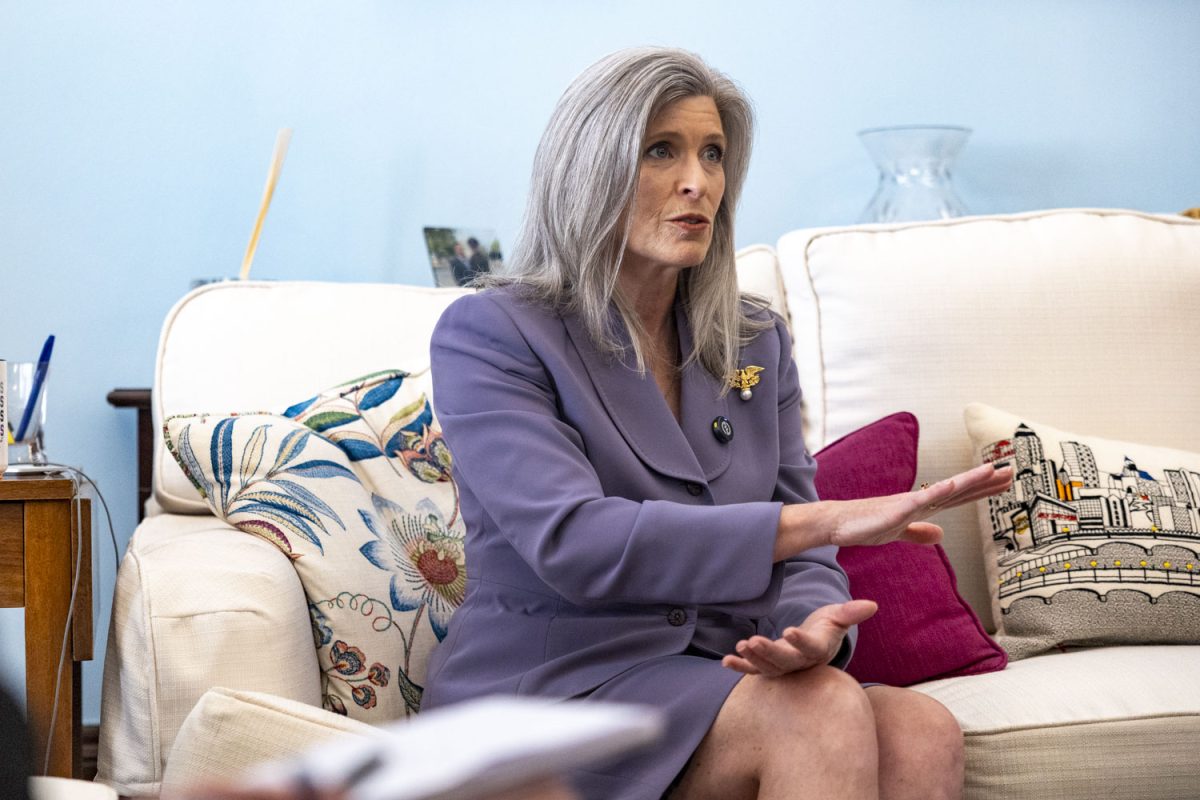
WASHINGTON — As the U.S. enters its second week in a ceasefire with Iran, U.S. Sen. Joni Ernst, R-Iowa, said as a combat veteran, she prays for peace every day.
Ernst was the first female army combat veteran elected to the U.S. Senate, after serving in the Iowa Army National Guard from 1993 to 2015. In 2003, Ernst led the guard as a company commander during Operation Iraqi freedom in 2003, according to her website.
Ernst said she supports President Donald Trump and his efforts in Iran, and that a ceasefire in Iran is “extremely important.”
“We should never turn away from an opportunity to find peace,” Ernst said.
Ernst said leaders in a series of Arab nations have continued to recognize Iran’s use of proxies and its continued uranium enrichment.
According to The Washington Post, Vice President J.D. Vance proposed a 20-year temporary suspension of Iran’s uranium enrichment and Iran officials insisted on a 5-year suspension on April 14 during peace talks in Islamabad, Pakistan.
“They continue to enrich uranium for nuclear purposes which endangers the entire region as well as the United States of America. So all of that needs to be dismantled,” Ernst said.
According to the World Nuclear Association, Iran has an active uranium enrichment program.
Ernst said leaders in the region have told her directly to continue until the Iranian regime is dismantled.
“The leaders in that region, now that the war is underway, what they have told me directly is, keep going, do not stop until they have no further way of funding terrorist proxies, the ballistic missiles and nuclear ambitions,” Ernst said.
Ernst said the Strait of Hormuz needs to be opened “as quickly as possible” as fertilizer prices and the cost of E15 continue to rise.
“This is really bad for our farmers,” Ernst said.
According to CBS News, Trump declared a blockade on the Strait of Hormuz, a key transit point for oil, gas, and other exports in the Middle East, on April 14.
Brian Lai, a political science professor at the University of Iowa, said the cost of keeping the Strait of Hormuz closed for the U.S. spans across all sectors and supplies. On a broader scale, Lai said the larger implications fall on the global economy.
Though the U.S. does not get all of its oil from Iran, a lot of other countries do, Lai said, and such turmoil will affect the U.S. economy.
“Any optimism about negotiations has kind of buoyed the markets. But if the Strait stays closed for a long period of time, you continue to see global prices rise,” Lai said.
For Arab nations in the region, Lai sees exporting oil through the Strait of Hormuz would present a barrier if it remains closed, impacting their economies and oil production.
Lai said concerns surrounding infrastructure within those nations are likely if the threat of future Iranian strikes remains.
Lai said if the war were to continue, economic costs could rise and negotiations would become more difficult, with the U.S. focusing on Iran’s nuclear program and Iran wanting a guarantee for no further conflict.
According to Foreign Affairs, Iran wants a continued promise the U.S. and Israel, a key player in the ongoing war, will not engage in another war with Iran.
Lai said the ceasefire, however, presents an opportunity for continued negotiations, despite peace talks failing on April 12 after 21 hours of negotiation.
“Even though those peace talks did not go anywhere, it is hopeful and very possible they will continue negotiations in a couple of days,” Lai said.