


The evolution of platforms built around CS2 case opening and case battle site mechanics has changed how users approach inventory management. In 2026, it’s no longer just about opening cases or joining battles—exchange systems are becoming just as important, especially when they remove friction from the process.
One of the most discussed aspects is the idea of exchanging items without additional fees. While the concept sounds simple, the way it works in practice is more nuanced.
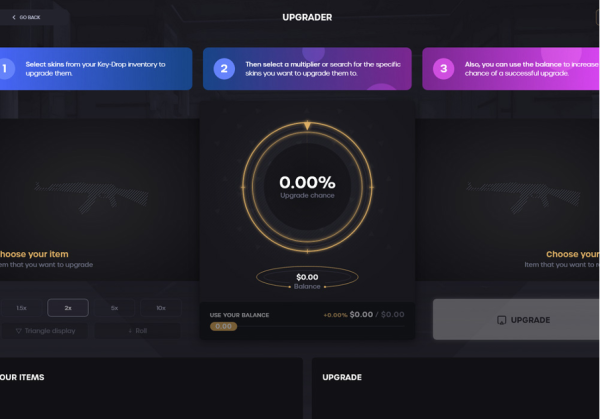
What “no-fee exchange” actually means
At first glance, exchanging without fees suggests a direct, lossless conversion between items. In reality, the system works differently.
Instead of charging a visible commission, platforms structure the exchange through internal pricing. This means:
- values are calculated within the platform’s own system
- exchanges happen instantly without negotiation
- there are no separate transaction costs added at checkout
So while there’s no explicit fee line, the balance is maintained through how items are valued internally.
How the exchange system works on Key-Drop
Key-Drop simplifies the exchange process into a few steps. The goal is to remove the need for external trading or manual deals.
The typical flow looks like this:
- select the item (or items) from your inventory
- view available exchange options
- confirm the swap instantly
There’s no waiting for another user, no negotiation, and no delays. This is what makes the system feel faster compared to traditional trading.
Why this approach feels more efficient
Speed is one of the biggest advantages. Traditional exchanges often involve multiple steps, including finding a partner, agreeing on terms, and confirming the trade.
Here, everything happens within a controlled environment. The benefits are clear:
- immediate execution
- predictable outcomes
- reduced complexity
For many users, this is more practical than manual trading, even if it offers less flexibility.
How it connects with case opening
Exchange systems don’t exist in isolation. They become more useful when combined with case opening.
After opening cases, users often end up with a mix of items that don’t align with their goals. Instead of leaving them unused, exchange allows for quick adjustments.
This creates a simple loop:
- open cases to generate inventory
- exchange selected items
- refine the overall inventory structure
The process becomes continuous rather than fragmented.
The role of case battle in this flow
Case battle adds another layer to the system. After participating in battles, results can vary significantly.
Exchange helps stabilize those results. Instead of keeping every item as-is, users can reshape outcomes to better match their preferences.
This makes exchange a balancing tool within a broader workflow.
Where the system has limitations
While the no-fee model is efficient, it does come with trade-offs.
One of the main limitations is reduced flexibility. Since exchanges are based on predefined options, users can’t negotiate custom deals.
Another point is that internal pricing may differ from external market perception. This doesn’t necessarily make it worse—it just means the system operates within its own logic.
Understanding this distinction helps avoid confusion.
Common mistakes when using exchange
Even with a simple interface, certain habits can reduce effectiveness.
A frequent mistake is exchanging items immediately without evaluating options. Quick decisions can lead to less optimal outcomes.
Another is focusing only on visible value. The usefulness of an item depends not just on its price, but on how it fits into the overall inventory.
There’s also a tendency to overuse exchange instead of combining it with other tools like upgrading.
How to use exchange more effectively
A more structured approach improves results without adding complexity.
Instead of treating exchange as a quick fix, it helps to:
- review available options before confirming
- think about how each item fits into the inventory
- combine exchange with other actions like upgrades
This turns exchange into part of a larger process rather than a standalone action.
Why no-fee systems are becoming standard
The move toward no-fee exchange reflects a broader trend. Platforms are focusing on reducing friction and making interactions faster.
Users now expect:
- instant actions
- transparent steps
- minimal interruptions
Systems that rely on slower, manual processes are becoming less attractive in comparison.
A smoother way to manage inventory
Exchange without visible fees doesn’t eliminate trade-offs, but it simplifies the experience. By removing extra steps, platforms like Key-Drop create a more fluid environment.
In 2026, managing inventory is less about individual actions and more about how those actions connect. Opening cases, upgrading skins, and exchanging items all form part of the same system.
Understanding that connection is what allows users to move from random outcomes to more structured decisions.