
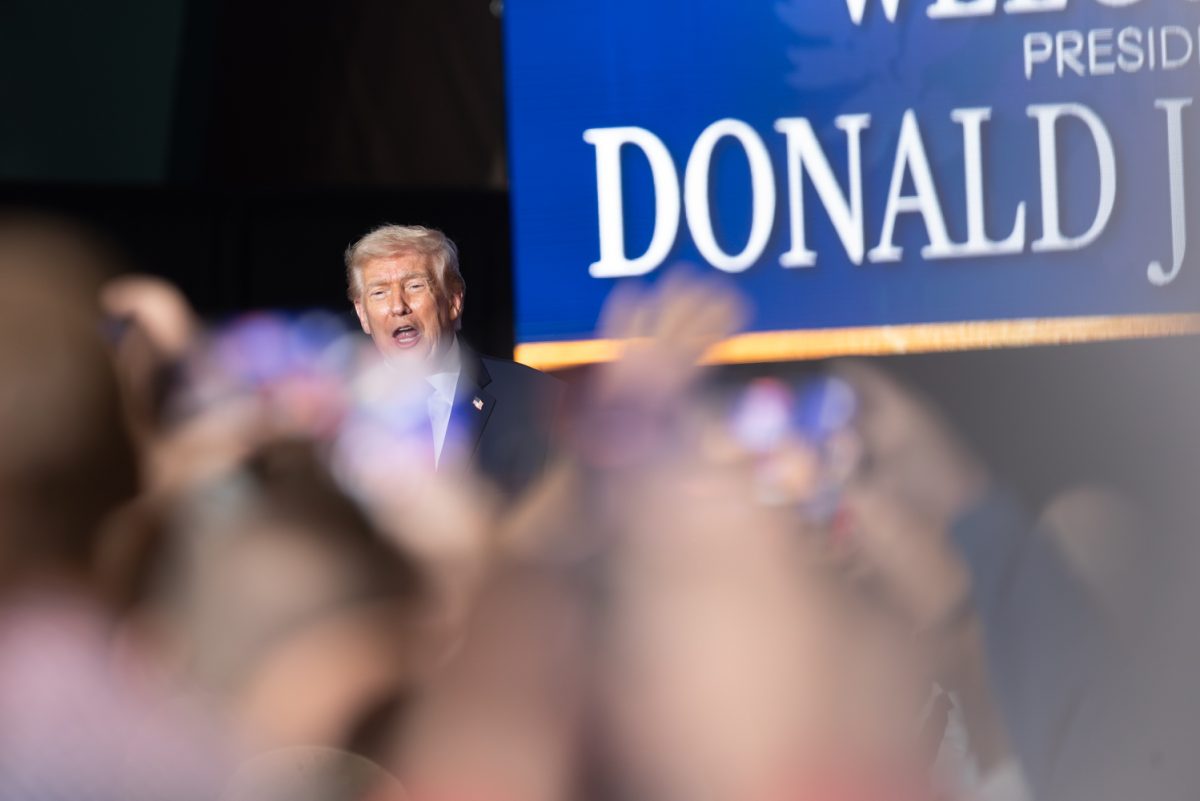
Automatic draft registration will start in December 2026, following President Donald Trump’s signing of the fiscal year 2026 National Defense Authorization Act into law in December 2025. This will allow the Selective Service System to automatically register all men ages 18 to 25 for the draft.
On March 30, the Selective Service System submitted a review for automatic draft registration to the White House Office of Information and Regulatory Affairs.
A University of Iowa professor and members of campus political organizations have varying sentiments about the broader implications of automatic draft registration, but there is a shared consensus that it will improve government efficiency.
Those excluded from draft registration include individuals who are incarcerated, hospitalized, or those with non-immigrant visas. According to the Selective Service System, automatic registration will be achieved through the sharing of federal data from other government agencies to identify eligible males.
RELATED: IC community rallies against the UI weapons manufacturing, foreign wars
According to a 2024 report from the Selective Service System, 46 states, including Iowa, have already implemented automatic draft registration through driver’s license, learner’s permit, and state identification enrollment. Federal regulation also requires male students to be registered with the Selective Service System before receiving student aid under Title IV of the Higher Education Act.
The last U.S. draft was in 1973 during the Vietnam War and had over 1.8 million inductions. Draft registration was suspended in 1975.
The military later transitioned to an all-volunteer force. Then, in 1980, former President Jimmy Carter reinstated the draft registration in response to the Soviet Union’s invasion of Afghanistan, and it has been active ever since.
Just days after the Selective Service System submission, Trump took to TruthSocial on April 8 to talk about the use of military personnel and equipment to destroy U.S. enemies in and around Iran as America’s next “conquest.”
Due to uncertainty with the Iran war and Trump’s social media announcements, confusion over what the automatic draft registration symbolizes has emerged.
UI political science professor Tim Hagle said the change is not significant, but there are both pros and cons to federal data sharing.
He said some people may fear data sharing for automatic draft registration being used as a tool to locate undocumented immigrants as part of the Trump administration’s mass deportation initiative, but he also thinks it will help with efficiency, as data sharing helps strengthen the registration process by detecting and reducing errors.
Hagle said the Iran war may lead people to question whether automatic draft registration is related to wartime preparation, but he does not believe that’s the exact case due to Trump’s open negotiations.
“As the president or any government leader, you generally want to keep your options open. You don’t want to signal to the opposition what you’re going to do,” he said. “But still, the military is involved, which does sort of raise those thoughts.”
Hagle referenced the Vietnam War as well and said that it is another concern, particularly for older generations who lived through it. Despite that, he thinks an active draft is unlikely due to bipartisan views in Congress that would oppose the draft today.
“It would not seem to be something that voters would agree to,” he said. “Even members of Congress, and we’re seeing Democrats saying that they want to have a vote in the War Powers Act to limit Trump’s ability to conduct these operations, and Republicans are not thrilled with the notion either.”
Hagle believes that prolonged conflicts, such as Iraq and Afghanistan, are additional reasons as to why neither party would want to execute a draft unless in a worst-case scenario where the U.S. were to be invaded by another strong militaristic country.
“We’d need to significantly and quickly build our military capabilities and have a draft as a result of that, but I think right now, they will stick with a volunteer force,” he said.
Isaac Branch, a second-year UI student and secretary of UI Turning Point USA, said he isn’t very concerned with the cross-agency data sharing, as long as the government isn’t hiring more federal workers. He does believe an automatic draft registration method is more cost-effective overall.
Branch said the U.S. acts as a mitigator for international wars, and it is important for our government to have greater military power to bring order, especially in issues such as genocide and the exploitation of certain groups.
“A way in which, not so much keeping America the global superpower, but ensuring safety around the world is through, if it is through people serving, it’s through people, great men and women, laying down their lives for this country,” he said. “Obviously, we want to reduce that, too, but at the same time, it’s necessary to an extent.”
He thinks this is an important dispute, an ongoing criticism of current global conflicts, and even small changes like this are used to ridicule policies in the Trump administration.
“I would say there’s a good amount of fear-mongering behind it, as there is with anything politically,” he said. “When one side makes a move, the other side reacts.”
Branch said living in America is a privilege, and so is fighting for the country’s liberty. If a draft were to happen, he said he is in support of imprisoning those who evade it.
The punishment for draft evasion or assisting someone in evasion is a $250,000 fine or five years of imprisonment.
“Obviously, there’s going to be people that disagree with that, even within my party, even within my club, I would say so,” he said. “But it is a luxury to live in this country. Every day.”
Fourth-year UI student and member of the university’s Young Democratic Socialists of America chapter, Dave Cacho, said draft evasion punishments favor the rich and are unfair to ordinary people.
Although Cacho does not think the change is significant, he said it would be better for the U.S. government to utilize shared data to help citizens vote rather than locate men who need to register for the draft.
Cacho also said it is coincidental that this change is happening during U.S. conflicts in Iran, Venezuela, and elsewhere, but does not believe it will lead to an active draft.
“I stand against these wars because it’s very clear that this is a matter of power and resources, and not about anything to do with our freedom, or anything about national security,” he said. “But I do feel like this is something that gets media hype before we find out that no huge changes have been made.”
Cacho recognized the worries people may have, specifically based on how the Trump administration has presented geopolitical information on social media.
“Like Trump’s post on Truthsocial about wiping off an entire civilization, it does bring concern as to how likely a draft would be,” he said.