


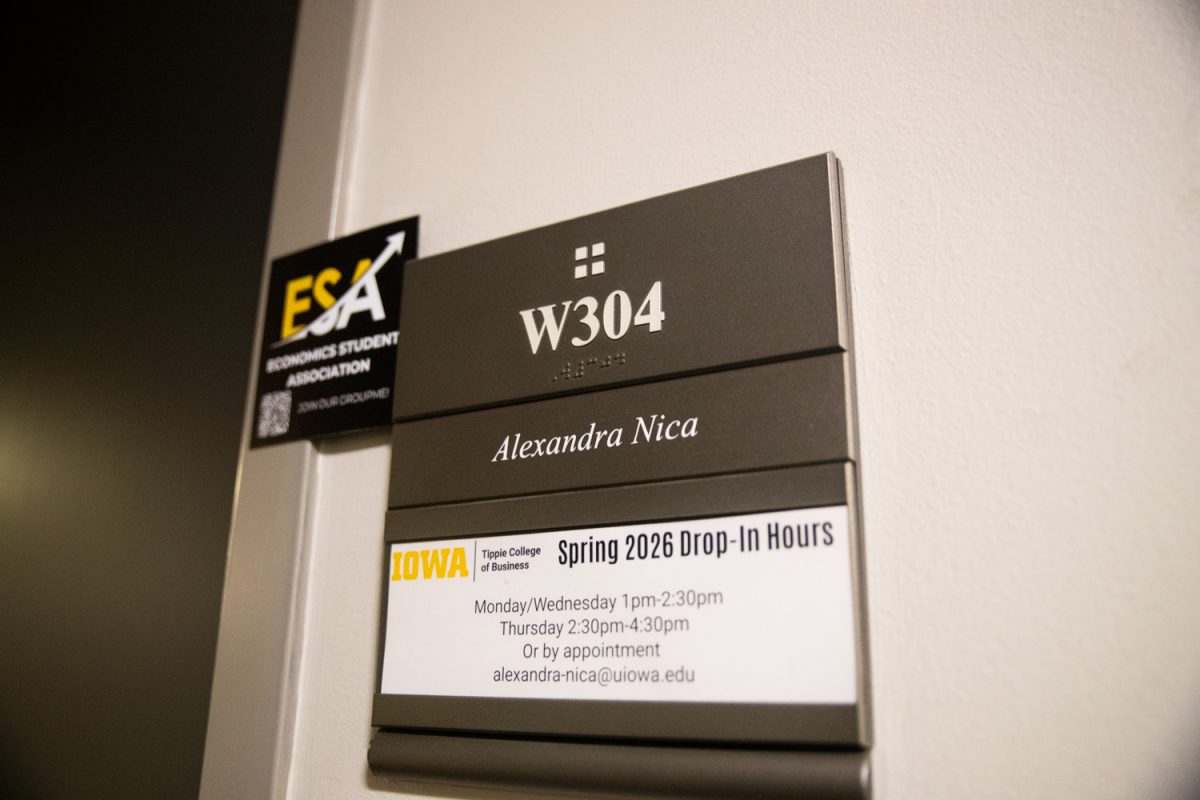
University of Iowa Tippie College of Business professor and Director of Undergraduate Studies in Economics, Alexandra Nica, received the Macmillan Publishers’ Justin Wolfer Guest Lecture award for her unique teaching style of art in macroeconomics.
The award celebrates the release of the third edition of “Principles of Economics,” authored by economists and University of Michigan professors Justin Wolfers and Betsy Stevenson, a textbook aimed at showing students the instances and applications of economic theories in everyday life. Wolfers lectured at two of Nica’s classes on concerns of how AI will affect the future of economics on April 8.
The winners consist of two instructors from different universities who have unique teaching methods for economics, and the instructors have been given a virtual or in-person lecture from either Stevenson or Wolfers.
Nica, who is from the Transylvania region in Romania, attended the UI as both a master’s and Ph.D. student in economics. Eventually graduating in 2013, she has been a UI faculty member since 2014. Nica has taught various courses, but is now the primary instructor for Principles of Macroeconomics and Intermediate Macroeconomics.
In those classes, Nica utilizes the textbook “Principles of Economics,” as it employs common real-life examples for students’ understanding. She said she first started with the book in 2020 after attending a conference where she pre-viewed the chapters.
“I really liked what I was seeing because it was such a great way for students to find economics a lot more relatable,” she said. “A lot of times, students find economics intimidating. It’s a lot of math. Justin and Betsy’s approach is so nice because they really help us make economics a lot more relatable to students.”
In addition to using the textbook, one of the unique methods for which she is being recognized was her visual project in partnership with the Stanley Museum’s ArtInfuse program.
This program helps faculty members integrate art into their lessons and assignments. Nica said combining art and economics helps students enhance their critical thinking skills. Students do a focus on exercise where they identify details in a piece of artwork. Then, they can apply this detailed analysis to the coursework, as they examine graphs and their meaning.
Nica said she had always wanted to incorporate art into her classroom. Much of this inspiration stems from her background as a well-recognized pianist, such as being a finalist for best contemporary period at the Washington International Piano Arts Council in 2017.
RELATED: Visiting professor speaks on journalism’s future, international issues
She said her assignments ask students to list three economic concepts they’ve learned in class as they concentrate on the art.
“For example, a painting showed workers gathering weeds, so the concept of trade applies. The concepts could also be about artists. What type of inputs has the artist used, in terms of colors, materials, or threads?” she said. ”It’s also so rewarding for me to see what they come up with and how they link that economics doesn’t just happen in the classroom. It’s everywhere.”
Nica believes everyone should understand cross-benefit analysis and opportunity costs. She said resources are scarce and time isn’t limitless, so understanding the variables that go into decision-making will yield better outcomes.
“I really wish people were not scared of economics,” she said. “This is why I went that route, where I am trying to teach it in a way that’s less scary.”
Tippie professor of management, educational policy, leadership, and entrepreneurship, Ken Brown, has worked at the UI for over 27 years and has known Nica since she was a Ph.D. candidate. He finds her visual project with the Stanley Museum exciting and provides a better way for students to learn.
“She’s a very talented professor, and she’s helping address anxiety that some students have with complex graphs,” he said. “In my own life, I remember my economics classes. The professor showed supply and demand curves as if I should understand them right away, but Alexandra makes stuff very approachable.”
Wolfers described Nica as an amazing professor who could help her students and said he was flattered to be chosen as a guest lecturer.
“AI seems like a topic that’s on a lot of people’s minds. Some people are anxious about it, some people are excited, both make a lot of sense,” he said. “It’s sort of fun to be able to talk about a topic that I hope resonated with students. I believe the world would be a better place if we all knew a little bit more economics.”
Wolfers also said his textbook, “Principles of Economics,” took over a decade to write with his partner Stevenson until it was first published in 2020. He said he wants to continue writing more textbooks that can help people grasp economics.
He reiterated a similar statement to Nica’s thoughts on why economics is important as well. Wolfers said when college students make decisions like attending college, setting up their alarm, or studying, economics helps manage the options.
He also said learning economics is especially crucial for kids of working-class families, as a means to lift themselves out of poverty.
“If we can help educate them to see the world and their choices a little more clearly, then they’ll be empowered to make better choices for the rest of their lives. That’s a possibility economic education can directly change and better people’s lives,” he said.