
I’ve never been a huge fan of hunting or hunters. I immediately swipe left on dating apps that proudly boast pictures with dead animals. It always seemed barbaric to me to enjoy the killing of another life.
But that’s my personal take. I can admit that it’s misguided and influenced by harmful stereotypes that aren’t always true of the majority of hunters.
Stigmas around hunting are often attributed to the minority of hunters that do so illegally or who hunt big game solely for sport without consideration for the wildlife. They give hunting a bad reputation.
But for most hunters out there, the hunt is about the experience, Johnson County Conservation Director Brad Friedhof said. It’s not about the harvest of the animal but the entire process of being connected with the environment, studying, and learning from animals and their behaviors.
The majority of great hunters are ethical. They’re effective and efficient. They respect the wildlife. Hunting isn’t just a hobby that allows for connection with nature; it’s an environmentally necessary process and a sustainable alternative to industrial agriculture.
Conservation is a balancing act between the protection and care of the environment with that of human actions. Humans have a heavy impact on their environment and hunting is an important counterweight that helps to keep that scale balanced.
“Our job is to manage wildlife populations because we’ve altered the natural ecosystems so much that we’ve eliminated some of those control factors,” Friedhof said.
When those control factors, namely apex predators, have been eliminated, populations grow too high for the environment to support, and that’s when other control factors, like disease and famine, take over. The latter factors can be devastating. They’re not quick or painless processes, and it’s tragic to see an animal suffering from something that could have been prevented.
We have a role to play, a responsibility owed to the environment through hunting. While we play that role well in some places, in others we struggle to fulfill that commitment.
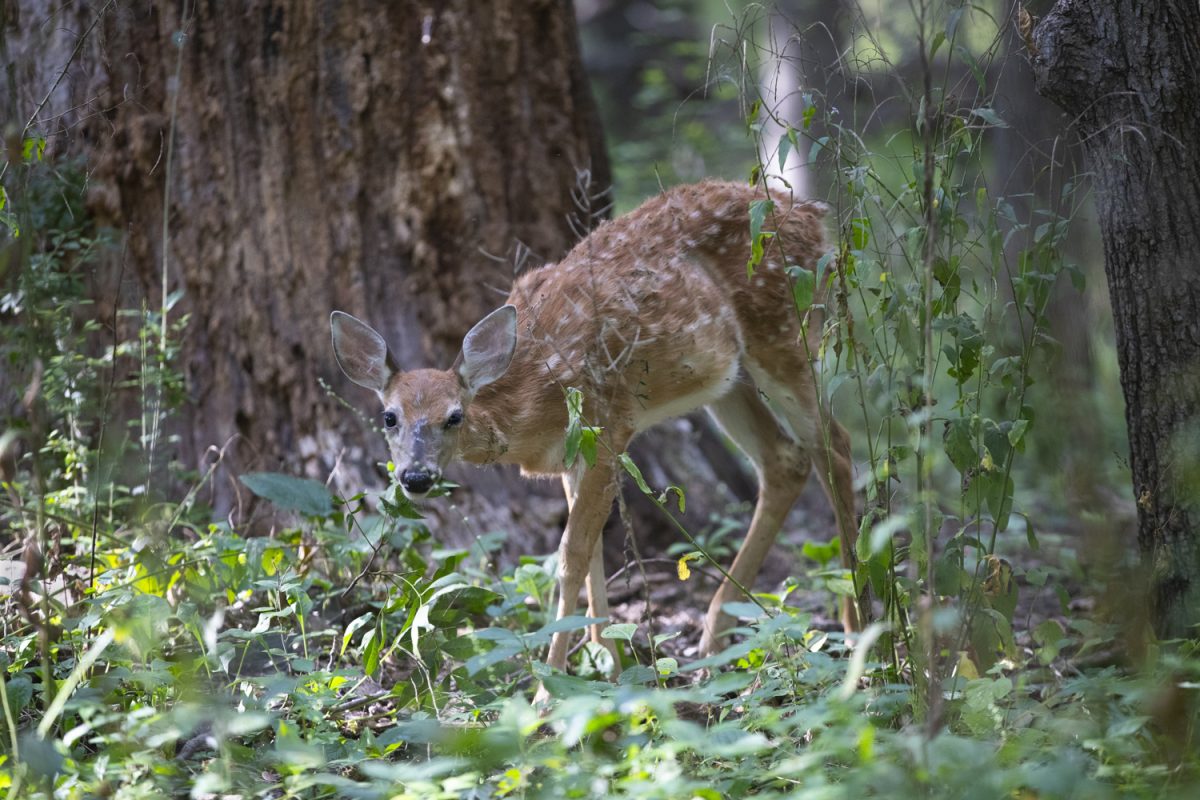
“In Iowa City, we struggle managing the white-tailed deer population,” Friedhof said. “We’ve got a lot of people, we’ve got a lot of different terrain, and it’s hard to get hunters in these locations to safely harvest those deer sometimes.”
In late February of 2025 a drone survey of deer in northern Iowa City found the population to be nearly four times its target of 25 deer per square mile. An alarming 480 deer were present in the 4.8 square mile survey area.
Ongoing issues with car collisions, trampled lawns, and eaten bushes have reflected the dense Iowa City deer population and the need for outside interference.
“Between April 2026 and 2029, the City may request one professional sharpshoot from the NRC.” The Iowa City Government page cites under its deer management program.
In-depth discussion and education regarding hunting helps to break harmful stigmas and encourages hunters to do their part in promoting healthy ecosystems.
Hunting also provides valuable information about population trends and wildlife behavior. In the case of white-tailed deer, the lower brain stem can be harvested and tested for chronic wasting disease. Some researchers study ticks collected or take blood samples from the deer to establish other fields of data and information. Anglers will do the same thing with tag fishing.
“The DNR collects a lot of data from [hunters and anglers],” Friedhof said. “We also thank those hunters and anglers because they’re providing funds to protect those environments.”
Hunting and fishing licenses go into wildlife habitat stamps, and those funds are spent across the state to protect and purchase or restore natural habitats for all species.We don’t always see this side of hunting and wildlife populations, and when we don’t, we don’t think about it, leading to harsh judgments and stereotypes. It’s not just the thrill of the kill. Hunting is a vital management, informational, and
economic tool.
“I look forward to, and I’m open to people who want to talk about this,” Friedhof said. “I think that the big thing is to have an open civic discussion.”