


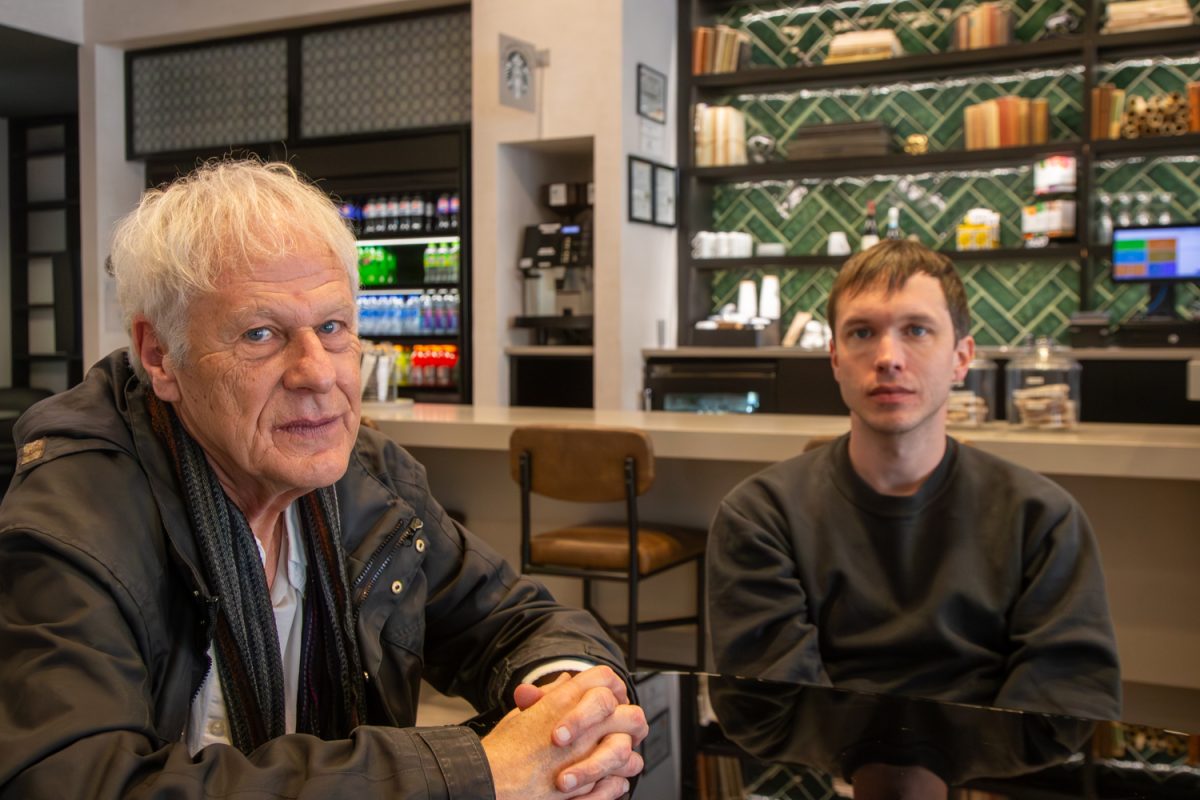
Dennis Cooper and Zac Farley are a longtime filmmaking duo who specialize in unconventional projects that transcend genre labels. Their new collaboration “Room Temperature” will be screened at FilmScene in collaboration with the Bijou Film Board on April 7 followed by a Q&A.
The Daily Iowan: What brought the two of you together, and what’s kept you together?
Farley: Dennis and I have been friends for 10 to 12 years, maybe more. The first film we made together ‘Like Cattle Towards Glow’ was, I don’t want to say an accident, but it kind of just happened.
Cooper: Producer Jürgen Brüning wrote saying, ‘I heard you wrote a script, I’d be curious to read it.’ Then I was like, ‘Zac, do you want to work on this?’ So we went through the script and re-wrote it, and Brüning said he would produce it.
Farley: We used it as an experiment about what we thought we could do with film. It was composed of five short films that are related to each other but were completely different in tone, characters, and locations. Making films is pretty addictive, so we just kept doing it.
How did this collaboration with FilmScene and the University of Iowa come about?
Farley: Ben [Romero] from the Bijou Film Board got in touch with us, asking if we would consider coming to Iowa City to show the film. Neither of us had been to Iowa before, but Dennis has a friend here who teaches. We were honored and excited to be asked.
How does “Room Temperature” both uphold your established voice and represent a new artistic avenue?
Farley: We’ve both been obsessed with homemade haunted houses since we’ve known each other; it’s one of those brilliant outsider art forms. We wanted to use that but also set ourselves up with a challenge. Part of that was having a character in the film as important when he was there as when he wasn’t there, to haunt the film in a certain way.
Cooper: We wanted to make a film about this subject matter that wasn’t a horror movie, to do everything possible not to fall into those cliches. That was a big challenge too. As far as I can tell, there’s never been a fiction film about a home haunt. There’s no role model, no precedent. We had to figure out how to do it ourselves.
Do you think of “Room Temperature” as a horror film, or in terms of genre at all?
Cooper: No.
Farley: We play with that expectation at the start of the film. For the first few minutes, you’re maybe convinced that it’s going to be a horror film but then the tone completely shifts. We’re not really commenting on the horror form but it’s subverting the expectations for sure.
If someone asked you to boil down your work into a single word, phrase, or pitch, what would you say?
Cooper: I’m trying to think of how publicists have described my stuff because I hate how they describe it. I think my work is about confusion but that’s not a very good pitch.
Farley: That’s a pretty good pitch.
Cooper: We’re weird people. Most people would read that it’s about confusion and think, ‘well I’m not reading that one.’
Farley: I’m really interested in form. I know confusion and form don’t immediately seem compatible but they mess with each other.
What’s next for the two of you?
Cooper: We’re just finishing writing a new film. Then we have to find a producer and see how it’s going to get made. Unfortunately we make really strange films that are never going to win prizes or get big distribution at Sundance Film Festival, so it’s tricky. Our last two narrative films have this very strong central premise, but this one we’re trying to do without a throughline. There’s characters and there’s things going on but there’s not really a ‘pitch.’