


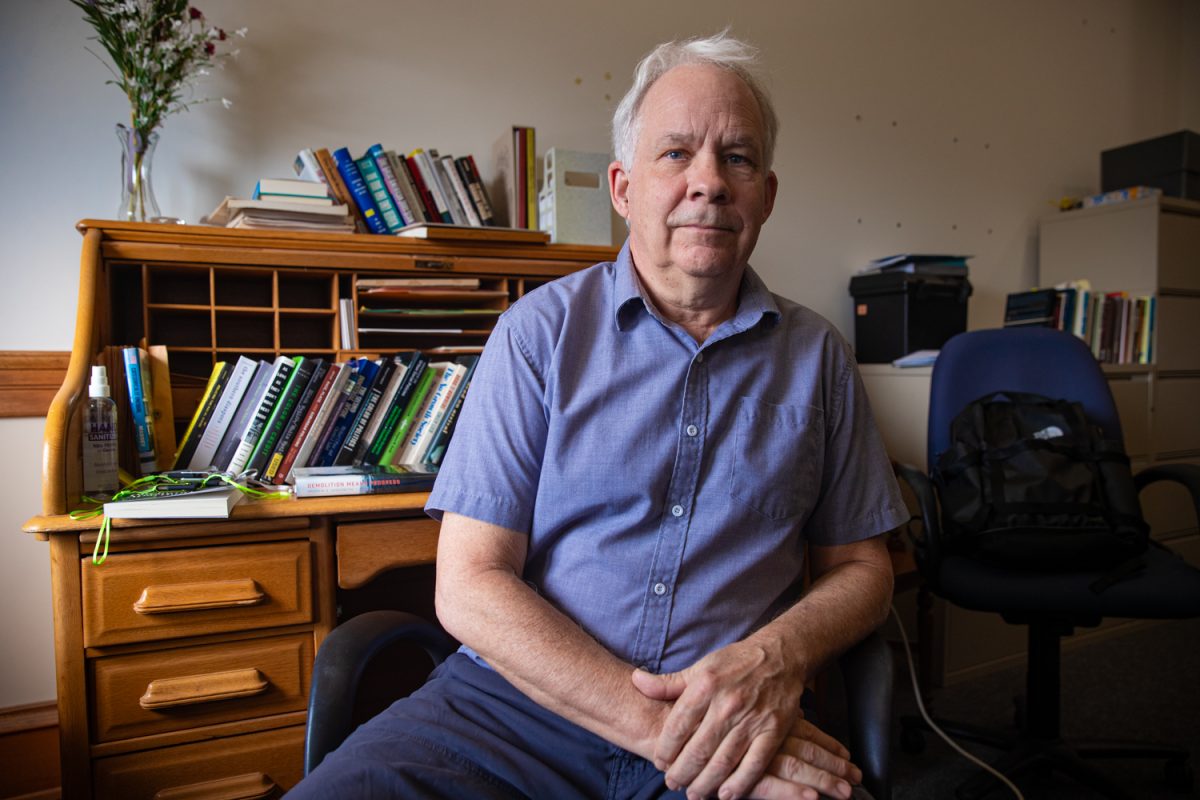
University of Iowa History Department Chair and professor Colin Gordon was named the 2026 UI Distinguished Chair in March. Gordon received this title after making significant research contributions at the UI.
The title of distinguished chair, for which all tenured professors are eligible, is one of the highest honors that UI professors can be awarded, according to the Office of the Executive Vice President and Provost’s website.
The title recognizes and rewards exceptional UI scholars of national and international distinction who are making significant contributions to the university and beyond.
Gordon said his research mainly focuses on modern American history. Recently, he has been focusing on the origins of racial segregation in American cities. He has written several books, such as “Mapping Decline” and “Patchwork Apartheid”, that focus on urban crises and racial segregation in the U.S. Other titles include “Citizen Brown” and “Dead on Arrival”.
Along with the title, he will receive $250,000 in funding from the Office of the Provost to support research and activities, allocated annually in increments of $50,000. He will retain the title as long as he remains a professor in good standing at the UI. According to the UI’s website, there have been 12 professors chosen as Distinguished Chairs since 2020 across several departments.
Gordon plans to use the funding for two projects. One is in collaboration with UI professor Ashley Howard, researching the Great Migration in Iowa. Gordon explained the Great Migration as the movement of African Americans to Iowa in the first half of the 20th century. The project will focus on creating an interactive digital map displaying the migration.
The second project he is working on is with colleagues at the University of Delaware. They are focusing on the history of American social policy and programs for low-income families with children.
Gordon was honored when he learned that he received the award. He said it would give him more time to efficiently do his research and is especially looking forward to hiring his own research assistant. Gordon said that this will be a big boost for his research.
“I was pretty delighted,” he said, “It’s a pretty major chunk of support for someone who does the kind of work I do.”
Gordon has been at the UI for over 30 years, working as a professor since 1994. He said the intellectual climate of the university has stayed mostly the same, although the history department has gone through a few changes since he began teaching.
Gordon said academic job markets are more competitive than they used to be, causing the UI’s history department to get better, more productive candidates. He also said the history department is about half the size of what it was when he arrived at the UI. He said this is mostly because it is difficult to keep up with retirements in the department.
“It’s hard to run a full-fledged program in history, for example, when you don’t have expertise in parts of the world,” Gordon said.
RELATED: UI researcher investigates mass-produced AI-generated content’s effects
Gordon said the department used to have historians of China, India, and Japan, but now only has a historian of China. He said they have not been able to teach Japanese history for five years now, though. Gordon said this is more of a departmental issue than university-wide.
“As individuals in the College of Liberal Arts and Sciences, we’re still pretty well supported,” he said.
Gordon said another change he has experienced is in the federal research funding he and many other professors are provided. He said under the Trump administration, funding has almost disappeared for many fields.
Gordon has held many titles during his time as a UI professor, such as the F. Wendell Miller Distinguished Professorship, which also provided him with research funding. He said that this honor is different from the others because it is an endowed professorship, as well as being a permanent title.
“It comes with more than just a token amount of money, like enough to really support my research and hire a research assistant,” Gordon said.
He said he would use the money to expand the impact of his work by involving more students. Gordon said funding for a historian gives them time away to do their own research, and that they do not usually get money to hire research assistants.
“It’s really good for undergraduate and graduate students in the history department to have those kinds of research experiences,” he said.
Gordon said he wants to show the importance of undergraduate teaching. He said that his research has been shaped heavily by the undergraduate courses he has taught, giving the example of a course he teaches focusing on African Americans in Iowa counties.
“I find it really rewarding to try and make links between my research and what I do in the classroom,” Gordon said.
Gregory Wickenkamp, a doctoral candidate in the UI’s history department, said he really enjoys working with Gordon. He said his commitment to his students is impressive.
“He’s focused on the task at hand, but also makes time to relate to people, and when we were co-teaching, occasionally students would have questions or issues, and he was always available for them,” Wickenkamp said.
He said he has a lot of respect for Gordon and described him as being brilliant, thoughtful, and oriented toward justice.
“He’s very dependable,” Wickenkamp said, “Exceptionally bright and focused in the vision of work that he wants to accomplish.”
Wickenkamp worked with Gordon and Howard, researching the Great Migration and racial housing segregation in the Midwest. He said that in his time working with him, Gordon was very straightforward.
“His sort of disciplined approach belies a kindness that I think is right there behind the surface, so he’s very easy to work with,” Wickenkamp said.
Wickenkamp said Gordon receiving the distinguished professor title was not a surprise to him at all.
“When you have a scholar and person of Colin Gordon’s caliber, it makes sense that the university would recognize his achievements,” he said.