


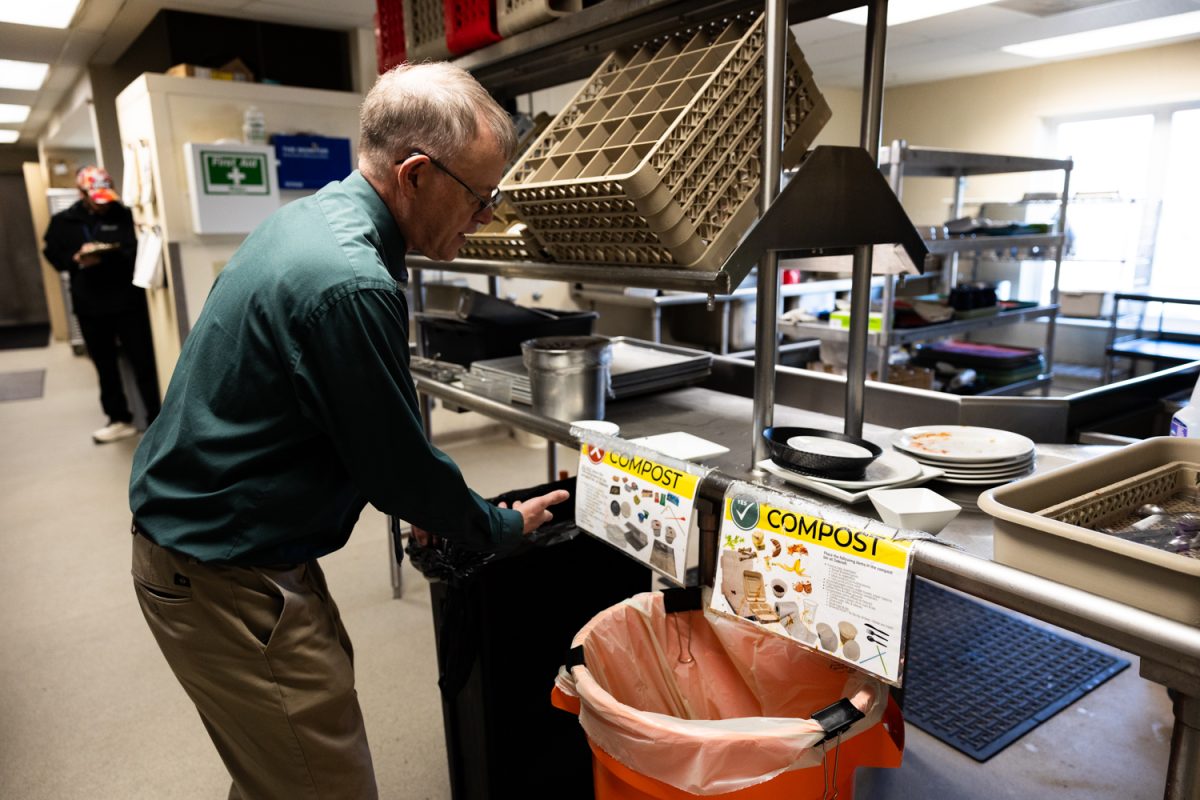
A composting initiative at Oaknoll Retirement Residence in Iowa City is keeping tens of thousands of pounds of food waste out of landfills each year, part of a broader push by residents to make the community more sustainable.
Oaknoll Dining Services Director Bruce Titus said the residence diverted roughly 73,000 pounds of waste in 2025, and in March, 4,300 pounds were diverted.
The initiative began with support from a Climate Action and Outreach grant from the City of Iowa City, which provided nearly $10,000 to help Oaknoll purchase bins, liners, and other materials needed to launch the program.
RELATED: Retirement community expands to meet Iowa City’s aging population
That funding allowed the facility to test the system before continuing it independently after the grant period ended in 2025.
Titus said Oaknoll separates food waste and sends it off-site for processing, and that the program adds additional costs. The compost pickup service costs more than $500 per month. However, only $200 is being saved because of the decrease in garbage pickup.
Supplies also come at a higher price. Compostable liners cost about $96 per 100 bags — roughly $1 each — compared to about 34 cents per bag for standard trash liners, Titus said.
Despite those added expenses, Titus said the program is still making an impact by reducing how much waste ends up in landfills and that a “dent” is being made.
According to the United States Environmental Protection Agency, over 21 percent of municipal solid waste is made of food.
That effort is supported by staff and residents, who Titus said are generally engaged and willing to participate in separating waste correctly.
“It’s your generation that needs a sustainable planet,” Karin Franklin, a resident at Oaknoll and member of the sustainability committee, said.
Franklin said the composting initiative stands out as one of the committee’s most important accomplishments, building on long-standing recycling programs and expanding the community’s approach to sustainability.
The program first launched at Oaknoll East before expanding to the main campus, where a larger population has increased its overall impact.
Beyond composting, sustainability efforts at Oaknoll extend across landscaping, education, and building design.
Sara Rynes-Weller, chair of the sustainability committee, said the group was reestablished after the COVID-19 pandemic and now includes 14 members across both campuses.
The committee works to educate residents through presentations and discussions on topics such as electric vehicles, pesticide use, and environmental health, while also supporting hands-on changes throughout the community.
Those changes include expanding native plant landscaping and pollinator-friendly spaces, as well as efforts to reduce pesticide use where possible — an area that requires long-term planning and input from both residents and staff.
Sustainability is also built into some of Oaknoll’s newer facilities. Rynes-Weller said the 1201 building, which houses memory care, includes geothermal energy, solar panels, and LED lighting.
Rynes-Weller said the newer buildings on the main campus, including the spring building, also use geothermal systems, while Oaknoll East relies on all-electric utilities and energy-efficient lighting.
The community has also expanded electric vehicle infrastructure by installing charging stations and providing information sessions for residents interested in hybrid or electric cars, Rynes-Welker said.
Looking ahead, residents, such as Franklin, hope to continue building on those efforts.
Franklin said one project involves transitioning landscaping equipment from gas-powered to electric, with plans to gradually replace equipment through grants and donations. She said those efforts are part of a broader responsibility to take care of the environment.
“It’s an important part of living on this planet,” Franklin said. “We all need to do what we can.”