


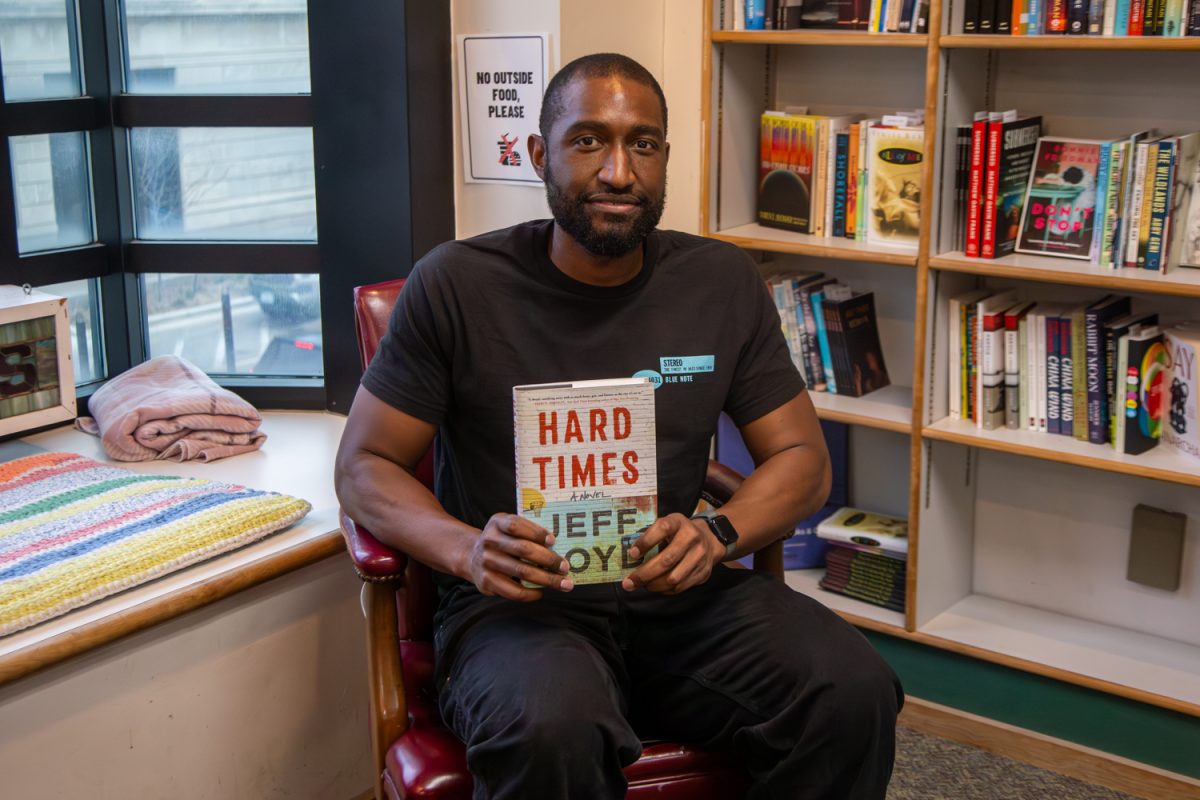
Jeff Boyd is the author of “The Weight” and his newest novel, Hard Times. Boyd is a graduate of the University of Iowa’s Writer’s program, and has many years working as an English teacher, and time working at the University of Iowa, teaching creative writing classes. He has returned to local bookstore, Prairie Lights to read from his newest novel on March 30, from 7 to 8 p.m.
The Daily Iowan: What decisions in your life led you to becoming a writer?
Boyd: Well, I’ve always liked reading, especially in my early life. As a kid the subject I did a lot was English, and I liked it so much I became an English teacher. When I got to Iowa, I taught creative writing courses. Although, I never decided I wanted to be a writer until I was already teaching middle school.
It started as part of the job, pulling apart stories and trying to get the students to really understand setting, and how dialogue works, and the basic parts of reading literature. I eventually decided that it was something I’d want to try, because of summer breaks too. My PlayStation had broken, and I decided that instead of buying a new PlayStation, I would instead try to use my imagination and pick up my own kind of RPG situations.
What does a typical writing routine look like for you?
Boyd: I think it depends on what I’m working on. You have to write a few pages or a few sentences, or just have an idea in my head, but it’s not always super easy to sit down with it. Eventually, I do get to a point, and sit down writing there with whatever inspiration strikes me. I have a good group of writing friends too, and with one of my good friends, we used to challenge each other to write about 300 words a day. Somebody would say, “Oh, did you write your words today?” It didn’t matter how good or bad the words were, it was just that you’d get it done in the end, because you knew somebody was going to ask you about it. It was a challenge of accountability.
Where do you usually find inspiration for your stories and/or characters?
Boyd: It comes to me from seeing other stuff, or watching movies, reading books, or conversions with other people. But the stories usually conceptually come from somewhere. For example, I’ll be talking or thinking, “Wouldn’t it be interesting if we had this person and they were in this situation?” Usually I start with the moment, or conflict and start to think about the people that will be in that moment.
What is a piece of literature or piece of media that has inspired some of your work?
I read a lot of books, put it down, love it, and it’s somewhere in my head. The book just changes all the time. For this book, I thought back on a lot of film noir movies that I’ve loved. Dashiell Hammett, Richard Price, and Dennis LeHane were some people I really liked.
What message or ideas do you find yourself returning to often?
Well I think what I write goes into social realism. I’m always concerned about the individual, and maybe that’s a Western concept but I’m always very intrigued by how unique every individual person is in a situation. In this book it’s on the South Side of Chicago, and it’s mostly Black people. Some have money, some don’t. Some are cops, some are teachers. And I try to figure out what all the students are like, what all the teachers are like, and what this cop may do in this situation. I love to focus and find out who that individual person really is, and what unique set of circumstances led them to where they are.
I grew up pretty religious and I wonder how much of our life is actually in our hands, and what we can control, and what can be done about this randomness of life. You can’t control some things in your life, and there’s characters in my book that are wrestling with that, the same way I wrestle with it myself. I like to think that with real people as well, and I’ve believed that this does something to build empathy, and understanding, and seeing people for who they are. I like to see the humanity in everyone.