


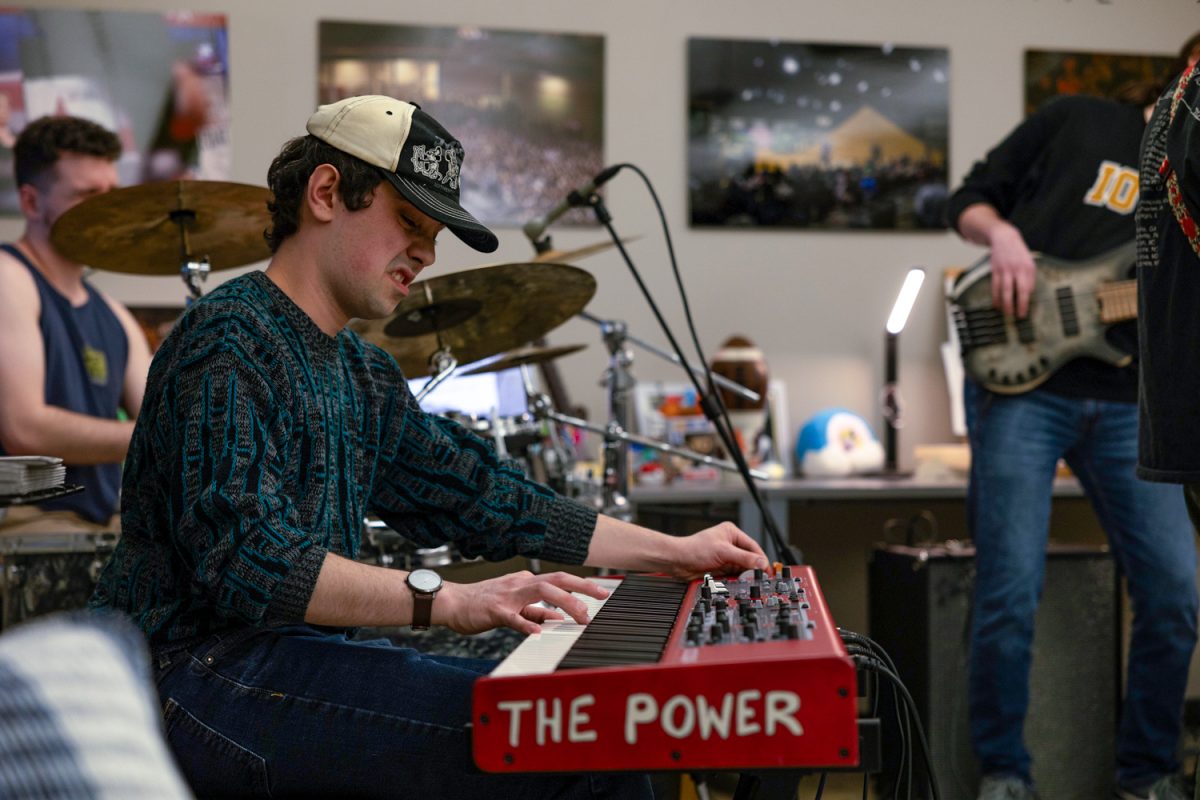
There is more to music than what is played through headphones. Music also includes the process it takes to become a song: brainstorming, writing, recording, mixing, and endless retakes until it feels perfect. Cedar Rapids band Spirit Awake delved into that in-depth process as they worked on their third album.
Spirit Awake recently performed as part of the DI 2026 Headliners. The band consists of four members: guitarist Ian Landuyt, bass player Patrick Seaton, drummer Zacary Heinzerling, and keyboardist Jacob Cacioppo.
Landuyt shared that he had come up with the idea shortly after Cacioppo joined the band. As the bandleader, he wanted to create an album that everyone in the band would enjoy working on. The final idea is an album that documents a person going through the stages of life, with an estimated 10 songs.
“The first song is going to be a kind of representation of being born, and then the second or third song is literally about being a toddler and not having object permanence, and it kind of goes on to teenage years and stuff like that,” Landuyt said.
The album is in its production stage. At the time of talking with The Daily Iowan, the band had written all the songs, but had not yet recorded them. The band delved into the songwriting and recording processes.
“I mean, I will say the most collaboration we’ve ever done as writers has been this third album, which feels really good, because, obviously like I said, I want everyone to feel satisfied and connected to it,” Landuyt said.
Now that the songs are written, the band will begin recording the scratch tracks. As the drummer, Heinzerling explained that these scratch tracks would help him determine where the drums should be recorded. After the drums are recorded, Heinzerling will then edit and mix them.
He shared that the past two records differed when it came to mixing. Record one, called “I Know,” took months to mix due to the drums being recorded in a not-ideal basement. Whereas, record two, titled “Change” mixed itself, Heinzerling said.
“So with record three, I’m hoping to have kind of the same easy record somewhere where it’ll practically mix itself,” Heinzerling said.
After the drums are recorded and edited, Heinzerling then moves on to recording the bass. Heinzerling noted that there are bands who prefer recording the guitars next, but he prefers this way as it helps establish a foundation for the record. He noted that this does not take too long as Seaton is quick at getting the bass recorded.
Once the bass is recorded, guitars are next, and this process takes around a week, mainly due to the guitar solos. For record one, the band shared that there was a song where they spent three to four hours on guitar solos, before ultimately moving on. For record two, they had a similar experience with one song, and invested a lot of time in the song before realizing that they were content with it as is.
“That’s just essentially what the recording process is,” Cacioppo said. “You don’t quite know how you’re going to navigate it or what all the answers are for whatever song it is. Sometimes, it just depends on the rhythm of each part, but Zac has a very good way of navigating that and giving us a template for it.”
Once the guitars are recorded, then the band will record vocals. Heinzerling shared that this is the process that takes the longest because there are multiple factors that can influence the recording including the weather, the emotions of the song, and if the band chooses to record layers or not.
The band will record the keyboard last. Cacioppo now owns a Nord keyboard, and shared that he was looking forward to using it on this album.
“The cool thing about it, too, is that it’s a lot more versatile live,” Cacioppo said.” So, a lot of the bold choices we make with synth or things that we would kind of layer in, attract later, sometimes we can end up doing it in a live show, which makes it really cool and we can kind of bring what our intention is to an actual live setting.”
In anticipation of recording the album, the band shared what their favorite aspects of making an album were. For Heinzerling, he enjoyed collaborating with other artists. Seaton said that he liked seeing all the elements come together.
“For me, it’s like building a puzzle,” Seaton said. “Kind of seeing how the songs sound without certain instruments, and then when we add the instruments as we go, seeing how the song really just transforms.”
Cacioppo said that the recording process both encouraged and limited the perfectionist in him. He illustrated that while recording, the band has to make a final decision on how they want the song to sound, even though it could be played in numerous different ways. Cacciopo said that final decision is very satisfying for him.
For Landuyt, his favorite part was building a soundscape — how the sounds can resonate with the listeners. He said that the reason he writes and records music was because of the space it puts the listener in, and hoped that the album would resonate with them.
“I guess the takeaway would be that people resonate with all of those different stages, and have like, ‘Oh, yeah, this song is definitely exactly how I felt as a teenager or now or something like that,’” Landuyt said.