

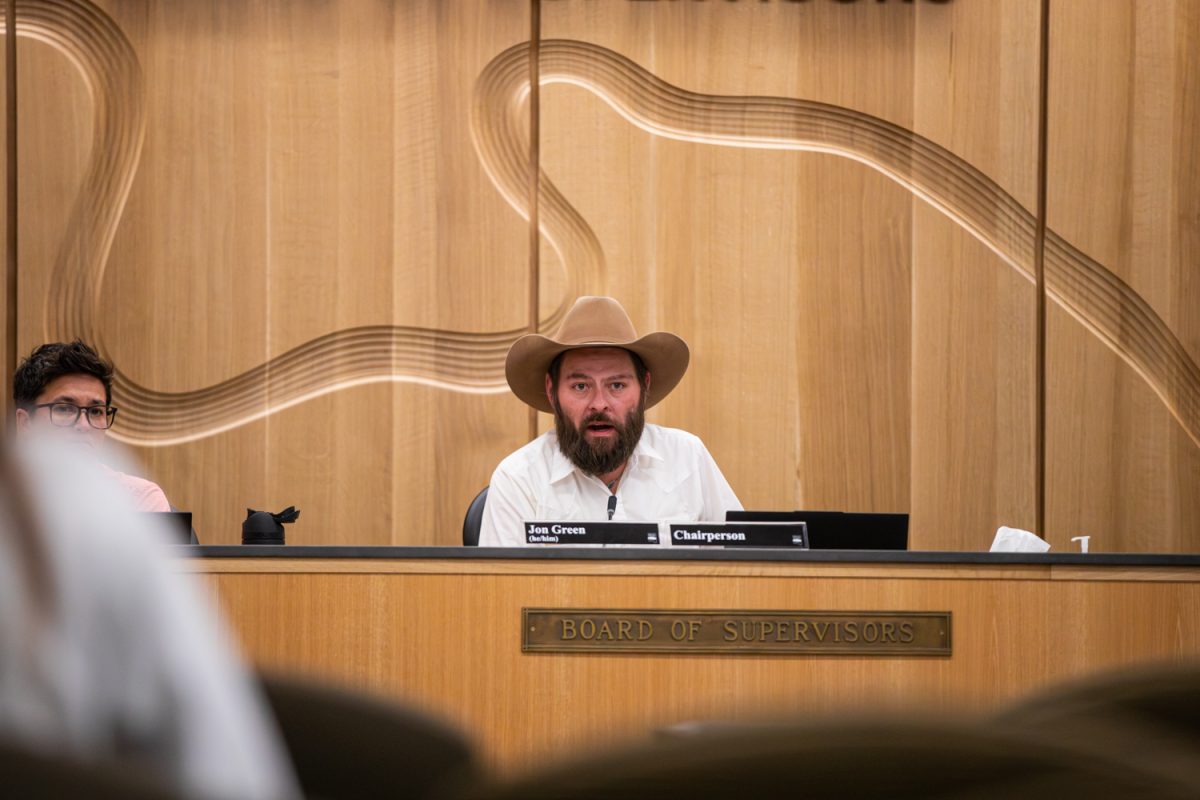
Several Johnson County residents spoke against proposed tax levies for fiscal year 2027 to the Johnson County Board of Supervisors during a public hearing. The hearing took place on March 25 at the Johnson County Health and Human Services Building.
The public hearing was attended by around 15 community members. A few of the supervisors made rounds through the boardroom, introducing themselves and making light conversation with county residents, while others sat at the front of the room preparing themselves for the meeting.
Property owners throughout Johnson County recently received statements by mail alerting them of changes in property tax rates. These increases, if approved, will be implemented in fiscal year 2027, which will begin on Sept. 27, 2026, and extend through Sept. 25, 2027.
Before the hearing was opened up for public comment, Johnson County Finance Director Dana Aschenbrenner gave a presentation to attendees of the hearing explaining the tax levies.
The presentation stated that general services countywide taxes, taxes on the consumption of certain goods and services, will be 9.3 percent less in fiscal year 2027, with a proposed tax levy rate of 12.6 percent less than the fiscal year 2026 rate. According to the state of Indiana’s website, tax levies determine the amount that a local government can collect on a tax rate.
The proposed debt service fund taxes for fiscal year 2027 will increase by 12.9 percent, with the proposed tax levy rate increasing by 7.8 percent. The increased funds from these taxes will be put toward repayment of county loans. By June 2026, the county is expected to owe $5,275,000 in loans according to Iowa Debt Reporting.
According to the presentation, rural services taxes, which fund resources specific to rural areas, will increase in fiscal year 2027 by as much as 9.9 percent, with the tax levy rate increasing by 9.4 percent. Aschenbrenner said the reason for the increase is to provide better funding for rural needs.
RELATED: JoCo Board of Supervisors approves $549,000 for sheriff’s office study
The presentation listed certain rural services that will receive more funding. This includes the Secondary Roads Department for rural road maintenance and improvements, rural residents’ local library usage, animal control fees, and solid waste disposal services.
More funding will also be put toward payroll and benefit increases for the Soil and Water Conservation Coordinator and a Sheriff Patrol Deputy.
Aschenbrenner said despite this increase in rural services and debt services taxes, the proposed taxes combined will still be decreasing by over roughly $1 million overall from fiscal year 2026. He provided attendees with the contact information of several departments for them to direct their questions to, also offering to personally assist them.
“I encourage anyone to call the finance department, and I’ll certainly look at your individual situation if you so choose, and I know the board is always looking for feedback from the public,” Aschenbrenner said.
Following Aschenbrenner’s presentation, board Chair Jon Green opened the hearing for public comment.
Curt Moore, an Iowa City resident since 1987, said all of the houses around him are now worth millions of dollars, so his taxes have risen so much that he can no longer afford to live in Johnson County. Moore lives on Dubuque Street in Iowa City.
“The house is 125 years old,” Moore said. “I’d like to die there, but unfortunately, I’m getting taxed out of my house.”
He asked the supervisors not to raise his property taxes, explaining that he is on Social Security and cannot afford an increase, but acknowledged that the board is in a tough spot concerning school district taxes.
The Iowa City Community School District recently proposed a 10 percent increase in property tax rates as a solution to their ongoing budget struggles. They plan to use the increased money from taxes to fund general operations, pay management costs, improve facilities, and repay past debts.
Green said the supervisors do not have much control and that the county is only responsible for the collection and disbursement of taxes from school districts and cities. He pointed Moore toward the Iowa City Community School District Board of Trustees, as they determine the school district tax levies.
“We only collect the money and disperse it to them. We have no discretion to set or adjust another taxing authority’s levy rates,” Green said.
The second speaker was rural Johnson County resident Paula Altmaier. She had similar concerns to Moore and said she is also living on Social Security with a very small income.
“The tax increase is going to very negatively impact my ability to continue living in this county,” Altmaier said.
She said she lives in Johnson County because she can afford the current property taxes, but she fears that may change. Altmaier did say that she appreciates the road maintenance that her taxes will be funding.
“I live on a gravel road. They just put the new gravel down, which made some skid, but it makes things a lot safer in the long run, so I appreciate that,” she said.
Altmaier told the supervisors she was confused as to why residents in incorporated areas of Johnson County will receive a reduction in their taxes, while rural residents will receive a significant increase.
She said she is not opposed to road maintenance or the deputy and that she appreciates those things very much, but that she did not understand why she will have to pay so much more as a rural resident.
“The number of services that we get, relative to what people in incorporated areas get, is much smaller,” Altmaier said.
Green said there is a distinction between county, city, and school taxes. He told Altmaier that for most residential owners in unincorporated Johnson County, their county share of property taxes will go down. School district taxes make up the larger part of rural residents’ taxes.
Green said the reason residents in unincorporated areas will experience an increase in their tax rates is to pay for services specific to rural residents. He said rural residents do receive additional services compared to incorporated residents, such as the gravel road maintenance
“I thought that it was important that folks like me who live in unincorporated Johnson County, that we pay for the services that we receive,” Green said.
The board will make final decisions and vote on the proposed tax levies on April 23.
“I want to thank all of you for your attention, comments, and feedback tonight,” Green said to the attendees, “We’re doing the best that we can and I’m happy with the work product we’ve put together here.”