


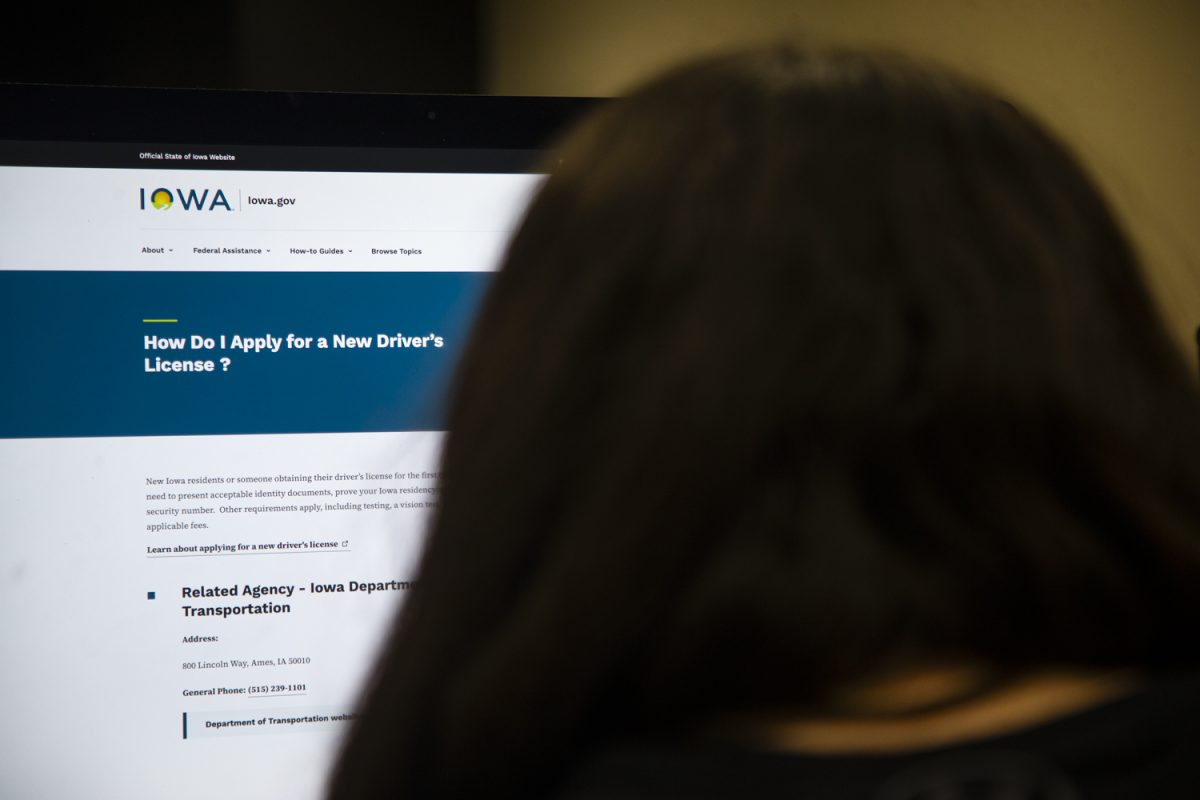
In a state where daily life often depends on being able to drive, access to a driver’s license matters. But, a newly proposed bill in the Iowa legislature could make it harder for residents who don’t use English as their primary language to get behind the wheel legally.
House File 2102 passed the House in February and is on its way to becoming law. If enacted, it would require driver’s license exams to be conducted only in English, removing the existing exception that allowed tests to be offered in 20 other languages, according to the Iowa Department of Transportation, including Spanish and Arabic.
Undocumented immigrants in Iowa are already unable to obtain driver’s licenses.
This bill negatively affects legal immigrants who are already living and working in this country.
Supporters frame the policy as a matter of safety. On March 9, during a subcommittee hearing about the bill, Iowa Sen. Mark Costello, R-Imogene, defended it, saying, “If you can’t speak English well enough to pass this exam, there might be issues understanding signs and understanding what you should be doing very quickly.”
But rather than improving road safety, the policy targets immigrant and minority communities who are simply trying to follow the law.
As of 2023, about 60 percent of noncitizens in Iowa have reported speaking English less than “very well,” according to the Migration Policy Institute. Among foreign-born individuals, naturalized citizens still account for a relatively high percentage at 38.2 percent.
Ensuring that drivers understand traffic laws is essential, but restricting driver’s license exams to English alone does little to improve that goal, since comprehension and safety are not inherently tied to taking a test in English.
Instead, it would punish those still learning the language.
If the goal is safer roads, limiting access to testing may have the opposite effect. If the legal pathway becomes too hard, people will just adapt. As Iowa Rep. Angel Ramirez, D-Cedar Rapids, has warned, restricting access to licenses could push more people to drive without one, undermining the very safety the bill claims to promote.
Multilingual testing can help ensure that drivers fully understand the rules of the road, rather than forcing them to struggle through a language barrier that may not reflect their actual driving ability. Only six other states have exclusively English examinations, with others offering more than 20 languages to accommodate their diverse populations, according to U.S. English.
Nineteen states in the U.S. have tried a different, better solution, but Iowa is not one of them. These states allow unauthorized immigrants to obtain driver’s licenses. Under AB 60 in California, the ID cannot be used for federal purposes, like passing through TSA or verifying identity to federal law enforcement. But they do allow individuals to drive legally, which should be the priority.
Two years after its implementation, a 2017 study found no significant effect of AB 60 on overall car accidents or fatalities. While fatalities did not decline, there was also no evidence that they increased.
However, more notably, the data did show a decrease in hit-and-run incidents, possibly because unauthorized immigrants no longer feared deportation if they were caught.
“This bill is a continuation of an unfortunate history our state has of blocking people whose first language isn’t English from accessing life in Iowa,” Erica Johnson, the founding executive director at Iowa Migrant Movement for Justice, said.
Johnson pointed to a pattern in Iowa history aimed at stopping immigrants or non-English speakers from being fully integrated in the state. In 1918, Gov. William Harding issued the Babel Proclamation, which banned the use of foreign languages in public, except English. For centuries, English has been used as a barrier to participation, and now, it is being weaponized against communities.
In 2002, Iowa passed a law to make English the official state language.
The argument for the bill was to “encourage every citizen of this state to become more proficient in the English language, thereby facilitating participation in the economic, political, and cultural activities of this state,” according to Iowa Code 1.18.
That same reasoning is now being used to defend HF 2102. State Rep. Josh Meggers, a Republican from Grundy Center, said requiring driver’s license exams to be given only in English would improve clarity by aligning with state law.
But the issue is access, not consistency.
Johnson continued, “Iowa is not really a state known for its public transportation. And so people have to drive to get to school, to get to church, and to get to the doctor. We want people on those roads, who understand the rules of the road, to have learned those rules in a way that is accessible to them.”
Iowa City might see its fair share of public transportation, but outside of the bubble, hundreds of residents rely almost entirely on driving to get to work. Immigrants make up about 5.8 percent of Iowa’s population, with more than 120,000 participating in the labor force.
“It does not have to go in this direction. Iowans of all walks of life can choose a different direction by telling their representatives that bills like this are not a solution. This bill is not doing anything to make Iowa a better place,” Johnson said.