


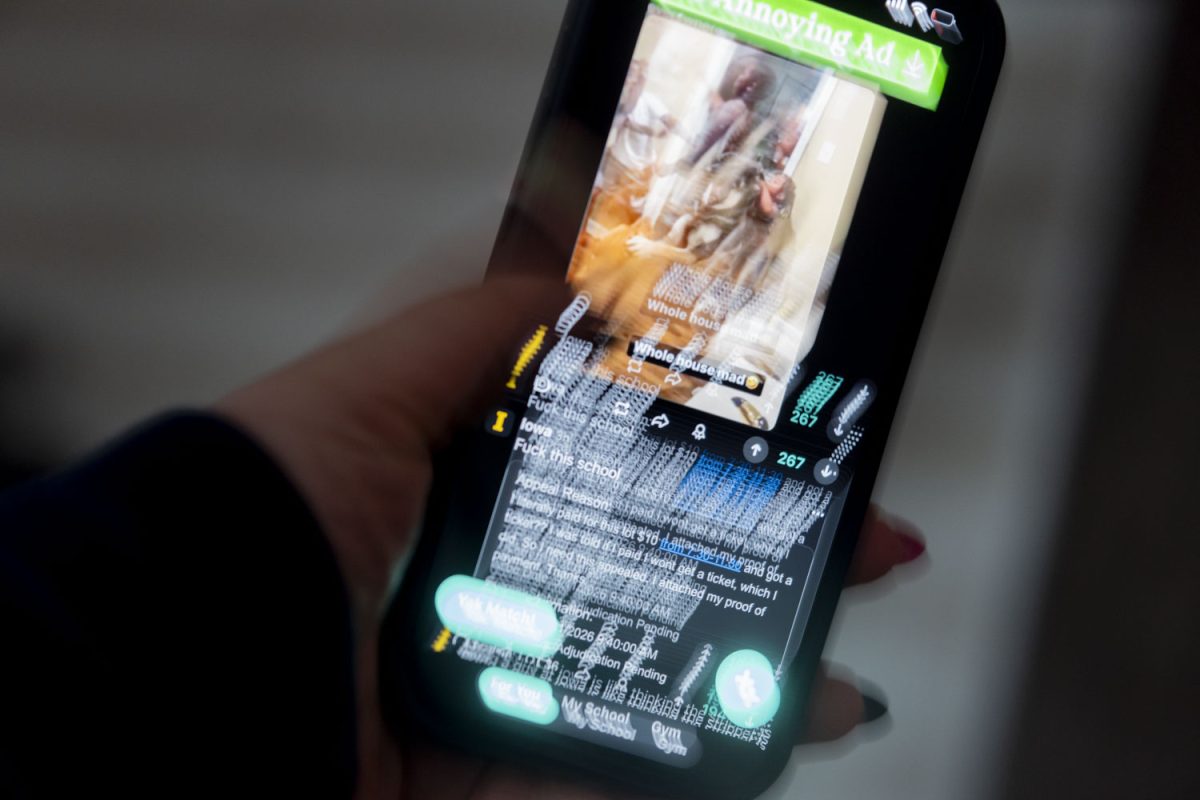
With anonymous social media apps like YikYak, users can freely express their viewpoints, experiences, comments, and almost anything else they feel like sharing, all without being associated with their identity. While the benefits and novelty of anonymity are prevalent, many University of Iowa students express concerns about the popularity of unchecked expressions without consequences.
YikYak is a location-based app, meaning users see comments that are posted within a five mile radius. Having launched in 2013 and then relaunched in 2021, the pseudonymous social media app was created with college campuses in mind and allows students to create and view discussion threads.
Annabelle Munoz, a UI second-year political science student, said she used YikYak briefly a year ago, then stopped.
“There’s a lot of spam posts and crude content, which wasn’t for me,” Munoz said. Though she no longer uses the app, she acknowledged that there is a strong draw around campus, especially in the technology-driven modern world, and she saw it firsthand when she was active on YikYak.
“Nowadays, it’s kind of hard to be anonymous in any capacity. Even in the real world, there’s the probability of being recorded and having your face posted all over the internet, so I think complete anonymity is a huge appeal,” Munoz said.
Natalie Conrad, a UI second-year biology student, agreed with the observation. Although she isn’t big on social media in general, she had a theory as to why students want to hide behind a pseudonym.
“There’s an appeal because people want to be known for their thoughts and ideas, and not the name or the face associated with it. I’m not sure why exactly, but there’s definitely a desire, and I’ve seen that,” Conrad said.
It’s in general agreement among these college students that young people are most often tempted to hide behind a screen. UI students seem to understand that without responsibility and liability for their words, the desire to express themselves is stronger.
RELATED: Column | Donating plasma is the ultimate charitable side gig
These desires can be, and often are, damaging. With absolutely no repercussions at hand, people lose the social filter and regard for others’ feelings that are often applied in the real world.
Olivia King, a UI first-year psychology student, stood true to her major and took a psychology-based approach to the topic.
“Anonymous social media can be a big problem. When you’re anonymous, and you’re in a big group, you tend to be dumber, make worse decisions, and pile on. You don’t really use all that much critical thinking, and it can be dangerous,” she said.
King also expressed her personal disinterest in the app.
“Even on a smaller scale, I don’t understand why people care what other people are thinking all the time — especially when you don’t even know who it is,” she said.
King elaborated, saying that anonymous platforms may offer students a place to speak freely, but there are often trade-offs as a result of that freedom. With a lack of accountability, conversations and posts can often switch from open discussion to careless and harmful commentary.
As apps like YikYak continue to circulate around college campuses, it’s ultimately up to students to find balance with honest, free expression while still maintaining empathy and consideration for others.