


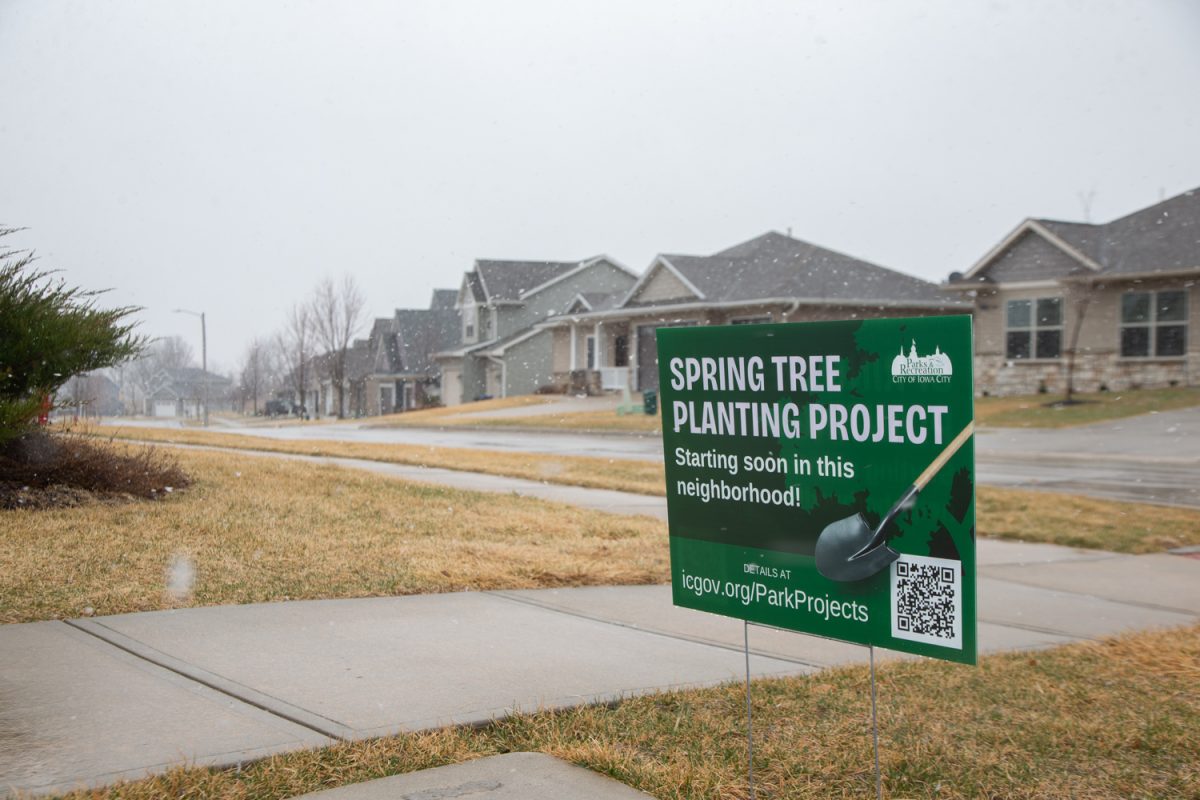
Following multiple requests from Iowa City’s west side neighborhood members, the Iowa City Parks and Forestry staff will plant 175 trees in neighborhoods in the area this spring.
The decision comes after the Iowa City City Council designated the area for spring tree planting and a request by the Iowa Homeowners Association.
The tree plantings are a part of a city council program that plants hundreds of trees each year to increase ecological diversity. They will be planted on a strip of land between the sidewalk and the road called the right-of-way. A map has been created to outline where the trees will be located.
Superintendent of Parks and Forestry Tyler Baird said over the last five years, about 800 trees are planted each year in Iowa City. While last year the amount of trees was under the average amount, this year the average is expected to be surpassed.
The project will begin in April and finish in early June. Baird said about 175 trees will be planted, including 25 different species. The city council selected a variety of tree types to foster ecological health.
“We want to plant a large amount of diverse species, so we do plant some non-native species, as long as they’re not invasive, to help boost diversity,” Baird said. “This also helps us send off some things like pests and diseases that may impact a specific tree type.”
Homeowners will not have to pay for the trees. Baird said the majority of the project’s funding comes from the city budget approved by the city council. Donations from rotary clubs, Summer of the Arts, and Heritage Trees will pay for about 50 of the trees.
RELATED: UI’s historic old Art Building set to reopen fall 2026
Any neighborhood members who do not want a tree in their right-of-way can contact the Parks and Forestry office by April 1.
According to Iowa City’s official website, door hangers and yard signs will be used to alert residents about the project. There may also be utility flags in certain areas to plan for the planting.
The right-of-way land was selected as a location for planting because it allows trees to reside in neighborhoods without occupying a large amount of space. Specific, smaller species are selected so that they don’t outgrow the small space.
“You really want to get the right tree for the spot,” University of Iowa Campus Arborist Andy Dahl said. “There may be things like overhead lines or something else, so you know a full-size oak tree might be a problem, so you pick a species with a smaller canopy, perhaps a Hornbeam or Crabapple.”
Dahl said trees have a large impact on the environment and communities. They can raise property values, release oxygen into the air, provide shade for residents, capture stormwater runoff, and make roads safer.
Nick Dallege, an Iowa City resident and president of the Cedar Rapids-Iowa City Wild Ones Chapter of the national native landscaping organization, said he walks frequently on the west side of Iowa City and would appreciate the benefits that trees provide.
“The shade is probably the biggest thing,” Dallege said. “Everyone likes to have shade in the summertime when you are walking on the sidewalk, especially when it comes to street trees.”
Dallege has planted his own American Hop Hornbeam tree in his right-of-way and advocates for more Oak trees in Iowa City.
Baird said various city council members form the Parks and Forestry department and community volunteers will do the planting. All of the trees will be installed at once to ease the process of watering and maintenance.
After the planting, residents will not be responsible for upkeeping the trees. The city will be responsible for maintenance, but residents are encouraged to water the newly planted trees if they choose.
“We want as many people as we can educate to consider planting something their neighbor doesn’t have to help keep that diversity as high as we would like,” Baird said.